
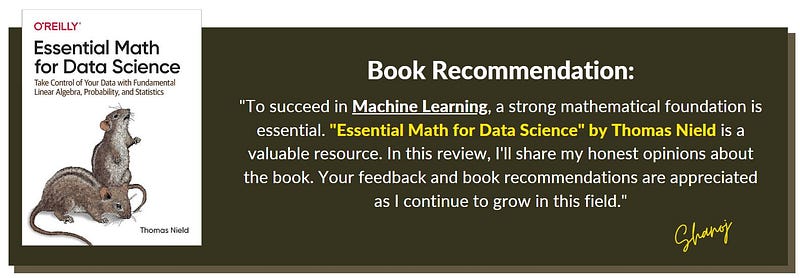
I recently asked my close friends for feedback on what skills I should work on to advance my career. The consensus was clear: I must focus on AI/ML and front-end technologies. I take their suggestions seriously and have decided to start with a strong foundation. Since I’m particularly interested in machine learning, I realized that mathematics is at the core of this field. Before diving into the technological aspects, I must strengthen my mathematical fundamentals. With this goal in mind, I began exploring resources and found “Essential Math for Data Science” by Thomas Nield to be a standout book. In this review, I’ll provide my honest assessment of the book.
Review:
Chapter 1: Basic Mathematics and Calculus The book starts with an introduction to basic mathematics and calculus. This chapter serves as a refresher for those new to mathematical concepts. It covers topics like limits and derivatives, making it accessible for beginners while providing a valuable review for others. The use of coding exercises helps reinforce understanding.
Chapter 2: Probability The second chapter introduces probability with relevant real-life examples. This approach makes the abstract concept of probability more relatable and easier to grasp for readers.
Chapter 3: Descriptive and Inferential Statistics Chapter 3 builds on the concepts of probability, seamlessly connecting them to descriptive and inferential statistics. The author’s storytelling approach, such as the example involving a botanist, adds a practical and engaging dimension to statistics.
Chapter 4: Linear Algebra is a fundamental topic for data science, and this chapter covers it nicely. It starts with the basics of vectors and matrices, making it accessible to those new to the subject.
Chapter 5: The chapter on linear regression is well-structured and covers key aspects, including finding the best-fit line, correlation coefficients, and prediction intervals. Including stochastic gradient descent is a valuable addition, providing readers with a practical understanding of the topic.
Chapter 6: This chapter delves into logistic regression and classification, explaining concepts like R-squared, P-values, and confusion matrices. The discussion of ROC AUC and handling class imbalances is particularly useful.
Chapter 7: offers an overview of neural networks, discussing the forward and backward passes. While it provides a good foundation, it could benefit from more depth, especially considering the importance of neural networks in modern data science and machine learning.
Chapter 8: The final chapter offers valuable career guidance for data science enthusiasts. It provides insights and advice on navigating a career in this field, making it a helpful addition to the book.
Exercises and Examples One of the book’s strengths is its inclusion of exercises and example problems at the end of each chapter. These exercises challenge readers to apply what they’ve learned and reinforce their understanding of the concepts.
“Essential Math for Data Science” by Thomas Nield is a fantastic resource for individuals looking to strengthen their mathematical foundation in data science and machine learning. It is well-structured, and the author’s practical approach makes complex concepts more accessible. The book is an excellent supplementary resource, but some areas have room for additional depth. On a scale of 1 to 10, I rate it a solid 9.
As I delve deeper into the world of data science and machine learning, strengthening my mathematical foundation is just the beginning. “Essential Mathematics for Data Science” has provided me with a solid starting point. However, my learning journey continues, and I’m excited to explore these additional resources:
- “Essential Math for AI: Next-Level Mathematics for Efficient and Successful AI Systems”
- “Practical Linear Algebra for Data Science: From Core Concepts to Applications Using Python”
- “Practical Statistics for Data Scientists: 50+ Essential Concepts Using R and Python”
Also, I value your insights, and if you have any recommendations or advice to share, please don’t hesitate to comment below. Your feedback is invaluable as I progress in my studies.
🌟 Enjoying my content? 🙏 Follow me here: Shanoj Kumar V
Stackademic
Thank you for reading until the end. Before you go:
- Please consider clapping and following the writer! 👏
- Follow us on Twitter(X), LinkedIn, and YouTube.
- Visit Stackademic.com to find out more about how we are democratizing free programming education around the world.
 Shanoj