Monthly Archives: June 2024

Software Architecture: Space-Based Architecture Pattern

Scaling an application is a challenging task. To scale effectively, you often need to increase the number of web servers, application servers, and database servers. However, this can make your architecture complex due to the need for high performance and scalability to serve thousands of concurrent users.

Horizontal scaling of the database layer typically involves sharding, which adds further complexity and makes it difficult to manage.

In general, Space-Based Architecture (SBA) addresses the challenge of creating highly scalable and elastic systems capable of handling a vast number of concurrent users and operations. Traditional architectures often struggle with performance bottlenecks due to direct interactions with the database for transactional data, leading to limitations in scalability and elasticity.

What is Space-Based Architecture (SBA)?

In Space-Based Architecture (SBA), you scale your application by removing the database and instead using memory grids to manage the data. Instead of scaling a particular tier in your application, you scale the entire architecture together as a unified process. SBA is widely used in distributed computing to increase the scalability and performance of a solution. This architecture is based on the concept of a tuple space.

Note: A tuple space is a shared memory object that provides operations to store and retrieve ordered sets of data, called tuples. It is an implementation of the associative memory paradigm for parallel/distributed computing, allowing multiple processes to access and manipulate tuples concurrently.

Goals of SBA

High Scalability and Elasticity:

· Efficiently managing and processing millions of concurrent users and transactions without direct database interactions.

· Enabling rapid scaling from a small number of users to hundreds of thousands or more within milliseconds.

Performance Optimization:

· Reducing latency by utilizing in-memory data grids and caching mechanisms instead of direct database reads and writes.

· Ensuring quick data access times measured in nanoseconds for a seamless user experience.

Eventual Consistency:

· Maintaining eventual consistency across distributed processing units through replicated caching and asynchronous data writes to the database.

Decoupling Database Dependency:

· Minimizing the dependency on the database for real-time transaction processing to prevent database bottlenecks and improve system responsiveness.

Handling High Throughput:

Managing high throughput demands without overwhelming the database by leveraging in-memory data replication and distributed processing units.

Key Components of SBA
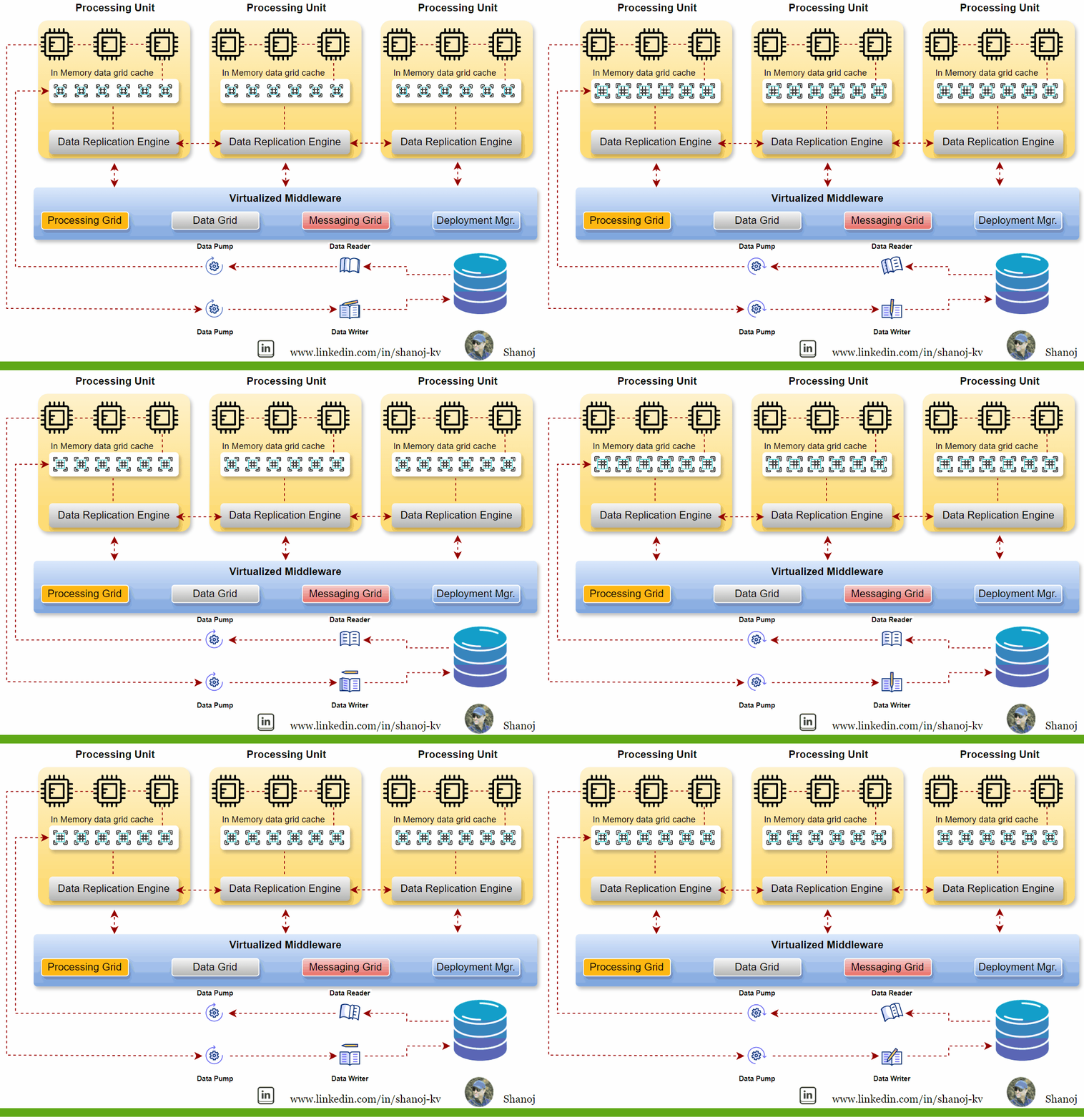
Processing Units (PU):

These are individual nodes or containers that encapsulate the processing logic and the data they operate on. Each PU is responsible for executing business logic and can be replicated or partitioned for scalability and fault tolerance. They typically include web-based components, backend business logic, an in-memory data grid, and a replication engine.

Virtualized Middleware:

This layer handles shared infrastructure concerns and includes:

· Data Grid: A crucial component that allows requests to be assigned to any available processing unit, ensuring high performance and reliability. The data grid is responsible for synchronizing data between the processing units by building the tuple space.

· Messaging Grid: Manages the flow of incoming transactions and communication between services.

· Processing Grid: Enables parallel processing of events among different services based on the master/worker pattern.

· Deployment Manager: Manages the startup and shutdown of PUs, starts new PUs to handle additional load, and shuts down PUs when no longer needed.

· Data Pumps and Data Readers/Writers: Data pumps marshal data between the database and the processing units, ensuring consistent data updates across nodes.

Now you might be naturally thinking, what makes SBA different from a traditional memory cache database?

Differences Between SBA and Memory Cache Databases

Data Consistency:

· SBA: Uses an eventual consistency model, where updates are asynchronously propagated across nodes, ensuring eventual convergence without the need for immediate consistency, which can introduce significant performance overhead.

· Memory Cache Database: Typically uses strong consistency models, ensuring immediate consistency across all nodes, which can impact performance.

Scalability:

· SBA: Achieves linear scalability by adding more processing units (PUs) as needed, ensuring the system can handle increasing workloads without performance degradation.

· Memory Cache Database: Scalability is often limited by the underlying database architecture and can be more complex to scale horizontally.

Data Replication:

· SBA: Replicates data across multiple nodes to ensure fault tolerance and high availability. In the event of a node failure, the system can seamlessly recover by accessing replicated data from other nodes.

· Memory Cache Database: Data replication is used for performance and availability but can be more complex to manage and maintain consistency.

Data Grid:

· SBA: Utilizes a distributed data grid that allows requests to be assigned to any available processing unit, ensuring high performance and reliability.

· Memory Cache Database: Typically uses a centralized cache that can become a bottleneck as the system scales.

Processing:

· SBA: Enables parallel processing across multiple nodes, leading to improved throughput and response times.

· Memory Cache Database: Processing is typically done within the database or cache layer, which can be less scalable and efficient.

Deployment:

· SBA: Supports elastic scalability by adding or removing nodes as needed, ensuring the system can handle increased workloads without compromising performance or data consistency.

· Memory Cache Database: Deployment and scaling can be more complex and often require significant infrastructure changes.

Cost:

· SBA: Can be more cost-effective by leveraging distributed computing and in-memory processing, reducing the need for expensive hardware and infrastructure upgrades.

· Memory Cache Database: Can be more expensive due to the need for high-performance hardware and infrastructure to support the cache layer.

Now you might be wondering, is SBA suitable for every scenario?

Limitations of SBA

High Data Synchronization and Consistency Requirements:

Systems that require immediate data consistency and high synchronization across all components will not benefit from SBA due to its eventual consistency model.

The delay in synchronizing data with the database may not meet the needs of applications requiring real-time consistency.

Large Volumes of Transactional Data:

Applications needing to store and manage massive amounts of transactional data (e.g., terabytes) are not suitable for SBA.

Keeping such large volumes of data in memory is impractical and may exceed the memory capacity of available hardware.

Budget and Time Constraints:

Projects with strict budget and time constraints are likely to overrun their resources due to the technical complexity of implementing SBA.

The initial setup and implementation are resource-intensive, requiring significant investment in both time and money.

Technical Complexity:

The high technical complexity of SBA makes it challenging to implement, maintain, and troubleshoot.

Organizations lacking the necessary expertise and experience may find it difficult to manage the intricacies of SBA.

Cost Considerations:

The cost of maintaining in-memory data grids and replicated caching can be prohibitive, especially for smaller organizations or projects with limited budgets.

The infrastructure required to support SBA’s scalability and performance may be expensive to acquire and maintain.

Limited Agility:

SBA offers limited agility compared to other architectural styles due to its complex setup and eventual consistency model.

Changes and updates to the system may require significant effort and coordination across distributed processing units.

Now, let’s dive into some use cases and solutions that demonstrate the power of SBA.

Use Cases and Solutions

Space-Based Architecture (SBA) addresses several critical challenges that traditional architectures face, particularly in high-transaction, high-availability, and variable load environments.

Scalability Bottlenecks:

· Problem: Traditional architectures often struggle to scale horizontally due to limitations in centralized data storage and processing.

· Solution: SBA enables horizontal scalability by distributing processing units (PUs) across multiple nodes. Each PU can handle a portion of the workload independently, allowing the system to scale out by simply adding more PUs.

High Availability and Fault Tolerance:

· Problem: Ensuring high availability and fault tolerance is challenging in monolithic or tightly coupled systems.

· Solution: SBA enhances fault tolerance through redundancy and data replication. Each PU operates independently, and data is replicated across multiple PUs. If one PU fails, others can take over, ensuring continuous availability and minimal downtime.

Performance Issues:

· Problem: Traditional systems often rely heavily on relational databases, leading to performance bottlenecks due to slow disk I/O and limited scalability of single-node databases.

· Solution: SBA leverages in-memory data grids, which provide faster data access and reduce the dependency on disk-based storage, significantly improving response times and overall system performance.

Handling Variable and Unpredictable Loads:

· Problem: Many applications experience variable and unpredictable workloads, such as seasonal spikes in e-commerce or fluctuating traffic in social media platforms.

· Solution: SBA’s elastic nature allows it to automatically adjust to varying loads by adding or removing PUs as needed, ensuring the system can handle peak loads without performance degradation.

Reducing Single Points of Failure:

· Problem: Centralized components, such as single database servers or monolithic application servers, can become single points of failure.

· Solution: SBA decentralizes processing and storage, eliminating single points of failure. Each PU can function independently, and the system can continue to operate even if some PUs fail.

Complex Data Management:

· Problem: Managing large volumes of data and ensuring its consistency, availability, and partitioning across a distributed system can be complex.

· Solution: SBA uses distributed data stores and in-memory data grids to manage data efficiently, ensuring data consistency and availability through replication and partitioning strategies.

Simplifying Deployment and Maintenance:

· Problem: Deploying and maintaining traditional monolithic applications can be cumbersome.

· Solution: SBA’s modular nature simplifies deployment and maintenance. Each PU can be developed, tested, and deployed independently, reducing the risk of system-wide issues during updates or maintenance.

Latency and Real-Time Processing:

· Problem: Real-time processing and low-latency requirements are difficult to achieve with traditional architectures.

· Solution: SBA’s use of in-memory data grids and asynchronous messaging grids ensures low latency and real-time processing capabilities, crucial for applications requiring immediate data processing and response.


Space-Based Architecture addresses several significant challenges faced by traditional architectures, making it an ideal choice for applications requiring high scalability, performance, availability, and resilience. By distributing processing and data management across independent units, SBA ensures that systems can handle modern demands efficiently and effectively.

Stackademic 🎓

Thank you for reading until the end. Before you go:

Event-Driven Architecture (EDA)

Event-Driven Architecture (EDA) is a software design paradigm that emphasizes producing, detecting, and reacting to events. Two important architectural concepts within EDA are:

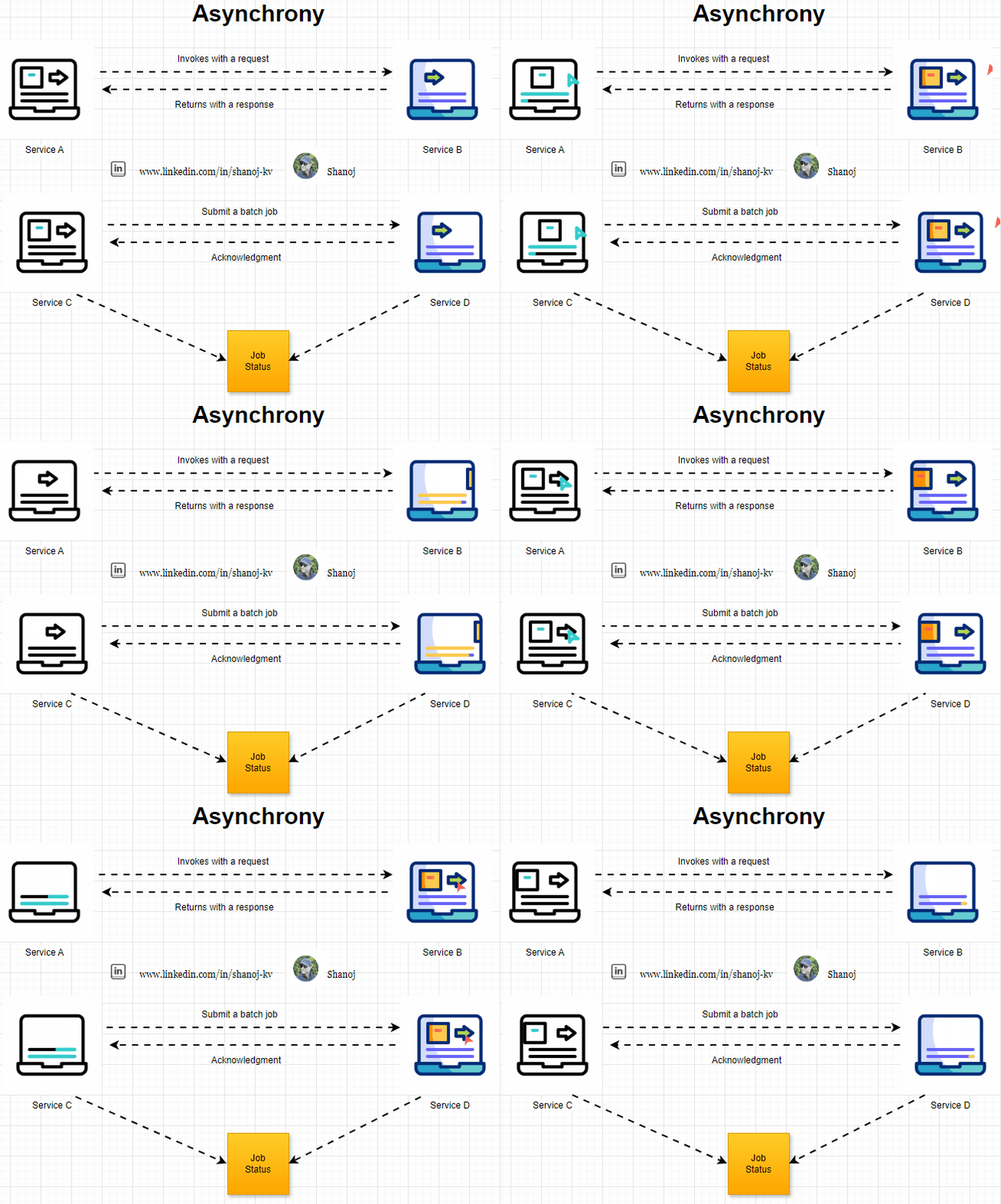
Asynchrony

Asynchrony in EDA refers to the ability of services to communicate without waiting for immediate responses. This is crucial for building scalable and resilient systems. Here are key points about asynchrony:

  • Decoupled Communication: Services can send messages or events without needing to wait for a response, allowing them to continue processing other tasks. This decoupling enhances system performance and scalability.
  • Example: Service A invokes Service B with a request and receives a response asynchronously. Similarly, Service C submits a batch job to Service D and receives an acknowledgement, then polls for the job status and gets updates later

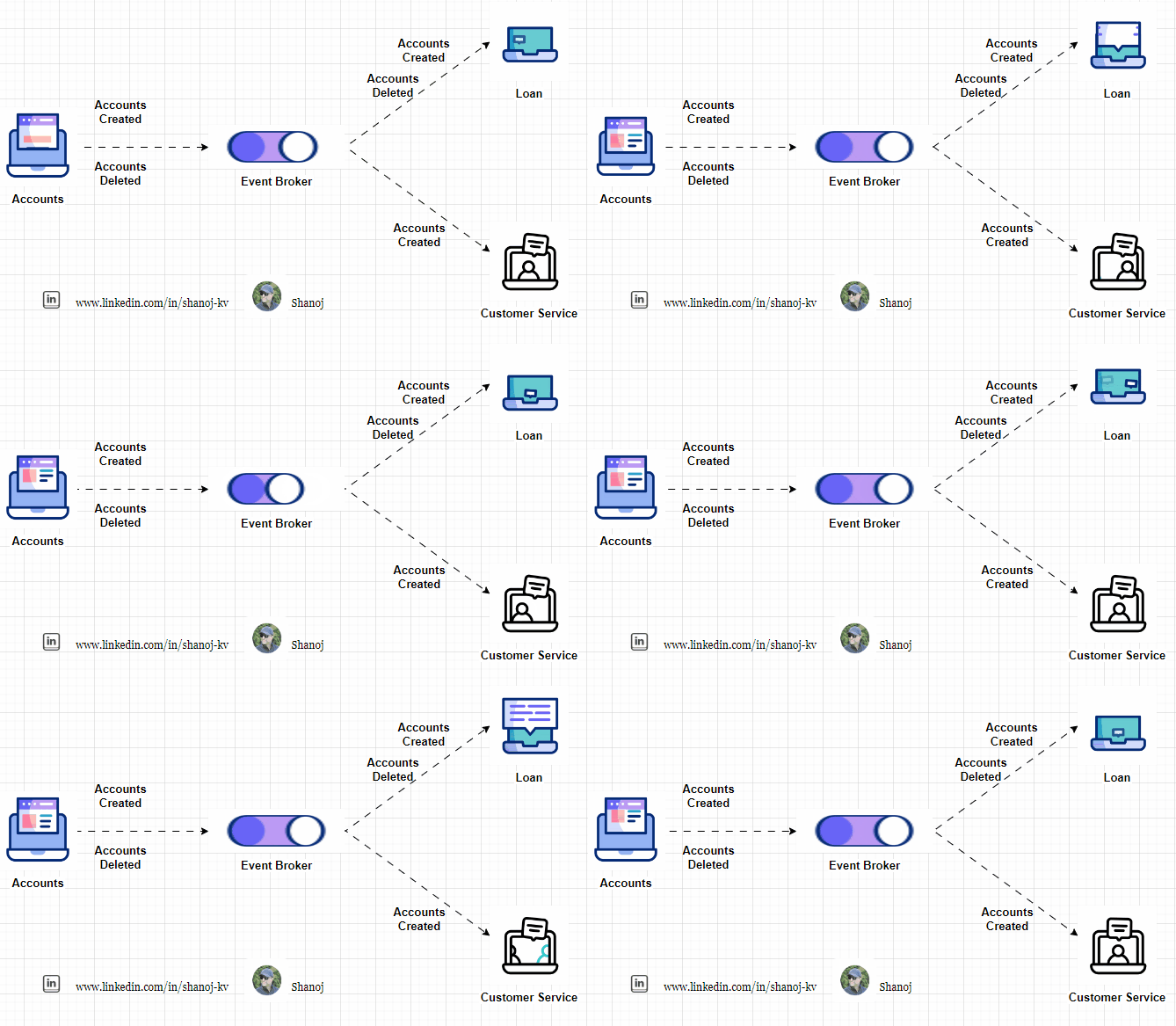
Event-Driven Communication

Event-driven communication is the core of EDA, where events trigger actions across different services. This approach ensures that systems can react to changes in real-time and remain loosely coupled. Key aspects include:

  • Event Producers and Consumers: Events are generated by producers and consumed by interested services. This model supports real-time processing and decoupling of services.
  • Example: Service C submits a batch job to Service D and receives an acknowledgement. Upon completion, Service D sends a notification to Service C, allowing it to react to the event without polling

Key Definitions

  • Event-driven architecture (EDA): Uses events to communicate between decoupled applications asynchronously.
  • Event Producer or Publisher: Generates events, such as account creation or deletion.
  • Event Broker: Receives events from producers and routes them to appropriate consumers.
  • Event Consumer or Subscriber: Receives and processes events from the broker.

Characteristics of Event Components

Event Producer:

  • Agnostic of consumers
  • Adds producer’s identity
  • Conforms to a schema
  • Unique event identifier
  • Adds just the required data

Event Consumer:

  • Idempotent (can handle duplicate events without adverse effects)
  • Ordering not guaranteed
  • Ensures event authenticity
  • Stores events and processes them

Event Broker:

  • Handles multiple publishers and subscribers
  • Routes events to multiple targets
  • Supports event transformation
  • Maintains a schema repository

Important Concepts

  • Event: Something that has already happened in the system.
  • Service Choreography: A coordinated sequence of actions across multiple microservices to accomplish a business process. It promotes service decoupling and asynchrony, enabling extensibility.

Common Mistakes

Overly complex event-driven designs can lead to tangled architectures.

Overly complex event-driven designs can lead to tangled architectures, which are difficult to manage and maintain. Here are some real-world examples and scenarios illustrating this issue:

Example 1: Microservices Overload

In a large-scale microservices architecture, each service may generate and process numerous events. For example, an e-commerce platform might include services for inventory, orders, payments, shipping, and notifications. If each of these services creates events for every change in state and processes events from various other services, the number of event interactions can grow significantly. This can result in a scenario where:

  • Event Storming: Too many events are being produced and consumed, making it hard to track which service is responsible for what.
  • Service Coupling: Services become tightly coupled through their event dependencies, making it difficult to change one service without impacting others.
  • Debugging Challenges: Tracing the flow of events to diagnose issues becomes complex, as events might trigger multiple services in unpredictable ways.

Example 2: Financial Transactions

In a financial system, different services might handle account management, transaction processing, fraud detection, and customer notifications. If these services are designed to emit and listen to numerous events, the architecture can become tangled:

  • Complex Event Chains: A single transaction might trigger a cascade of events across multiple services, making it hard to ensure data consistency and integrity.
  • Latency Issues: The time taken for events to propagate through the system can introduce latency, affecting the overall performance.
  • Security Concerns: With multiple services accessing and emitting sensitive financial data, ensuring secure communication and data integrity becomes more challenging.

Example 3: Healthcare Systems

In a healthcare system, services might handle patient records, appointment scheduling, billing, and notifications. An overly complex event-driven design can lead to:

  • Data Inconsistency: If events are not processed in the correct order or if there are failures in event delivery, patient data might become inconsistent.
  • Maintenance Overhead: Keeping track of all the events and ensuring that each service is correctly processing them can become a significant maintenance burden.
  • Regulatory Compliance: Ensuring that the system complies with healthcare regulations (e.g., HIPAA) can be more difficult when data is flowing through numerous services and events.

Mitigation Strategies

To avoid these pitfalls, it is essential to:

  • Simplify Event Flows: Design events at the right level of abstraction and avoid creating too many fine-grained events.
  • Clear Service Boundaries: Define clear boundaries for each service and ensure that events are only produced and consumed within those boundaries.
  • Use Event Brokers: Employ event brokers or messaging platforms to decouple services and manage event routing more effectively.
  • Invest in Observability: Implement robust logging, monitoring, and tracing to track the flow of events and diagnose issues quickly.

“Simplicity is the soul of efficiency.” — Austin Freeman


By leveraging asynchrony and event-driven communication, EDA enables the construction of robust, scalable, and flexible systems that can handle complex workflows and real-time data processing.

Stackademic 🎓

Thank you for reading until the end. Before you go:

Microservice 101: Micro Frontend Architecture Pattern

The Micro Frontend Architecture Pattern is a design approach that entails breaking down a large web application into smaller, independent front-end applications. Each of these applications is responsible for a specific part of the user interface. This approach draws inspiration from microservices architecture and aims to deliver similar benefits, such as scalability, faster development times, and improved resource management.

Key Points

  • Decomposition: Break down a large web application into smaller, independent front-end applications.
  • Autonomy: Each front-end application is responsible for a specific part of the UI and can be developed, deployed, and maintained independently.
  • Scalability: Micro frontends can be scaled up or down independently, allowing for more efficient resource allocation.
  • Faster Development: Independent development teams can work on different micro frontends simultaneously, reducing development time.
  • Better Resource Management: Micro frontends can be optimized for specific tasks, reducing the load on the server and improving performance.

Types of Micro Frontend Patterns

  • Component Library Pattern: A centralized library of reusable components that can be used across multiple micro frontends.
  • Component Sharing Pattern: Micro frontends share components, reducing duplication and improving consistency.
  • Route-Based Pattern: Micro frontends are organized based on routes, with each route handling a specific part of the UI.
  • Event-Driven Pattern: Micro frontends communicate with each other through events, allowing for loose coupling and greater flexibility.
  • Iframe-Based Pattern: Micro frontends are embedded in separate iframes, providing isolation and reducing conflicts.
  • Server-Side Rendering Pattern: The server assembles the HTML and components of multiple micro frontends into a single page, reducing client-side complexity.

Advantages

  • Improved Scalability: Micro frontends can be scaled up or down independently, allowing for more efficient resource allocation.
  • Faster Development: Independent development teams can work on different micro frontends simultaneously, reducing development time.
  • Better Resource Management: Micro frontends can be optimized for specific tasks, reducing the load on the server and improving performance.
  • Enhanced Autonomy: Each micro frontend can be developed, deployed, and maintained independently, allowing for greater autonomy and flexibility.

Challenges

  • Complexity: Micro frontends can introduce additional complexity, especially when integrating multiple micro frontends.
  • Communication: Micro frontends need to communicate with each other, which can be challenging, especially in event-driven patterns.
  • Testing: Testing micro frontends can be more complex due to the distributed nature of the architecture.

Tools and Technologies

  • Bit: A platform that allows for building, sharing, and reusing components across micro frontends.
  • Client-Side Composition: A technique that uses client-side scripting to assemble the HTML and components of multiple micro frontends.
  • Server-Side Rendering: A technique that uses server-side rendering to assemble the HTML and components of multiple micro frontends into a single page.

Examples

  • Amazon: Uses micro frontends to manage different parts of its UI, such as search and recommendations.
  • Zalando: Uses micro frontends to manage different parts of its e-commerce platform, such as product listings and checkout.
  • Capital One: Uses micro frontends to manage different parts of its banking platform, such as account management and transactions.

The Micro Frontends Architecture Pattern is an effective approach for creating scalable, maintainable, and efficient web applications. It involves breaking down a large application into smaller, independent front-end applications. This approach helps developers work more efficiently, reduce complexity, and improve performance. However, it requires careful planning, communication, and testing to ensure seamless integration and achieve optimal results.

Stackademic 🎓

Thank you for reading until the end. Before you go:

Microservice 101: The Strangler Fig pattern

The Strangler Fig pattern is a design pattern used in microservices architecture to gradually replace a monolithic application with microservices. It is named after the Strangler Fig tree, which grows around a host tree, eventually strangling it. In this pattern, new microservices are developed alongside the existing monolithic application, gradually replacing its functionality until the monolith is no longer needed.

Key Steps

  1. Transform: Identify a module or functionality within the monolith to be replaced by a new microservice. Develop the microservice in parallel with the monolith.
  2. Coexist: Implement a proxy or API gateway to route requests to either the monolith or the new microservice. This allows both systems to coexist and ensures uninterrupted functionality.
  3. Eliminate: Gradually shift traffic from the monolith to the microservice. Once the microservice is fully functional, the monolith can be retired.

Advantages

  • Incremental Migration: Minimizes risks associated with complete system rewrites.
  • Flexibility: Allows for independent development and deployment of microservices.
  • Reduced Disruptions: Ensures uninterrupted system functionality during the migration process.

Disadvantages

  • Complexity: Requires careful planning and coordination to manage both systems simultaneously.
  • Additional Overhead: Requires additional resources for maintaining both the monolith and the microservices.

Implementation

  1. Identify Module: Select a module or functionality within the monolith to be replaced.
  2. Develop Microservice: Create a new microservice to replace the identified module.
  3. Implement Proxy: Configure an API gateway or proxy to route requests to either the monolith or the microservice.
  4. Gradual Migration: Shift traffic from the monolith to the microservice incrementally.
  5. Retire Monolith: Once the microservice is fully functional, retire the monolith.

Tools and Technologies

  • API Gateway: Used to route requests to either the monolith or the microservice.
  • Change Data Capture (CDC): Used to stream changes from the monolith to the microservice.
  • Event Streaming Platform: Used to create event streams that can be used by other applications.

Examples

  • E-commerce Application: Migrate order management functionality from a monolithic application to microservices using the Strangler Fig pattern.
  • Legacy System: Use the Strangler Fig pattern to gradually replace a legacy system with microservices.

The Strangler Fig pattern is a valuable tool for migrating monolithic applications to microservices. It allows for incremental migration, reduces disruptions, and minimizes risks associated with complete system rewrites. However, it requires careful planning and coordination to manage both systems simultaneously.

Stackademic 🎓

Thank you for reading until the end. Before you go:

Solution Architect: Different Methodologies

This article is an outcome of a discussion with a fellow solution architect. We were discussing the different approaches or schools of thought a solution architect might follow. If there is some disagreement, we kindly ask that you respect our point of view, and we are open to any kind of healthy discussion on this topic.

“Good architecture is like a great novel: it gets better with every reading.” — Robert C. Martin

In the field of solution architecture, there are several approaches one might take. Among them are the Problem-First Approach, Design-First Approach, Domain-Driven Design (DDD), and Agile Architecture. Each has its own focus and methodology, and the choice of approach depends on the context and specific needs of the project.

“The goal of software architecture is to minimize the human resources required to build and maintain the required system.” — Robert C. Martin

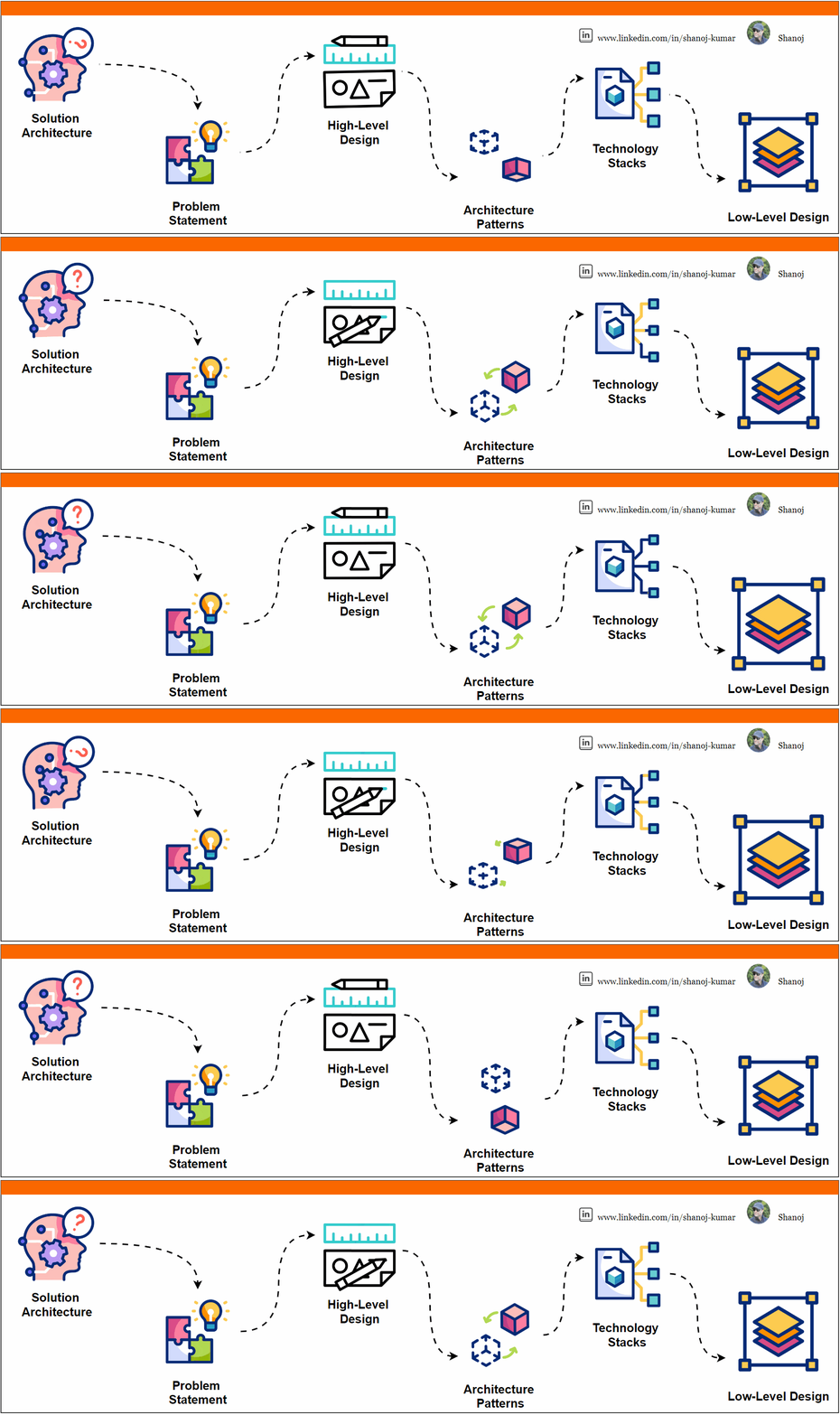
Based on the various approaches discussed, we propose a common and effective order for a solution architect to follow:

1. Problem Statement

Define and Understand the Problem: Begin by clearly defining the problem that needs to be solved. This involves gathering requirements, understanding business needs, objectives, constraints, and identifying any specific challenges. This foundational step ensures that all subsequent efforts are aligned with solving the correct issue.

“In software, the most beautiful code, the most beautiful functions, and the most beautiful programs are sometimes not there at all.” — Jon Bentley

2. High-Level Design

Develop a Conceptual Framework: Create a high-level design that outlines the overall structure of the solution. Identify major components, their interactions, data flow, and the overall system architecture. This step provides a bird’s-eye view of the solution, ensuring that all stakeholders have a common understanding of the proposed system.

“The most important single aspect of software development is to be clear about what you are trying to build.” — Bjarne Stroustrup

3. Architecture Patterns

Select Suitable Patterns: Identify and choose appropriate architecture patterns that fit the high-level design and problem context. Patterns such as microservices, layered architecture, and event-driven architecture help ensure the solution is robust, scalable, and maintainable. Selecting the right pattern is crucial for addressing the specific needs and constraints of the project.

“A pattern is a solution to a problem in a context.” — Christopher Alexander

4. Technology Stacks

Choose Technologies: Select the technology stacks that will be used to implement the solution. This includes programming languages, frameworks, databases, cloud services, and other tools that align with the architecture patterns and high-level design. Consider factors like team expertise, performance, scalability, and maintainability. The choice of technology stack has a significant impact on the implementation and long-term success of the project.

“Any sufficiently advanced technology is indistinguishable from magic.” — Arthur C. Clarke

5. Low-Level Design

Detail Each Component: Create detailed, low-level designs for each component identified in the high-level design. Specify internal structures, interfaces, data models, algorithms, and detailed workflows. This step ensures that each component is well-defined and can be effectively implemented by development teams. Detailed design documents help in minimizing ambiguities and ensuring a smooth development process.

“Good design adds value faster than it adds cost.” — Thomas C. Gale

Summary of Order:

Practical Considerations:

  • Iterative Feedback and Validation: Incorporate iterative feedback and validation throughout the process. Regularly review designs with stakeholders and development teams to ensure alignment with business goals and to address any emerging issues. This iterative process helps in refining the solution and addressing any unforeseen challenges.

“You can’t improve what you don’t measure.” — Peter Drucker

  • Documentation: Maintain comprehensive documentation at each stage to ensure clarity and facilitate communication among stakeholders. Good documentation practices help in maintaining a record of decisions and the rationale behind them, which is useful for future reference and troubleshooting.
  • Flexibility: Be prepared to adapt and refine designs as new insights and requirements emerge. This approach allows for continuous improvement and alignment with evolving business needs. Flexibility is key to responding effectively to changing business landscapes and technological advancements.

“The measure of intelligence is the ability to change.” — Albert Einstein

Guidelines for Selecting an Approach

Here are some general guidelines for selecting an approach:

Problem-First Approach: This approach is suitable when the problem domain is well-understood, and the focus is on finding the best solution to address the problem. It works well for projects with clear requirements and constraints.

Design-First Approach: This approach is beneficial when the system’s architecture and design are critical, and upfront planning is necessary to ensure the system meets its quality attributes and non-functional requirements.

Domain-Driven Design (DDD): DDD is a good fit for complex domains with intricate business logic and evolving requirements. It promotes a deep understanding of the domain and helps in creating a maintainable and extensible system.

Agile Architecture: An agile approach is suitable when requirements are likely to change frequently, and the team needs to adapt quickly. It works well for projects with a high degree of uncertainty or rapidly changing business needs.

Ultimately, the choice of approach should be based on a careful evaluation of the project’s specific context, requirements, and constraints, as well as the team’s expertise and the organization’s culture and processes. It’s also common to combine elements from different approaches or tailor them to the project’s needs.

“The best way to predict the future is to invent it.” — Alan Kay

Real-Life Use Case: Netflix Microservices Architecture

A notable real-life example of following a structured approach in solution architecture is Netflix’s transition to a microservices architecture. Here’s how Netflix applied a similar order in their architectural approach:

1. Problem Statement

Netflix faced significant challenges with their existing monolithic architecture, including scalability issues, difficulty in deploying new features, and handling increasing loads as their user base grew globally. The problem was clearly defined: the need for a scalable, resilient, and rapidly deployable architecture to support their expanding services.

“If you define the problem correctly, you almost have the solution.” — Steve Jobs

2. High-Level Design

Netflix designed a high-level architecture that focused on breaking down their monolithic application into smaller, independent services. This conceptual framework provided a clear vision of how different components would interact and be managed. They aimed to achieve a highly decoupled system where services could be developed and deployed independently.

3. Architecture Patterns

Netflix chose a combination of several architectural patterns to meet their specific needs:

  • Microservices Architecture: This pattern allowed Netflix to create independent services that could be developed, deployed, and scaled individually. Each microservice handled a specific business capability and communicated with others through well-defined APIs. This pattern provided the robustness and scalability needed to handle millions of global users.
  • Event-Driven Architecture: Netflix implemented an event-driven architecture to handle asynchronous communication between services. This pattern was essential for maintaining responsiveness and reliability in a highly distributed system. Services are communicated via events, allowing the system to remain loosely coupled and scalable.

Ref: https://github.com/Netflix/Hystrix

  • Circuit Breaker Pattern: Using tools like Hystrix, Netflix adopted the circuit breaker pattern to prevent cascading failures and to manage service failures gracefully. This pattern improved the resilience and fault tolerance of their architecture.
  • Service Discovery Pattern: Netflix utilized Eureka for service discovery. This pattern ensured that services could dynamically locate and communicate with each other, facilitating load balancing and failover strategies.
  • API Gateway Pattern: Zuul was employed as an API gateway, providing a single entry point for all client requests. This pattern helped manage and route requests to the appropriate microservices, improving security and performance.

4. Technology Stacks

Netflix selected a technology stack that included:

  • Java: For developing the core services due to its maturity, scalability, and extensive ecosystem.
  • Cassandra: For data storage, providing high availability and scalability across multiple data centers.
  • AWS: For cloud infrastructure, offering scalability, reliability, and a wide range of managed services.

Netflix also implemented additional tools and technologies to support their architecture patterns:

  • Hystrix: For implementing the circuit breaker pattern.
  • Eureka: For service discovery and registration.
  • Zuul: For API gateway and request routing.
  • Kafka: For event-driven messaging and real-time data processing.
  • Spinnaker: For continuous delivery and deployment automation.

5. Low-Level Design

Detailed designs for each microservice were created, specifying how they would interact with each other, handle data, and manage failures. This included defining:

  • APIs: Well-defined interfaces for communication between services.
  • Data Models: Schemas and structures for data storage and exchange.
  • Communication Protocols: RESTful APIs, gRPC, and event-based messaging.
  • Internal Structures: Detailed workflows, algorithms, and internal component interactions.

Each microservice was developed with clear boundaries and responsibilities, ensuring a well-structured implementation. Teams were organized around microservices, allowing for autonomous development and deployment cycles.

“The details are not the details. They make the design.” — Charles Eames

Practical Considerations

Netflix continuously incorporated iterative feedback and validation through extensive testing and monitoring. They maintained comprehensive documentation for their microservices, facilitating communication and understanding among teams. Flexibility was a core principle, allowing Netflix to adapt and refine their services based on real-time performance data and user feedback.

  • Iterative Feedback and Validation: Netflix used canary releases, A/B testing, and real-time monitoring to gather feedback and validate changes incrementally. This allowed them to make informed decisions and continuously improve their services.

Ref: https://netflixtechblog.com/automated-canary-analysis-at-netflix-with-kayenta-3260bc7acc69

  • Documentation: Detailed documentation was maintained for each microservice, including API specifications, architectural decisions, and operational guidelines. This documentation was essential for onboarding new team members and ensuring consistency across the organization.
  • Flexibility: The architecture was designed to be adaptable, allowing Netflix to quickly respond to changing requirements and scale services as needed. Continuous integration and continuous deployment (CI/CD) practices enabled rapid iteration and deployment.

“Flexibility requires an open mind and a welcoming of new alternatives.” — Deborah Day

By adopting a combination of architecture patterns and leveraging a robust technology stack, Netflix successfully transformed their monolithic application into a scalable, resilient, and rapidly deployable microservices architecture. This transition not only addressed their immediate challenges but also positioned them for future growth and innovation.


The approach a solution architect takes can significantly impact the success of a project. By following a structured process that starts with understanding the problem, moving through high-level and low-level design, and incorporating feedback and flexibility, a solution architect can create robust, scalable, and effective solutions. This methodology not only addresses immediate business needs but also lays a strong foundation for future growth and adaptability. The case of Netflix demonstrates how applying these principles can lead to successful, scalable, and resilient architectures that support business objectives and user demands.

Stackademic 🎓

Thank you for reading until the end. Before you go:

Kubernetes 101: Deploying & Scaling a Microservice Application

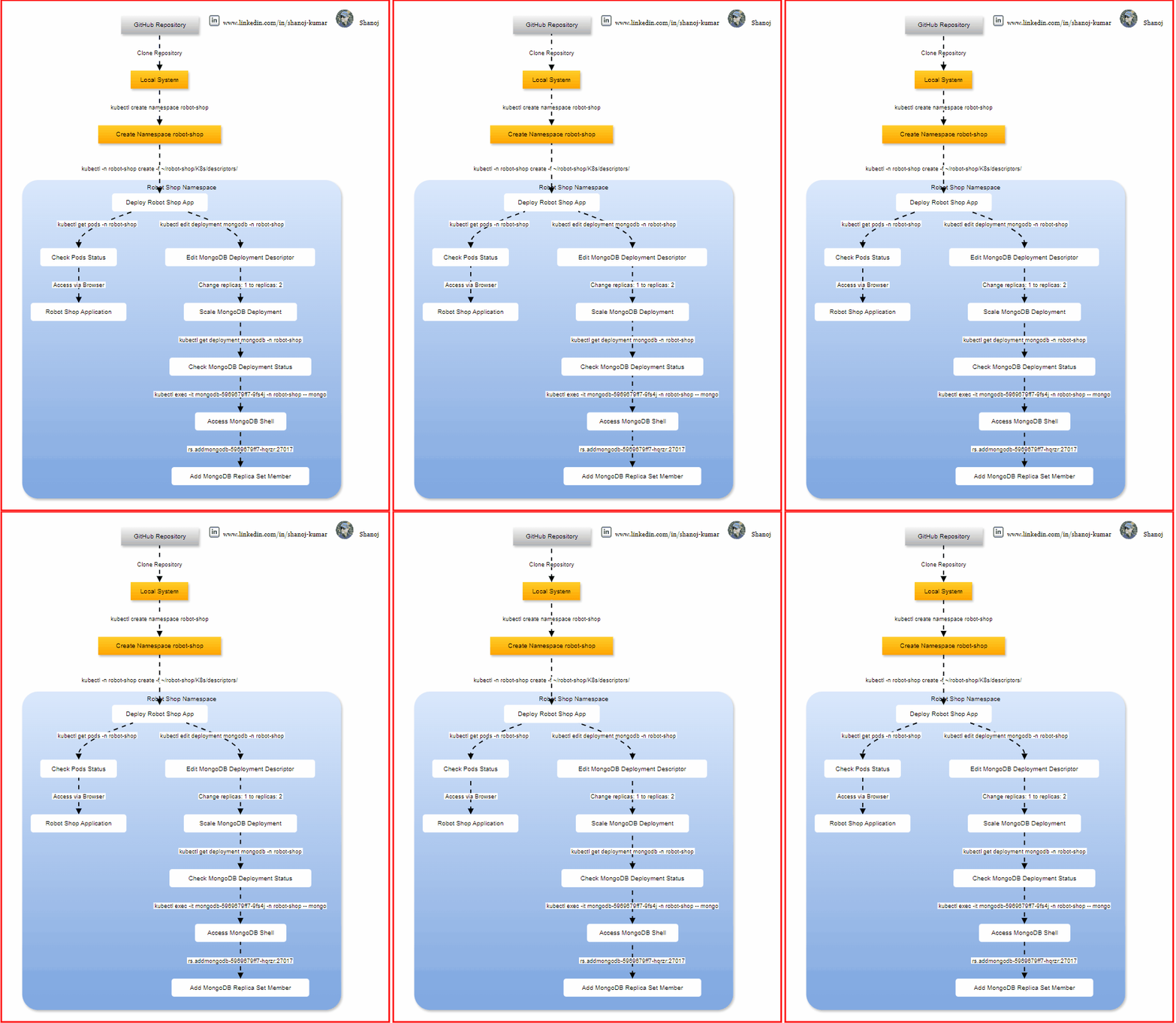
Clone the Git Repository

First, clone the Git repository that contains the pre-made descriptors for the Robot Shop application.

cd ~/
git clone https://github.com/instana/robot-shop.git

Thanks to Instana for providing the Robot Shop application!

Create a Namespace

Since the Robot Shop application consists of multiple components, it’s a good practice to create a separate namespace for the application. This isolates the resources and makes management easier.

kubectl create namespace robot-shop

Deploy the Application

Deploy the application to the Kubernetes cluster using the provided descriptors.

kubectl -n robot-shop create -f ~/robot-shop/K8s/descriptors/

Check the Status of the Application’s Pods

To ensure the deployment was successful, check the status of the application’s pods.

kubectl get pods -n robot-shop

Access the Robot Shop Application

You should be able to reach the Robot Shop application from your browser using the Kubernetes master node’s public IP.

http://<kube_master_public_ip>:30080

Scale Up the MongoDB Deployment

To ensure high availability and reliability, scale up the MongoDB deployment to two replicas instead of just one.

Edit the Deployment Descriptor

Edit the MongoDB deployment descriptor.

kubectl edit deployment mongodb -n robot-shop

In the YAML file that opens, locate the spec: section and find the line that says replicas: 1. Change this value to replicas: 2.

spec:
replicas: 2

Save and exit the editor.

Check the Status of the Deployment

Verify that the MongoDB deployment has scaled up to two replicas.

kubectl get deployment mongodb -n robot-shop

After a few moments, you should see the number of available replicas is 2.

Add a New Replica Set Member

To further ensure data redundancy, add the new MongoDB replica to the replica set.

Execute MongoDB Shell

Use kubectl exec to open a MongoDB shell session in one of the MongoDB pods.

kubectl exec -it mongodb-5969679ff7-nkgpq -n robot-shop -- mongo

Replace <mongodb-pod-name 1> with the name of one of the MongoDB pods.

Add the New Replica Set Member

In the MongoDB shell, run the following command to add the new member to the replica set.

Check the status of the replica set.

rs.status()

Add the other MongoDB pod to the replica set.

rs.add("mongodb-5969679ff7-w5kpg:27017")

By following these steps, you have successfully deployed the Robot Shop application, scaled up the MongoDB deployment for high availability, and added a new replica set member to ensure data redundancy. This setup helps in maintaining a reliable and robust application environment.

Stackademic 🎓

Thank you for reading until the end. Before you go:

Kubernetes 101: Deploying and Testing a Service

This hands-on article will help you create a simple deployment and a service, enabling you to manage and access applications efficiently within a Kubernetes cluster. You will create a deployment for the shanoj-testapp service with four replicas and a service that other pods in the cluster can access.

Creating the Deployment

A deployment ensures that a specified number of pod replicas are running at any given time. In this case, we will create a deployment for the shanoj-testapp service with four replicas.

Create the Deployment YAML File

Create a YAML file for the deployment using the cat command and the following content:

cat << EOF | kubectl apply -f -
apiVersion: apps/v1
kind: Deployment
metadata:
name: shanoj-testapp
labels:
app: shanoj-testapp
spec:
replicas: 4
selector:
matchLabels:
app: shanoj-testapp
template:
metadata:
labels:
app: shanoj-testapp
spec:
containers:
- name: shanoj-testapp
image: nginx:latest
ports:
- containerPort: 80
EOF

Image Reference: https://hub.docker.com/_/nginx

Creating the Service

A service in Kubernetes defines a logical set of pods and a policy by which to access them. In this step, we will create a service to provide access to the shanoj-testapp pods.

Create the Service YAML File

Create a YAML file for the service using the cat command and the following content:

cat << EOF | kubectl apply -f -
kind: Service
apiVersion: v1
metadata:
name: shanoj-svc
spec:
selector:
app: shanoj-testapp
ports:
- protocol: TCP
port: 80
targetPort: 80
EOF

This YAML file defines a service named shanoj-svc that selects pods with the label app=shanoj-testapp and forwards traffic to port 80 on the pods.

Verifying the Service

After creating the service, verify that it is running and accessible within the cluster.

Check the Service Status

Use the following command to check the status of the shanoj-svc service:

kubectl get svc shanoj-svc

Access the Service from a shanojtesting-pod Pod

Creating the shanojtesting-pod Pod

You need to create a shanojtesting-pod pod to use it for testing. Create a YAML configuration file for the shanojtesting-pod pod. Create a file named shanojtesting-pod.yaml with the following content:

cat << EOF > shanojtesting-pod.yaml
apiVersion: v1
kind: Pod
metadata:
name: shanojtesting-pod
labels:
app: shanojtesting-pod
spec:
containers:
- name: shanojtesting-pod
image: alpine
command: ['sh', '-c', 'sleep 3600']
EOF

Image Reference: https://hub.docker.com/_/alpine

Apply the configuration to create the shanojtesting-pod pod:

kubectl apply -f shanojtesting-pod.yaml

Ensure the shanojtesting-pod pod is running:

kubectl get pods

Testing the Service

To ensure the service is accessible, use the kubectl exec command to query the shanoj-svc service from the shanojtesting-pod testing pod:

kubectl exec shanojtesting-pod -- curl -s shanoj-svc

If the service is functioning correctly, this command should return a response from the shanoj-testapp pods.

Stackademic 🎓

Thank you for reading until the end. Before you go: