Author Archives: Shanoj

Unknown's avatar

About Shanoj

Author : Shanoj is a Data engineer and solutions architect passionate about delivering business value and actionable insights through well-architected data products. He holds several certifications on AWS, Oracle, Apache, Google Cloud, Docker, Linux and focuses on data engineering and analysis using SQL, Python, BigData, RDBMS, Apache Spark, among other technologies. He has 17+ years of history working with various technologies in the Retail and BFS domains.

Distributed Systems Design Pattern: Temporal Decoupling — [E-commerce Promotions & Order…

In distributed e-commerce systems, managing accurate inventory and pricing data is crucial, especially during dynamic promotional events. The Temporal Decoupling pattern introduces a delay buffer to handle out-of-order events, ensuring updates like promotions, orders, and inventory changes are processed in the correct sequence to maintain data consistency.

The Problem: Out-of-Order Events and Data Inconsistency

In e-commerce systems, events such as promotions, inventory changes, and customer orders often occur independently. This independence can lead to challenges like:

  • Event Arrival Delays: A promotion update might arrive after a customer order due to network latency, leading to incorrect pricing.
  • Concurrency Issues: Inventory updates from different warehouses may be processed in varying orders, causing inaccurate stock levels.
  • Order-Dependent Processing: Applying promotions, discounts, or inventory updates out of order can lead to pricing errors and stock inconsistencies.

For instance, during a flash sale, a promotion starting at 10:00 AM may arrive after an order placed at 10:01 AM due to network delays. This could result in the order being processed without the intended discount, frustrating the customer and leading to operational issues.

Temporal Decoupling: Correcting the Sequence of Events

The Temporal Decoupling pattern resolves these issues by introducing a delay buffer, which holds events temporarily to ensure they are processed in the correct order based on their timestamps. Here’s how it works:

  1. Timestamp Assignment: Each event is tagged with a timestamp at the source, indicating when it was generated.
  2. Delay Buffer: Events are temporarily stored in a delay buffer to allow for dependency resolution and ordering.
  3. Order-Based Processing: Events are processed from the buffer only after their dependencies (e.g., related promotions or inventory updates) have been applied.

By ensuring events are processed in the correct order, this pattern prevents inconsistencies caused by asynchronous updates.

Implementation: Temporal Decoupling in E-commerce Systems

Step 1: Assigning Timestamps to Events

Every event, such as a promotion update or customer order, is assigned a timestamp when generated. For example, a promotion starting at 10:00 AM is tagged with a corresponding timestamp.

Step 2: Storing Events in a Delay Buffer

Incoming events are stored in a delay buffer, which holds them until their dependencies are resolved. For instance, an order placed at 10:01 AM will wait until the promotion tagged at 10:00 AM is applied.

Step 3: Processing Events in Timestamp Order

The system processes events from the buffer based on their timestamps. A promotion update at 10:00 AM is applied before an order at 10:01 AM, ensuring that the order reflects the correct promotional pricing.

Advantages of Temporal Decoupling

  1. Accurate Event Processing: Ensures that promotions, inventory updates, and orders are applied in the correct order, preventing data inconsistencies.
  2. Enhanced Customer Experience: Guarantees that customers receive correct pricing and stock information, even during high-traffic events like flash sales.
  3. Operational Reliability: Handles delayed or out-of-order events caused by network issues without compromising system integrity.

Practical Considerations and Trade-Offs

While the Temporal Decoupling pattern provides clear benefits, there are trade-offs:

  • Latency Overhead: Introducing a delay buffer may add minor delays to event processing.
  • Memory Usage: Storing events temporarily increases memory requirements during peak loads.
  • Complexity: Managing dependencies and resolving out-of-order events adds implementation complexity.

The Temporal Decoupling pattern is a practical solution for managing out-of-order events in distributed e-commerce systems. By introducing a delay buffer, it ensures that updates are processed in the correct sequence, maintaining data accuracy and operational reliability. This approach is essential for high-demand scenarios like flash sales, where consistency and accuracy are paramount.

Stackademic 🎓

Thank you for reading until the end. Before you go:

How Do RNNs Handle Sequential Data Using Backpropagation Through Time?

Recurrent Neural Networks (RNNs) are essential for processing sequential data, but the true power of RNNs lies in their ability to learn dependencies over time through a process called Backpropagation Through Time (BPTT). In this article, we will dive into the mechanisms of BPTT, how it enables RNNs to learn from sequences, and explore its strengths and challenges in handling sequential tasks. With detailed explanations and diagrams, we’ll demystify the forward and backward computations in RNNs.

Quick Recap of RNN Forward Propagation

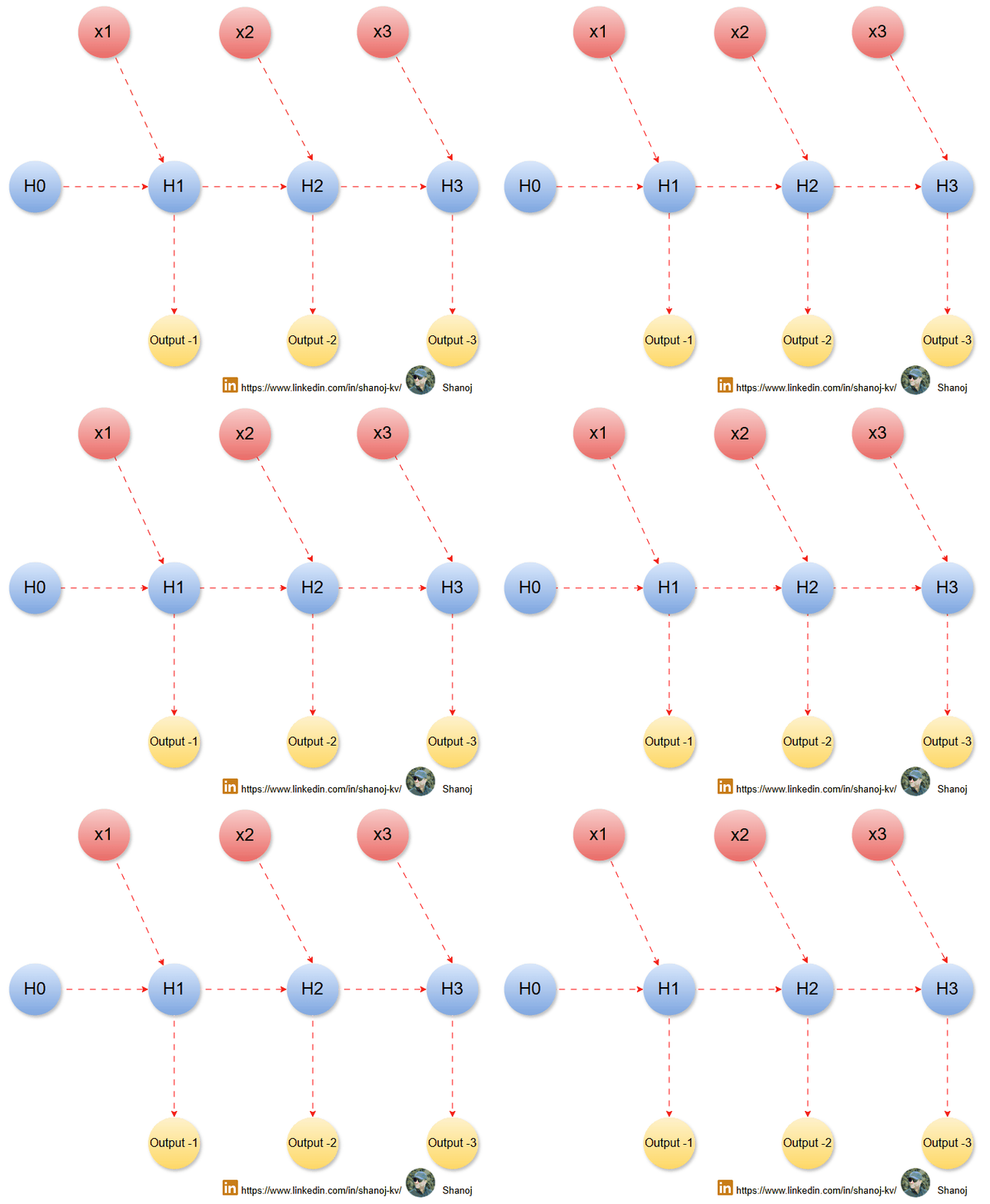
RNNs process sequential data by maintaining hidden states that carry information from previous time steps. For example, in sentiment analysis, each word in a sentence is processed sequentially, and the hidden states help retain context.

Forward Propagation Equations

Forward Propagation in RNN

Backpropagation Through Time (BPTT)

BPTT extends the backpropagation algorithm to sequential data by unrolling the RNN over time. Gradients are calculated for each weight across all time steps and summed up to update the weights.

Challenges in BPTT

  1. Vanishing Gradient Problem: Gradients diminish as they propagate back, making it hard to capture long-term dependencies.
  2. Exploding Gradient Problem: Gradients grow excessively large, causing instability during training.

Mitigation:

  • Use Long Short-Term Memory (LSTM) or Gated Recurrent Units (GRUs) to manage long-term dependencies.
  • Apply gradient clipping to control exploding gradients.

Backpropagation Through Time is a crucial technique for training RNNs on sequential data. However, it comes with challenges such as vanishing and exploding gradients. Understanding and implementing these methods effectively is key to building robust sequential models.

Stackademic 🎓

Thank you for reading until the end. Before you go:

Can We Solve Sentiment Analysis with ANN, or Do We Need to Transition to RNN?

Sentiment analysis involves determining the sentiment of textual data, such as classifying whether a review is positive or negative. At first glance, Artificial Neural Networks (ANN) seem capable of tackling this problem. However, given the sequential nature of text data, RNNs (Recurrent Neural Networks) are often a more suitable choice. Let’s explore this in detail, supported by visual aids.

Sentiment Analysis Problem Setup

We consider a dataset with sentences labelled with sentiments:

Preprocessing the Text Data

  1. Tokenization: Splitting sentences into words.
  2. Vectorization: Using techniques like bag-of-words or TF-IDF to convert text into fixed-size numerical representations.

Example: Bag-of-Words Representation

Given the vocabulary: ["food", "good", "bad", "not"], each sentence can be represented as:

  • Sentence 1: [1, 1, 0, 0]
  • Sentence 2: [1, 0, 1, 0]
  • Sentence 3: [1, 1, 0, 1]

Attempting Sentiment Analysis with ANN

The diagram below represents how an ANN handles the sentiment analysis problem.

  • Input Layer: Vectorized representation of text.
  • Hidden Layers: Dense layers with activation functions.
  • Output Layer: A single neuron with sigmoid activation, predicting sentiment.

Issues with ANN for Sequential Data

  1. Loss of Sequence Information:
  • ANN treats input as a flat vector, ignoring the word order.
  • For example, “The food is not good” is indistinguishable from “The good not food.”

2. Simultaneous Input:

  • All words are processed together, failing to capture dependencies between words.

Transition to RNN

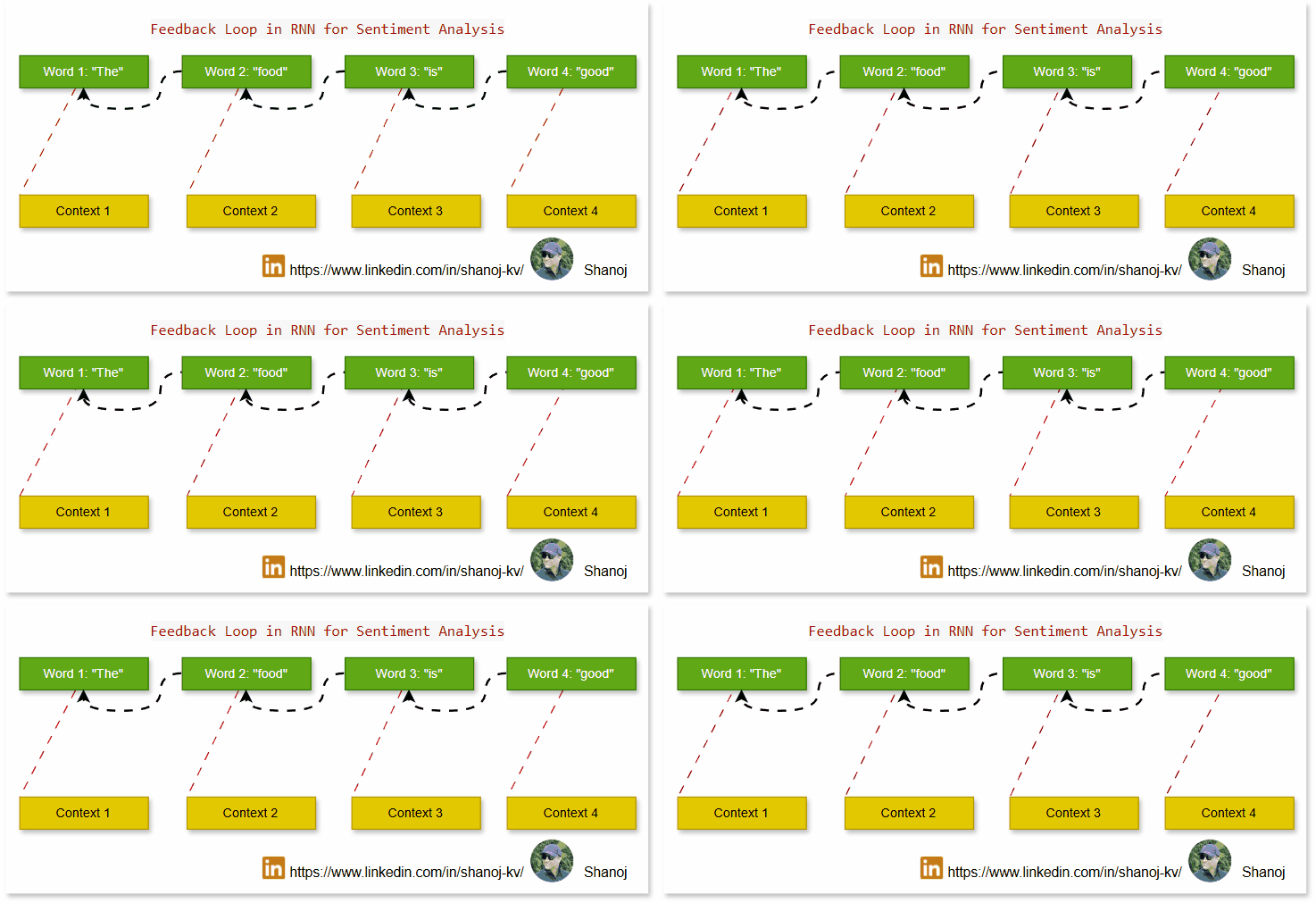
Recurrent Neural Networks address the limitations of ANNs by processing one word at a time and retaining context through hidden states.

The recurrent connections allow RNNs to maintain a memory of previous inputs, which is crucial for tasks involving sequential data.
  • Input Layer: Words are input sequentially (e.g., “The” → “food” → “is” → “good”).
  • Hidden Layers: Context from previous words is retained using feedback loops.
  • Output Layer: Predicts sentiment after processing the entire sentence.

Comparing ANN and RNN for Sentiment Analysis

While ANNs can solve simple text classification tasks, they fall short when dealing with sequential data like text. RNNs are designed to handle sequences, making them the ideal choice for sentiment analysis and similar tasks where word order and context are crucial.

By leveraging RNNs, we ensure that the model processes and understands text in a way that mimics human comprehension. The feedback loop and sequential processing of RNNs make them indispensable for modern NLP tasks.

Stackademic 🎓

Thank you for reading until the end. Before you go:

Distributed Systems Design Pattern: Version Vector for Conflict Resolution — [Supply Chain Use…

In distributed supply chain systems, maintaining accurate inventory data across multiple locations is crucial. When inventory records are updated independently in different warehouses, data conflicts can arise due to network partitions or concurrent updates. The Version Vector pattern addresses these challenges by tracking updates across nodes and reconciling conflicting changes.

The Problem: Concurrent Updates and Data Conflicts in Distributed Inventory Systems

This diagram shows how Node A and Node B independently update the same inventory record, leading to potential conflicts.

In a supply chain environment, inventory records are updated across multiple warehouses, each maintaining a local version of the data. Ensuring that inventory information remains consistent across locations is challenging due to several key issues:

Concurrent Updates: Different warehouses may update inventory levels at the same time. For instance, one location might log an inbound shipment, while another logs an outbound transaction. Without a mechanism to handle these concurrent updates, the system may show conflicting inventory levels.

Network Partitions: Network issues can cause temporary disconnections between nodes, allowing updates to happen independently in different locations. When the network connection is restored, each node may have different versions of the same inventory record, leading to discrepancies.

Data Consistency Requirements: Accurate inventory data is critical to avoid overstocking, stockouts, and operational delays. If inventory levels are inconsistent across nodes, the supply chain can be disrupted, causing missed orders and inaccurate stock predictions.

Imagine a scenario where a supply chain system manages inventory levels for multiple warehouses. Warehouse A logs a received shipment, increasing stock levels, while Warehouse B simultaneously logs a shipment leaving, reducing stock. Without a way to reconcile these changes, the system could show incorrect inventory counts, impacting operations and customer satisfaction.

Version Vector: Tracking Updates for Conflict Resolution

This diagram illustrates a version vector for three nodes, showing how Node A updates the inventory and increments its counter in the version vector.

The Version Vector pattern addresses these issues by assigning a unique version vector to each inventory record, which tracks updates from each node. This version vector allows the system to detect conflicts and reconcile them effectively. Here’s how it works:

Version Vector: Each inventory record is assigned a version vector, an array of counters where each counter represents the number of updates from a specific node. For example, in a system with three nodes, a version vector [2, 1, 0] indicates that Node A has made two updates, Node B has made one update, and Node C has made none.

Conflict Detection: When nodes synchronize, they exchange version vectors. If a node detects that another node has updates it hasn’t seen, it identifies a potential conflict and triggers conflict resolution.

Conflict Resolution: When conflicts are detected, the system applies pre-defined conflict resolution rules to determine the final inventory level. Common strategies include merging updates or prioritizing certain nodes to ensure data consistency.

The Version Vector pattern ensures that each node has an accurate view of inventory data, even when concurrent updates or network partitions occur.

Implementation: Resolving Conflicts with Version Vectors in Inventory Management

In a distributed supply chain with multiple warehouses (e.g., three nodes), here’s how version vectors track and resolve conflicts:

Step 1: Initializing Version Vectors

Each inventory record starts with a version vector initialized to [0, 0, 0] for three nodes (Node A, Node B, and Node C). This vector keeps track of the number of updates each node has applied to the inventory record.

Step 2: Incrementing Version Vectors on Update

When a warehouse updates the inventory, it increments its respective counter in the version vector. For example, if Node A processes an incoming shipment, it updates the version vector to [1, 0, 0], indicating that it has made one update.

Step 3: Conflict Detection and Resolution

This sequence diagram shows the conflict detection process. Node A and Node B exchange version vectors, detect a conflict, and resolve it using predefined rules.

As nodes synchronize periodically, they exchange version vectors. If Node A has a version vector [2, 0, 0] and Node B has [0, 1, 0], both nodes recognize that they have unseen updates from each other, signaling a conflict. The system then applies conflict resolution rules to reconcile these changes and determine the final inventory count.

The diagram below illustrates how version vectors track updates across nodes and detect conflicts in a distributed supply chain. Each node’s version vector reflects its update history, enabling the system to accurately identify and manage conflicting changes.

Consistent Inventory Data Across Warehouses: Advantages of Version Vectors

  1. Accurate Conflict Detection: Version vectors allow the system to detect concurrent updates, minimizing the risk of unnoticed conflicts and data discrepancies.
  2. Effective Conflict Resolution: By tracking updates from each node, the system can apply targeted conflict resolution strategies to ensure inventory data remains accurate.
  3. Fault Tolerance: In case of network partitions, nodes can operate independently. When connectivity is restored, nodes can reconcile updates, maintaining consistency across the entire network.

Practical Considerations and Trade-Offs

While version vectors offer substantial benefits, there are some trade-offs to consider in their implementation:

Vector Size: The version vector’s size grows with the number of nodes, which can increase storage requirements in larger systems.

Complexity of Conflict Resolution: Defining rules for conflict resolution can be complex, especially if nodes make contradictory updates.

Operational Overhead: Synchronizing version vectors across nodes requires extra network communication, which may affect performance in large-scale systems.

Eventual Consistency in Supply Chain Inventory Management

This diagram illustrates how nodes in a distributed supply chain eventually synchronize their inventory records after resolving conflicts, achieving consistency across all warehouses.

The Version Vector pattern supports eventual consistency by allowing each node to update inventory independently. Over time, as nodes exchange version vectors and resolve conflicts, the system converges to a consistent state, ensuring that inventory data across warehouses remains accurate and up-to-date.

The Version Vector for Conflict Resolution pattern effectively manages data consistency in distributed supply chain systems. By using version vectors to track updates, organizations can prevent conflicts and maintain data integrity, ensuring accurate inventory management and synchronization across all locations.

Stackademic 🎓

Thank you for reading until the end. Before you go:

Distributed Systems Design Pattern: Quorum-Based Reads & Writes — [Healthcare Records…

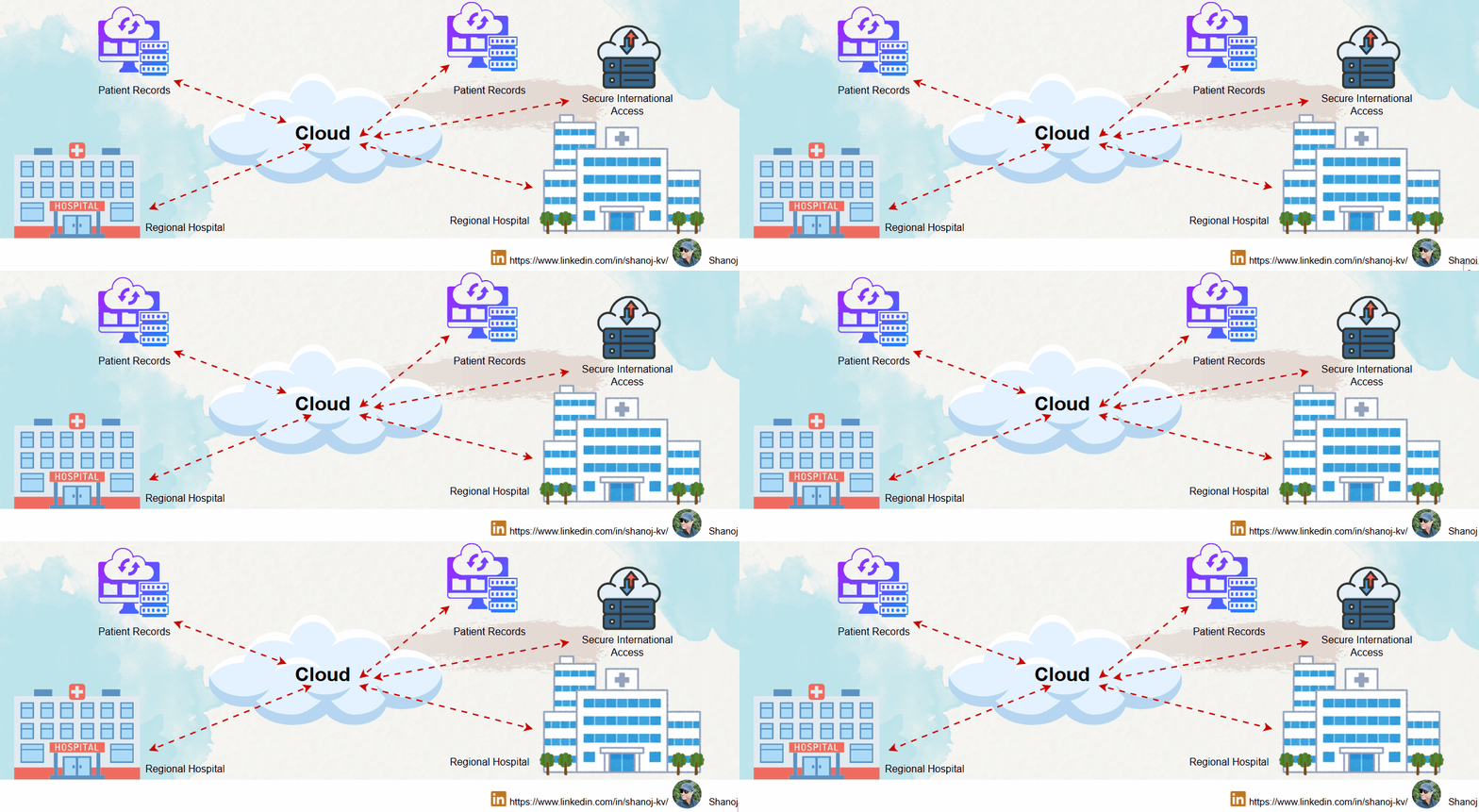
The Quorum-Based Reads and Writes pattern is an essential solution in distributed systems for maintaining data consistency, particularly in situations where accuracy and reliability are vital. In these systems, quorum-based reads and writes ensure that data remains both available and consistent by requiring a majority consensus among nodes before any read or write operations are confirmed. This is especially important in healthcare, where patient records need to be synchronized across multiple locations. By using this pattern, healthcare providers can access the most up-to-date patient information at all times. The following article offers a detailed examination of how quorum-based reads and writes function, with a focus on the synchronization of healthcare records.

The Problem: Challenges of Ensuring Consistency in Distributed Healthcare Data

In a distributed healthcare environment, patient records are stored and accessed across multiple systems and locations, each maintaining its own local copy. Ensuring that patient information is consistent and reliable at all times is a significant challenge for the following reasons:

  • Data Inconsistency: Updates made to a patient record in one clinic may not immediately reflect at another clinic, leading to data discrepancies that can affect patient care.
  • High Availability Requirements: Healthcare providers need real-time access to patient records. A single point of failure must not disrupt data access, as it could compromise critical medical decisions.
  • Concurrency Issues: Patient records are frequently accessed and updated by multiple users and systems. Without a mechanism to handle simultaneous updates, conflicting data may appear.

Consider a patient who visits two different clinics in the same healthcare network within a single day. Each clinic independently updates the patient’s medical history, lab results, and prescriptions. Without a system to ensure these changes synchronize consistently, one clinic may show incomplete or outdated data, potentially leading to treatment errors or delays.

Quorum-Based Reads and Writes: Achieving Consistency with Majority-Based Consensus

This diagram illustrates the quorum requirements for both write (w=3) and read (r=3) operations in a distributed system with 5 replicas. It shows how a quorum-based system requires a minimum number of nodes (3 out of 5) to confirm a write or read operation, ensuring consistency across replicas. The Quorum-Based Reads and Writes pattern solves these consistency issues by requiring a majority-based consensus across nodes in the network before completing read or write operations. This ensures that every clinic accessing a patient’s data sees a consistent view. The key components of this solution include:

  • Quorum Requirements: A quorum is the minimum number of nodes that must confirm a read or write request for it to be considered valid. By configuring quorums for reads and writes, the system creates an overlap that ensures data is always synchronized, even if some nodes are temporarily unavailable.
  • Read and Write Quorums: The pattern introduces two thresholds, read quorum (R) and write quorum (W), which define how many nodes must confirm each operation. These values are chosen to create an intersection between read and write operations, ensuring that even in a distributed environment, any data read or written is consistent.

To maintain this consistency, the following condition must be met:

R + W > N, where N is the total number of nodes.

This condition ensures that any data read will always intersect with the latest write, preventing stale or inconsistent information across nodes. It guarantees that reads and writes always overlap, maintaining synchronized and up-to-date records across the network.

Implementation: Synchronizing Patient Records with a Quorum-Based Mechanism

In a healthcare system with multiple clinics (e.g., 5 nodes), here’s how quorum-based reads and writes are configured and executed:

Step 1: Configuring Quorums

  • Assume a setup with 5 nodes (N = 5). For this network, set the read quorum (R) to 3 and the write quorum (W) to 3. This configuration ensures that any operation (read or write) requires confirmation from at least three nodes, guaranteeing overlap between reads and writes.
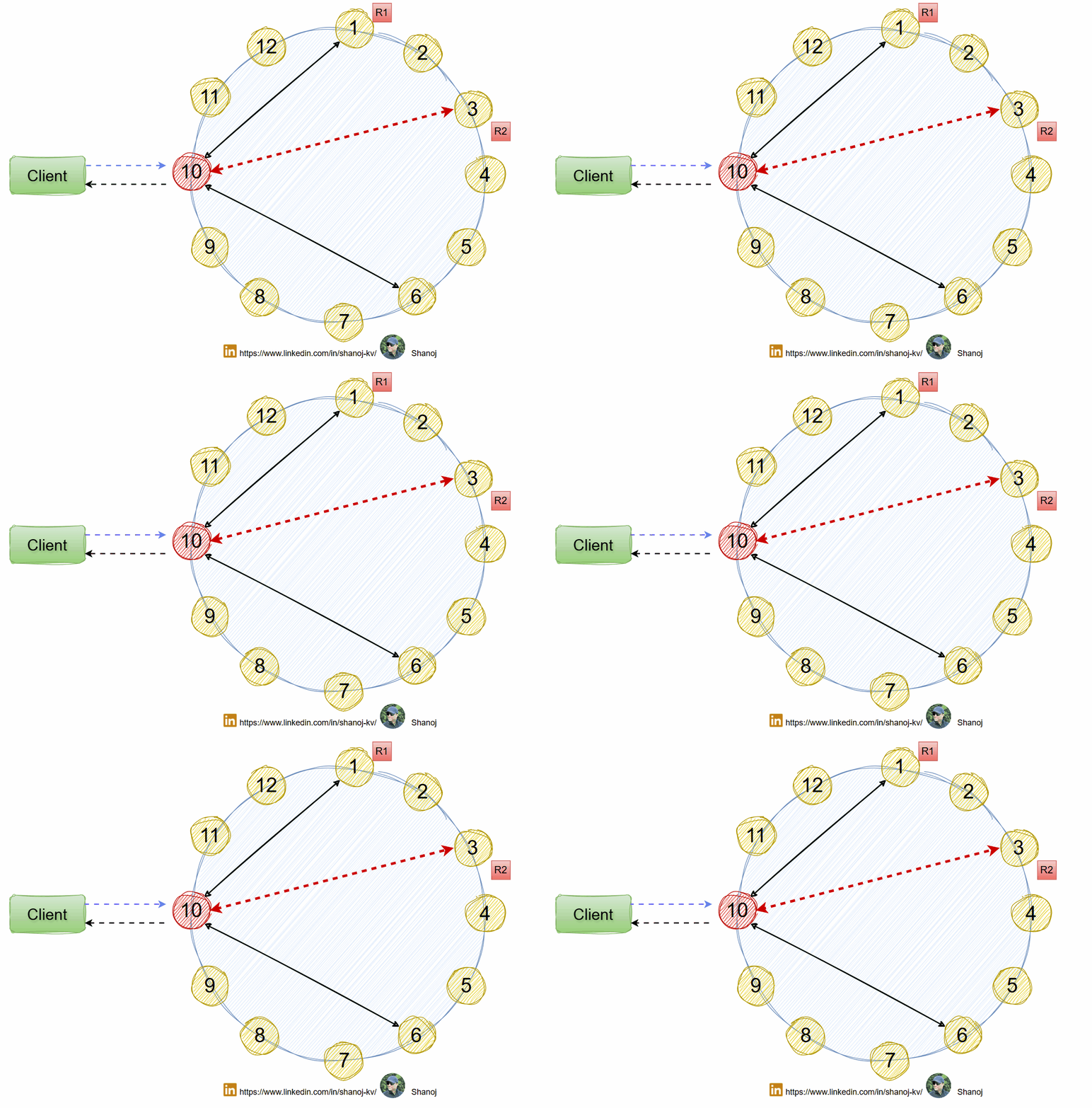
Step 2: Write Operation

This diagram demonstrates the quorum-based write operation in a distributed healthcare system, where a client (such as a healthcare provider) sends a write request to update a patient’s record. The request is first received by Node 10, which then propagates it to Nodes 1, 3, and 6 to meet the required write quorum. Once these nodes acknowledge the update, Node 10 confirms the write as successful, ensuring the record is consistent across the network. This approach provides high availability and reliability, crucial for maintaining synchronized healthcare data.
  • When a healthcare provider updates a patient’s record at one clinic, the system sends the update to all 5 nodes, but only needs confirmation from a quorum of 3 to commit the change. This allows the system to proceed with the update even if up to 2 nodes are unavailable, ensuring high availability and resilience.

Step 3: Read Operation

This diagram illustrates the quorum-based read operation process. When Clinic B (Node 2) requests a patient’s record, it sends a read request to a quorum of nodes, including Nodes 1, 3, and 4. Each of these nodes responds with a confirmed record. Once the read quorum (R=3) is met, Clinic B displays a consistent and synchronized patient record to the user. This visual effectively demonstrates the quorum confirmation needed for consistent reads across a distributed network of healthcare clinics.
  • When a clinic requests a patient record, it retrieves data from a quorum of 3 nodes. If there are any discrepancies between nodes, the system reconciles differences and provides the most recent data. This guarantees that the clinic sees an accurate and synchronized patient record, even if some nodes lag slightly behind.

Quorum-Based Synchronization Across Clinics

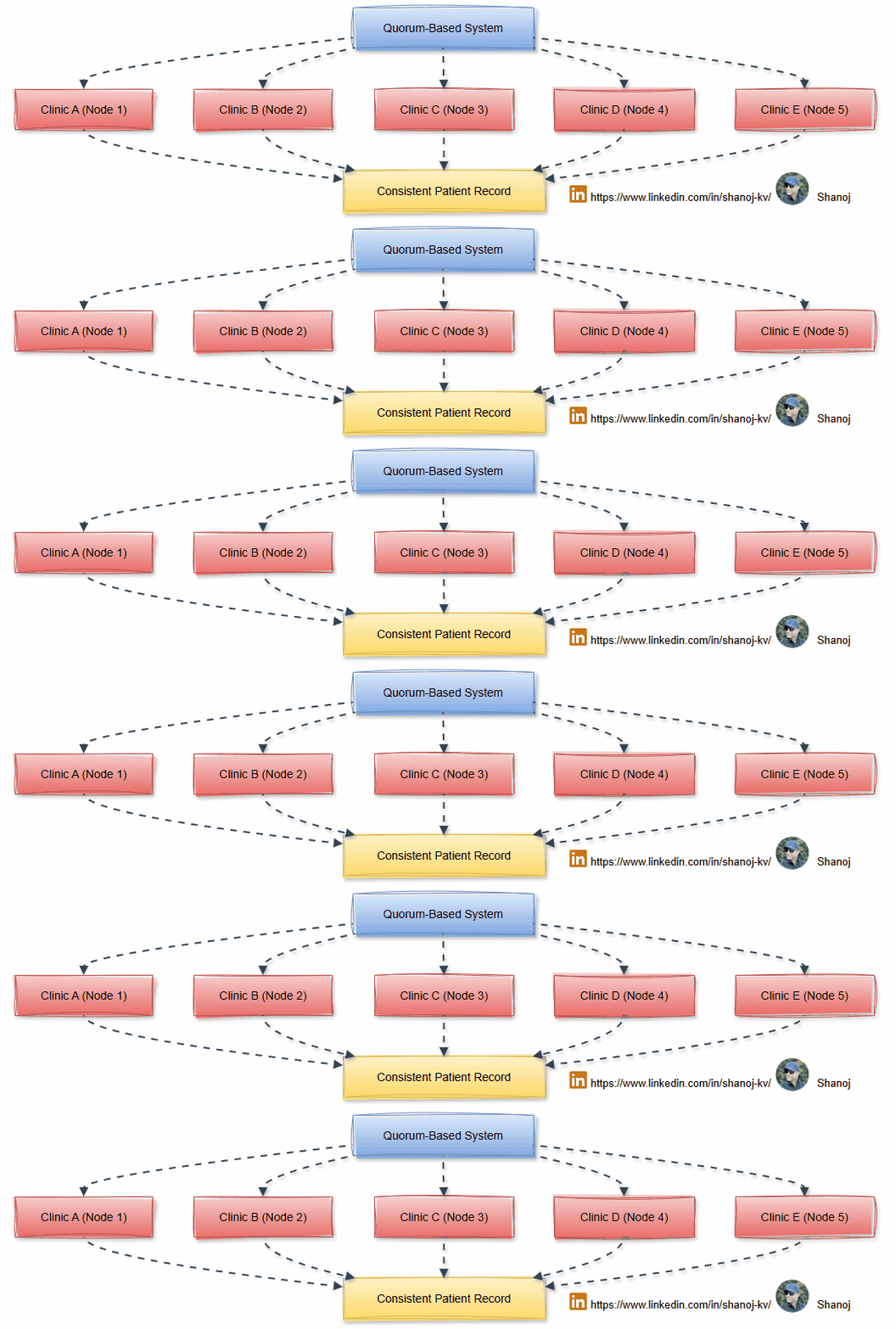
This diagram provides an overview of the quorum-based system in a distributed healthcare environment. It shows how multiple clinics (Nodes 1 through 5) interact with the quorum-based system to maintain a consistent patient record across locations.

Advantages of Quorum-Based Reads and Writes

  1. Consistent Patient Records: By configuring a quorum that intersects read and write operations, patient data remains synchronized across all locations. This avoids discrepancies and ensures that every healthcare provider accesses the most recent data.
  2. Fault Tolerance: Since the system requires only a quorum of nodes to confirm each operation, it can continue functioning even if a few nodes fail or are temporarily unreachable. This redundancy is crucial for systems where data access cannot be interrupted.
  3. Optimized Performance: By allowing reads and writes to complete once a quorum is met (rather than waiting for all nodes), the system improves responsiveness without compromising data accuracy.

Practical Considerations and Trade-Offs

While quorum-based reads and writes offer significant benefits, some trade-offs are inherent to the approach:

  • Latency Impacts: Larger quorums may introduce slight delays, as more nodes must confirm each read and write.
  • Staleness Risk: If a read quorum doesn’t intersect with the latest write quorum, there’s a minor chance of reading outdated data.
  • Operational Complexity: Configuring optimal quorum values (R and W) for a system’s specific requirements can be challenging, especially when balancing high availability and low latency.

Eventual Consistency and Quorum-Based Synchronization

Quorum-based reads and writes support eventual consistency by ensuring that all updates eventually propagate to every node. This means that even if there’s a temporary delay, patient data will be consistent across all nodes within a short period. For healthcare systems spanning multiple regions, this approach maintains high availability while ensuring accuracy across all locations.


The Quorum-Based Reads and Writes pattern is a powerful approach to ensuring data consistency in distributed systems. For healthcare networks, this pattern provides a practical way to synchronize patient records across multiple locations, delivering accurate, reliable, and readily available information. By configuring read and write quorums, healthcare organizations can maintain data integrity and consistency, supporting better patient care and enhanced decision-making across their network.

Stackademic 🎓

Thank you for reading until the end. Before you go:

ML Algorithms for Clustering: K-Means, Hierarchical, & DBSCAN

Clustering algorithms are essential for data analysis and serve as a fundamental tool in areas such as customer segmentation, image processing, and anomaly detection. In this guide, we will explore three popular clustering algorithms: K-Means, Hierarchical clustering, and DBSCAN. We will break down how each algorithm functions, discuss its strengths and limitations, and provide real-world use cases for each.

K-Means Clustering

K-Means is a highly efficient algorithm known for its simplicity and scalability, making it one of the most widely used clustering methods. Here’s a quick rundown of how it works and where it excels:

How K-Means Works

  1. Choose the Number of Clusters (K): You start by selecting how many clusters, or groupings, you want to form.
  2. Initialize Centroids Randomly: Initial centroids are randomly placed, and they serve as the “centers” of each cluster.
  3. Assign Points to Nearest Centroid: Each data point is assigned to the centroid it’s closest to, forming a preliminary cluster.
  4. Recalculate Centroids: Centroids are updated based on the mean position of points in each cluster.
  5. Repeat Until Convergence: Steps 3 and 4 continue iteratively until clusters stabilize.

Advantages of K-Means

  • Simple and Fast: Easy to implement and computationally efficient, even for large datasets.
  • Scales Well: Performs well in high-dimensional data spaces.
  • Tight Clustering: Produces compact, spherical clusters.

Disadvantages of K-Means

  • Requires Setting K: You need to pre-specify the number of clusters, which can be challenging.
  • Sensitive to Initial Placement: Starting points can affect final clusters.
  • Assumes Spherical Shapes: Struggles with non-circular clusters.
  • Outlier Sensitivity: Outliers can skew centroid positions, reducing accuracy.

K-Means Use Cases

  • Customer Segmentation: Grouping customers by purchasing behavior.
  • Image Compression: Reducing image complexity by clustering similar pixel colors.
  • Document Clustering: Organizing documents by similarity in content.
  • Anomaly Detection: Identifying outliers in financial or medical data.

Hierarchical Clustering

Hierarchical clustering creates a nested, tree-like structure (or dendrogram) of clusters, offering multiple levels of detail and making it ideal for data that benefits from hierarchical relationships.

Types of Hierarchical Clustering

  • Agglomerative (Bottom-Up): Begins with each data point as its own cluster and progressively merges clusters.
  • Divisive (Top-Down): Starts with all data in one cluster, then splits clusters recursively.

How Agglomerative Hierarchical Clustering Works

  1. Treat Each Point as a Cluster: Begin with each data point as its own cluster.
  2. Calculate Cluster Distances: Compute distances between all clusters.
  3. Merge Closest Clusters: Find and merge the two closest clusters.
  4. Update the Distance Matrix: Recalculate distances with the new clusters.
  5. Repeat Until All Points Are Merged: Continue merging until only one cluster remains.

Advantages of Hierarchical Clustering

  • No Pre-Specified K: You don’t need to set a fixed number of clusters in advance.
  • Visualized Structure: Produces a dendrogram, which can help in visualizing data hierarchies.
  • Flexible Cluster Shapes: Handles non-spherical clusters better than K-Means.

Disadvantages of Hierarchical Clustering

  • Computationally Intensive: Not suited for large datasets due to its O(n² log n) complexity.
  • No Undo in Agglomerative: Once merged, clusters can’t be separated in agglomerative methods.
  • Outlier Sensitivity: Sensitive to noise and outliers, potentially impacting structure.

Hierarchical Clustering Use Cases

  • Taxonomies and Phylogenetic Trees: Ideal for biological hierarchies and evolutionary studies.
  • Document Clustering: Groups similar documents with nested subgroups.
  • Social Network Analysis: Reveals nested structures within communities.
  • Gene Expression Analysis: Clusters genes with similar expression patterns.

DBSCAN (Density-Based Spatial Clustering of Applications with Noise)

DBSCAN is a density-based algorithm, making it powerful for discovering clusters of varying shapes and handling noise points as outliers.

How DBSCAN Works

  1. Set Parameters (ε and minPts): Choose an epsilon (ε) distance and a minimum points (minPts) count for density.
  2. Find Neighbor Points: For each point, identify neighboring points within distance ε.
  3. Form New Cluster: If a point has at least minPts neighbors, it forms the core of a new cluster.
  4. Expand Cluster: Add all density-reachable points to the cluster.
  5. Label Noise: Points not meeting density requirements are labeled as noise.

Advantages of DBSCAN

  • Arbitrary Cluster Shapes: Handles clusters of varying shapes and densities.
  • No Pre-Specified K: Automatically determines the number of clusters.
  • Robust to Outliers: Noise points are left out of clusters, reducing skew.

Disadvantages of DBSCAN

  • Sensitive to Parameters: Results depend on careful tuning of ε and minPts.
  • Challenges with High Dimensions: Suffers from the curse of dimensionality.
  • Difficulty with Density Variation: Clusters with different densities can be hard to capture.

DBSCAN Use Cases

  • Spatial Data Analysis: Effective in geographic information systems and spatial analytics.
  • Anomaly Detection: Detects outliers in network traffic and fraud detection.
  • Image Segmentation: Segments images based on density-based grouping of pixels.
  • Network Traffic Analysis: Identifies high-density traffic areas and potential outliers.

Comparative Summary

To help choose the right clustering algorithm, here’s a quick comparison:

When selecting a clustering algorithm, it’s important to consider the characteristics of your data. K-Means works well for spherical clusters, while Hierarchical Clustering uncovers nested relationships within the data. On the other hand, DBSCAN is effective for dealing with irregular shapes and noise. Understanding the strengths of these algorithms can help you leverage clustering as a valuable tool in your data analysis.

Stackademic 🎓

Thank you for reading until the end. Before you go:

Distributed Systems Design Pattern: Fixed Partitions [Retail Banking’s Account Management &…

In retail banking, where high-frequency activities like customer account management and transaction processing are essential, maintaining data consistency and ensuring efficient access are paramount. A robust approach to achieve this involves the Fixed Partitions design pattern, which stabilizes data distribution across nodes, allowing the system to scale effectively without impacting performance. Here’s how this pattern enhances retail banking by ensuring reliable access to customer account data and transactions.

Problem:

As banking systems grow, they face the challenge of managing more customer data, transaction histories, and real-time requests across a larger infrastructure. Efficient data handling in such distributed systems requires:

  1. Even Data Distribution: Data must be evenly spread across nodes to prevent any single server from becoming a bottleneck.
  2. Predictable Mapping: There should be a way to determine the location of data for quick access without repeatedly querying multiple nodes.

Consider a system where each customer account is identified by an ID and mapped to a node through hashing. If we start with a cluster of three nodes, the initial assignment might look like this:

As the customer base grows, the bank may need to add more nodes. When new nodes are introduced, the data mapping would normally change for almost every account due to the recalculated node index, requiring extensive data movement across servers. With a new cluster size of five nodes, the mapping would look like this:

Such reshuffling not only disrupts data consistency but also impacts the system’s performance.


Solution: Fixed Partitions with Logical Partitioning

The Fixed Partitions approach addresses these challenges by establishing a predefined number of logical partitions. These partitions remain constant even as physical servers are added or removed, thus ensuring data stability and consistent performance. Here’s how it works:

  1. Establishing Fixed Logical Partitions:
    The system is initialized with a fixed number of logical partitions, such as 8 partitions. These partitions remain constant, ensuring that the mapping of data does not change. Each account or transaction is mapped to one of these partitions using a hashing algorithm, making data-to-partition assignments permanent.
  2. Stabilized Data Mapping:
    Since each account ID is mapped to a specific partition that does not change, the system maintains stable data mapping. This stability prevents large-scale data reshuffling, even as nodes are added, allowing each customer’s data to remain easily accessible.
  3. Adjustable Partition Distribution Across Servers:
    When the bank’s infrastructure scales by adding new nodes, only the assignment of partitions to servers changes. This means the data itself doesn’t move, only the server responsible for managing each partition. As new nodes are added, they inherit portions of the existing partitions, reducing the amount of data that needs to migrate.
  4. Balanced Load Distribution:
    By distributing partitions evenly, the load is balanced across nodes. As additional nodes are introduced, only certain partitions are reassigned, which prevents overloading any single node, maintaining consistent performance across the system.

Example of Fixed Partitions:

Here’s a demonstration of how Fixed Partitions can be applied in a retail banking context, showing the stability of data mapping even as nodes are scaled.

Explanation of Each Column:

  • Account ID: Represents individual customer accounts, each with a unique ID.
  • Assigned Partition (Fixed): Each account ID is permanently mapped to a logical partition, which remains fixed regardless of changes in the cluster size.
  • Initial Server Assignment: Partitions are initially distributed across the original three nodes (Node A, Node B, Node C).
  • Server Assignment After Scaling: When two new nodes (Node D and Node E) are added, the system simply reassigns certain partitions to these new nodes. Importantly, the account-to-partition mapping remains unchanged, so data movement is minimized.

This setup illustrates that, by fixing partitions, the system can expand without redistributing the actual data, ensuring stable access and efficient performance.

Stackademic 🎓

Thank you for reading until the end. Before you go:

Distributed Systems Design Pattern: Consistent Core [Insurance Use Case]

In the insurance industry, managing large volumes of data and critical operations such as policy management, claims processing, and premium adjustments requires high consistency, fault tolerance, and performance. When dealing with distributed systems, ensuring that data remains consistent across nodes can be challenging, especially when operations must be fault-tolerant. As these systems grow, maintaining strong consistency becomes increasingly complex. This is where the Consistent Core design pattern becomes essential.

Problem: Managing Consistency in Large Insurance Data Clusters

As insurance companies scale, they need to handle more customer data, policy updates, and claims across distributed systems. Larger clusters of servers are necessary to manage the massive amounts of data, but these clusters also need to handle critical operations that require strong consistency and fault tolerance, such as processing claims, updating policies, and managing premium adjustments.

Problem Example:

Take the example of an insurance company, InsureX, which handles thousands of claims, policies, and customer data across a large distributed system. Let’s say a customer submits a claim:

  • The claim is submitted to the system, and it must be replicated across several nodes responsible for policyholder data, claims processing, and financial information.
  • The system relies on quorum-based algorithms to ensure all nodes have consistent information before processing the claim. However, as the system grows and the number of nodes increases, the performance degrades due to the time it takes for all nodes to reach consensus.
  • As a result, InsureX experiences slower performance in claims processing, delays in policy updates, and overall dissatisfaction among policyholders.

In larger systems, quorum-based algorithms introduce delays, especially when a majority of nodes must agree before an operation is completed. This makes the system inefficient when dealing with high transaction volumes, as seen in large insurance data clusters. So, how do we ensure strong consistency and maintain high performance as the system scales?

Solution: Implementing a Consistent Core

The Consistent Core design pattern solves this problem by creating a smaller cluster (usually 3 to 5 nodes) that handles key tasks requiring strong consistency. This smaller cluster is responsible for ensuring consistency in operations such as policy updates, claims processing, and premium adjustments, while the larger cluster handles bulk data processing.

Solution Example:

In the InsureX example, the company implements a small, consistent core to handle the critical tasks, separating the heavy data processing load from the operations that require strong consistency. Here’s how it works:

Consistent Core for Metadata Management:

  • The small consistent core handles tasks like claims updates, policyholder data, and premium adjustments. This cluster ensures that operations needing strong consistency (such as policy renewals) are processed without waiting for the entire cluster to reach consensus.

Separation of Data and Metadata:

  • The large cluster continues to handle the bulk of data processing, including the storage of customer records, claims history, and financial transactions. The consistent core ensures that metadata-related tasks, like updating claims status or policyholder information, are consistent across the system.

Fault Tolerance:

  • The consistent core uses quorum-based algorithms to ensure that even if one or two nodes fail, the system can continue to process critical tasks such as claims approvals or policy renewals.

By offloading these critical consistency tasks to a smaller cluster, InsureX ensures that policy updates, claims processing, and premium calculations are completed reliably and efficiently, without relying on the performance-degrading quorum consensus across the entire system.

Using Quorum-Based Algorithms in Claims Processing

One key area where the Consistent Core pattern shines is in claims processing. When a customer files a claim, the system must ensure the information is replicated accurately across nodes responsible for financial calculations, policyholder data, and claim approvals.

Example:

Let’s say a customer submits an accident claim. The system processes this claim by sending it to multiple nodes, and a majority quorum must confirm the claim before it is approved. The system tracks how many nodes confirm the claim and waits until at least two of the three relevant nodes agree.

  • Node 1 (Financial Calculations) agrees on the claim.
  • Node 2 (Policyholder Data) agrees on the claim.
  • Node 3 (Claims Approval) delays its response.

Once a quorum is reached, the claim is processed and approved.

This ensures that claims are processed efficiently and consistently, even if some nodes are delayed or experiencing issues. The Consistent Core ensures that these critical tasks are handled without compromising performance.

Using Leases for Premium Adjustments

Another practical application of the Consistent Core pattern is in premium adjustments and policy renewals. The system can use leases to temporarily manage premium adjustment operations across the distributed system.

Example:

When a large-scale premium adjustment is needed, the Consistent Core temporarily “holds a lease” over the operation. This allows the core to coordinate premium adjustments, ensuring that all related operations are synchronized across the system. Once the adjustment is completed, the lease is released.

The lease mechanism ensures that complex operations like premium adjustments are handled smoothly, without requiring quorum-based decisions across the entire cluster. This reduces operational delays and ensures consistency.


In a distributed insurance system where handling vast amounts of data efficiently and consistently is essential, the Consistent Core pattern provides an ideal solution. By separating the management of critical metadata and operations from the bulk data processing, the insurance company can ensure that operations such as policy updates, claims processing, and premium adjustments are completed quickly, accurately, and consistently.

Stackademic 🎓

Thank you for reading until the end. Before you go:

Distributed Systems Design Pattern: Request Waiting List [Capital Markets Use Case]

Problem Statement:

In a distributed capital markets system, client requests like trade executions, settlement confirmations, and clearing operations must be replicated across multiple nodes for consistency and fault tolerance. Finalizing any operation requires confirmation from all nodes or a Majority Quorum.

For instance, when a trade is executed, multiple nodes (such as trading engines, clearing systems, and settlement systems) must confirm the transaction’s key details — such as the trade price, volume, and counterparty information. This multi-node confirmation ensures that the trade is valid and can proceed. These confirmations are critical to maintaining consistency across the distributed system, helping to prevent discrepancies that could result in financial risks, errors, or regulatory non-compliance.

However, asynchronous communication between nodes means responses arrive at different times, complicating the process of tracking requests and waiting for a quorum before proceeding with the operation.

“The following diagram illustrates the problem scenario, where client trade requests are propagated asynchronously across multiple nodes. Each node processes the request at different times, and the system must wait for a majority quorum of responses to proceed with the trade confirmation.”

Solution: Request Waiting List Distributed Design Pattern

The Request Waiting List pattern addresses the challenge of tracking client requests that require responses from multiple nodes asynchronously. It maintains a list of pending requests, with each request linked to a specific condition that must be met before the system responds to the client.

Definition:

The Request Waiting List pattern is a distributed system design pattern used to track client requests that require responses from multiple nodes asynchronously. It maintains a queue of pending requests, each associated with a condition or callback that triggers when the required criteria (such as a majority quorum of responses or a specific confirmation) are met. This ensures that operations are finalized consistently and efficiently, even in systems with asynchronous communication between nodes.

Application in Capital Markets Use Case:

“The flowchart illustrates the process of handling a trade request in a distributed capital markets system using the Request Waiting List pattern. The system tracks each request and waits for a majority quorum of responses before fulfilling the client’s trade request, ensuring consistency across nodes.”

1. Asynchronous Communication in Trade Execution:

  • When a client initiates a trade, the system replicates the trade details across multiple nodes (e.g., order matching systems, clearing systems, settlement systems).
  • These nodes communicate asynchronously, meaning that responses confirming trade details or executing the order may arrive at different times.

2. Tracking with a Request Waiting List:

  • The system keeps a waiting list that maps each trade request to a unique identifier, such as a trade ID or correlation ID.
  • Each request has an associated callback function that checks if the necessary conditions are fulfilled to proceed. For example, the callback may be triggered when confirmation is received from a specific node (such as the clearing system) or when a majority of nodes have confirmed the trade.

3. Majority Quorum for Trade Confirmation:

  • The system waits until a majority quorum of confirmations is received (e.g., more than half of the relevant nodes) before proceeding with the next step, such as executing the trade or notifying the client of the outcome.

4. Callback and High-Water Mark in Settlement:

  • In the case of settlement, the High-Water Mark represents the total number of confirmations required from settlement nodes before marking the transaction as complete.
  • Once the necessary conditions — such as price match and volume confirmation — are satisfied, the callback is invoked. The system then informs the client that the trade has been successfully executed or settled.

This approach ensures that client requests in capital markets systems are efficiently tracked and processed, even in the face of asynchronous communication. By leveraging a waiting list and majority quorum, the system ensures that critical operations like trade execution and settlement are handled accurately and consistently.

Stackademic 🎓

Thank you for reading until the end. Before you go:

Distributed Systems Design Pattern: Clock-Bound Wait with Banking Use Case

The following diagram provides a complete overview of how the Clock-Bound Wait pattern ensures consistent transaction processing across nodes. Node A processes a transaction and waits for 20 milliseconds to account for clock skew before committing the transaction. Node B, which receives a read request, waits for its clock to catch up before reading and returning the updated value.

In distributed banking systems, ensuring data consistency across multiple nodes is critical, especially when transactions are processed across geographically dispersed regions. One major challenge is that system clocks on different nodes may not always be synchronized, leading to inconsistent data when updates are propagated at different times. The Clock-Bound Wait pattern addresses these clock discrepancies and ensures that data is consistently ordered across all nodes.

The Problem: Time Discrepancies and Data Inconsistency

In a distributed banking system, when customer transactions such as deposits and withdrawals are processed, the local node handling the transaction uses its system clock to timestamp the operation. If the system clocks of different nodes are not perfectly aligned, it may result in inconsistencies when reading or writing data. For instance, Node A may process a transaction at 10:00 AM, but Node B, whose clock is lagging, could still show the old account balance because it hasn’t yet caught up to Node A’s time. This can lead to confusion and inaccuracies in customer-facing data.

As seen in the diagram below, the clocks of various nodes in a distributed system may not be perfectly synchronized. Even a small time difference, known as clock skew, can cause nodes to process transactions at different times, resulting in data inconsistency.

Clock-Bound Wait: Ensuring Correct Ordering of Transactions

To solve this problem, the Clock-Bound Wait pattern introduces a brief waiting period when processing transactions to ensure that all nodes have advanced past the timestamp of the transaction being written or read. Here’s how it works:

Maximum Clock Offset: The system first calculates the maximum time difference, or offset, between the fastest and slowest clocks across all nodes. For example, if the maximum offset is 20 milliseconds, this value is used as the buffer for synchronizing data.

Waiting to Guarantee Synchronization: When Node A processes a transaction, it waits for a period (based on the maximum clock offset) to ensure that all other nodes have moved beyond the transaction’s timestamp before committing the change. For example, if Node A processes a transaction at 10:00 AM, it will wait for 20 milliseconds to ensure that all nodes’ clocks are past 10:00 AM before confirming the transaction.

The diagram illustrates how a transaction is processed at Node A, with a controlled wait for 20 milliseconds to allow other nodes (Node B and Node C) to synchronize their clocks before the transaction is committed across all nodes. This ensures that no node processes outdated or incorrectly ordered transactions.

Consistent Reads and Writes: The same waiting mechanism is applied when reading data. If a node receives a read request but its clock is behind the latest transaction timestamp, it waits for its clock to synchronize before returning the correct, updated data.

The diagram illustrates how a customer request for an account balance is handled. Node B, with a clock lagging behind Node A, must wait for its clock to synchronize before returning the updated balance, ensuring that the customer sees the most accurate data.

Eventual Consistency Without Significant Delays: Although the system introduces a brief wait period to account for clock discrepancies, the Clock-Bound Wait pattern allows the system to remain eventually consistent without significant delays in transaction processing. This ensures that customers experience up-to-date information without noticeable latency.

The diagram below demonstrates how regional nodes in different locations (North America, Europe, and Asia) wait for clock synchronization to ensure that transaction updates are consistent across the entire system. Once the clocks are in sync, final consistency is achieved across all regions.

Application in Banking Systems

In a distributed banking system, the Clock-Bound Wait pattern ensures that account balances and transaction histories remain consistent across all nodes. When a customer performs a transaction, the system guarantees that the updated balance is visible across all nodes after a brief wait period, regardless of clock discrepancies. This prevents situations where one node shows an outdated balance while another node shows the updated balance.


The Clock-Bound Wait pattern is a practical solution for managing clock discrepancies in distributed banking systems. By introducing a brief wait to synchronize clocks across nodes, the pattern ensures that transactions are consistently ordered and visible, maintaining data accuracy without significant performance overhead. This approach is particularly valuable in high-stakes industries like banking, where consistency and reliability are paramount.

Stackademic 🎓

Thank you for reading until the end. Before you go: