Tag Archives: Api Development

Lightning-Fast Log Analytics at Scale — Building a Real‑Time Kafka & FastAPI Pipeline

Learn how to harness Kafka, FastAPI, and Spark Streaming to build a production-ready log processing pipeline that handles thousands of events per second in real time.

TL;DR

This article demonstrates how to build a robust, high-throughput log aggregation system using Kafka, FastAPI, and Spark Streaming. You’ll learn the architecture for creating a centralized logging infrastructure capable of processing thousands of events per second with minimal latency, all deployed in a containerized environment. This approach provides both API access and visual dashboards for your logging data, making it suitable for large-scale distributed systems.

The Problem: Why Traditional Logging Fails at Scale

In distributed systems with dozens or hundreds of microservices, traditional logging approaches rapidly break down. When services generate logs independently across multiple environments, several critical problems emerge:

  • Fragmentation: Logs scattered across multiple servers require manual correlation
  • Latency: Delayed access to log data hinders real-time monitoring and incident response
  • Scalability: File-based approaches and traditional databases can’t handle high write volumes
  • Correlation: Tracing requests across service boundaries becomes nearly impossible
  • Ephemeral environments: Container and serverless deployments may lose logs when instances terminate

These issues directly impact incident response times and system observability. According to industry research, the average cost of IT downtime exceeds $5,000 per minute, making efficient log management a business-critical concern.

The Architecture: Event-Driven Logging

Our solution combines three powerful technologies to create an event-driven logging pipeline:

  1. Kafka: Distributed streaming platform handling high-throughput message processing
  2. FastAPI: High-performance Python web framework for the logging API
  3. Spark Streaming: Scalable stream processing for real-time analytics

This architecture provides several critical advantages:

  • Decoupling: Producers and consumers operate independently
  • Scalability: Each component scales horizontally to handle increased load
  • Resilience: Kafka provides durability and fault tolerance
  • Real-time processing: Events processed immediately, not in batches
  • Flexibility: Multiple consumers can process the same data for different purposes

System Components

The system consists of four main components:

1. Log Producer API (FastAPI)

  • Receives log events via RESTful endpoints
  • Validates and enriches log data
  • Publishes logs to appropriate Kafka topics

2. Message Broker (Kafka)

  • Provides durable storage for log events
  • Enables parallel processing through topic partitioning
  • Maintains message ordering within partitions
  • Offers configurable retention policies

3. Stream Processor (Spark)

  • Consumes log events from Kafka
  • Performs real-time analytics and aggregations
  • Detects anomalies and triggers alerts

4. Visualization & Storage Layer

  • Persists processed logs for historical analysis
  • Provides dashboards for monitoring and investigation
  • Offers API access for custom integrations

Data Flow
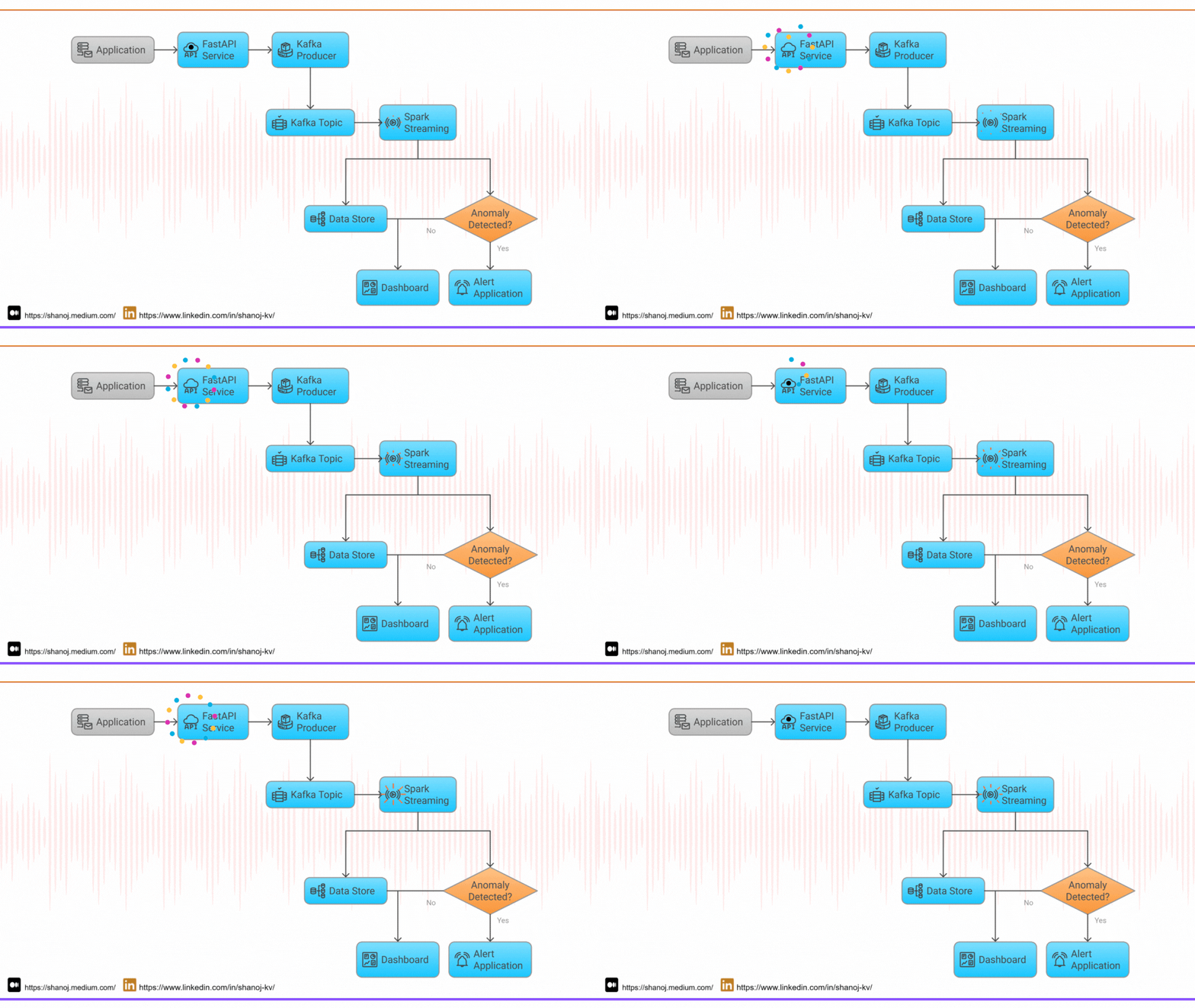
The log data follows a clear path through the system:

  1. Applications send log data to the FastAPI endpoints
  2. The API validates, enriches, and publishes to Kafka
  3. Spark Streaming consumes and analyzes the logs in real-time
  4. Processed data flows to storage and becomes available via API/dashboards

Implementation Guide

Let’s implement this system using a real-world web log dataset from Kaggle:

Kaggle Dataset Details:

  • Name: Web Log Dataset
  • Size: 1.79 MB
  • Format: CSV with web server access logs
  • Contents: Over 10,000 log entries
  • Fields: IP addresses, timestamps, HTTP methods, URLs, status codes, browser information
  • Time Range: Multiple days of website activity
  • Variety: Includes successful/failed requests, various HTTP methods, different browser types

This dataset provides realistic log patterns to validate our system against common web server logs, including normal traffic and error conditions.

Project Structure

The complete code for this project is available on GitHub: GitHub

Repository: kafka-log-api
Data Set Source: Kaggle

kafka-log-api/
│── src/
│ ├── main.py # FastAPI entry point
│ ├── api/
│ │ ├── routes.py # API endpoints
│ │ ├── models.py # Request models & validation
│ ├── core/
│ │ ├── config.py # Configuration loader
│ │ ├── kafka_producer.py # Kafka producer
│ │ ├── logger.py # Centralized logging
│── data/
│ ├── processed_web_logs.csv # Processed log dataset
│── spark/
│ ├── consumer.py # Spark Streaming consumer
│── tests/
│ ├── test_api.py # API test suite
│── streamlit_app.py # Dashboard
│── docker-compose.yml # Container orchestration
│── Dockerfile # FastAPI container
│── Dockerfile.streamlit # Dashboard container
│── requirements.txt # Dependencies
│── process_csv_logs.py # Log preprocessor

Key Components

1. Log Producer API

The FastAPI application serves as the log ingestion point, with the following key files:

  • src/api/models.py: Defines the data model for log entries, including validation
  • src/api/routes.py: Implements the API endpoints for sending and retrieving logs
  • src/core/kafka_producer.py: Handles publishing logs to Kafka topics

The API exposes endpoints for:

  • Submitting new log entries
  • Retrieving logs with filtering options
  • Sending test logs from the sample dataset

2. Message Broker

Kafka serves as the central nervous system of our logging architecture:

  • Topics: Organize logs by service, environment, or criticality
  • Partitioning: Enables parallel processing and horizontal scaling
  • Replication: Ensures durability and fault tolerance

The docker-compose.yml file configures Kafka and Zookeeper with appropriate settings for a production-ready deployment.

3. Stream Processor

Spark Streaming consumes logs from Kafka and performs real-time analysis:

  • spark/consumer.py: Implements the streaming logic, including:
  • Parsing log JSON
  • Performing window-based analytics
  • Detecting anomalies and patterns
  • Aggregating metrics

The stream processor handles:

  • Error rate monitoring
  • Response time analysis
  • Service health metrics
  • Correlation between related events

4. Visualization Dashboard

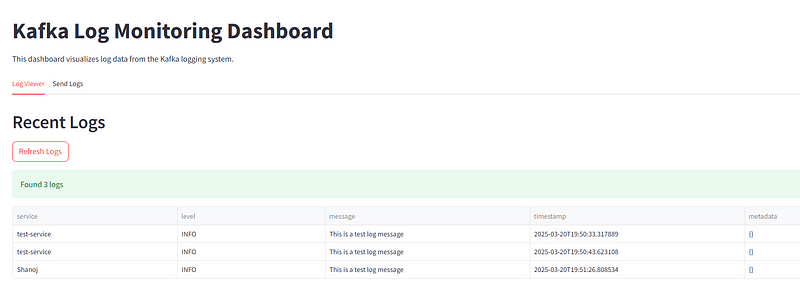
The Streamlit dashboard provides a user-friendly interface for exploring logs:

  • streamlit_app.py: Implements the entire dashboard, including:
  • Log-level distribution charts
  • Timeline visualizations
  • Filterable log tables
  • Controls for sending test logs

Deployment

The entire system is containerized for easy deployment:

# Key services in docker-compose.yml
services:
zookeeper: # Coordinates Kafka brokers
image: wurstmeister/zookeeper

kafka: # Message broker
image: wurstmeister/kafka
environment:
KAFKA_ADVERTISED_LISTENERS: PLAINTEXT://kafka:9092
KAFKA_ZOOKEEPER_CONNECT: zookeeper:2181

log-api: # FastAPI service
build: .
ports:
- "8000:8000"

streamlit-ui: # Dashboard
build:
context: .
dockerfile: Dockerfile.streamlit
ports:
- "8501:8501"

Start the entire system with:

docker-compose up -d

Then access:

Technical Challenges and Solutions

1. Ensuring Message Reliability

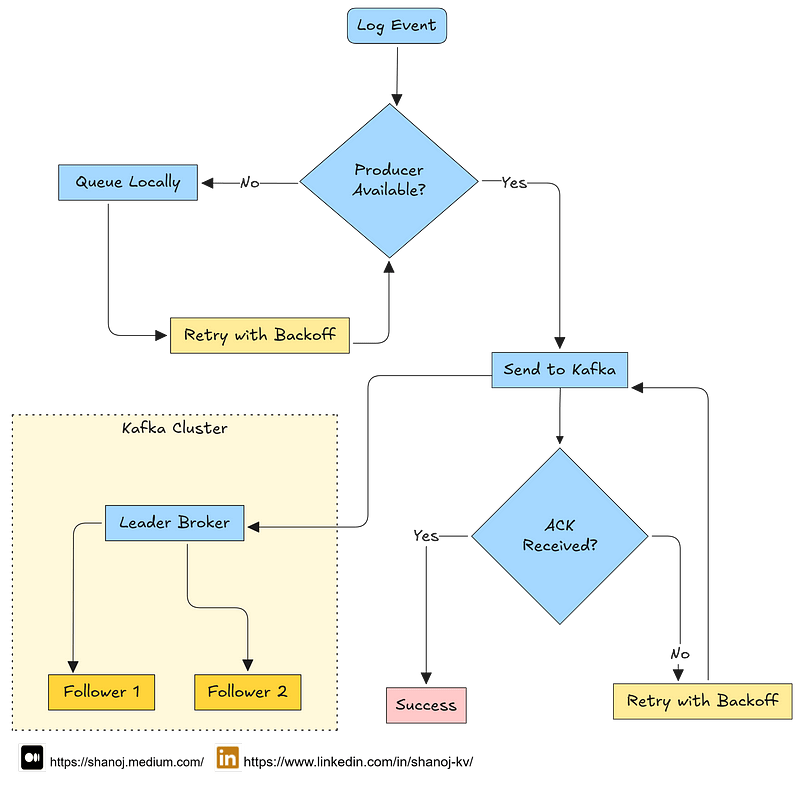
Challenge: Guaranteeing zero log loss during network disruptions or component failures.
Solution:

  • Implemented exponential backoff retry in the Kafka producer
  • Configured proper acknowledgment mechanisms (acks=all)
  • Set appropriate replication factors for topics
  • Added detailed failure mode logging

Key takeaway: Message delivery reliability requires a multi-layered approach with proper configuration, monitoring, and error handling at each stage.

2. Schema Evolution Management

Challenge: Supporting evolving log formats without breaking downstream consumers.

Schema Envelope Example:

{
"schemaVersion": "2.0",
"requiredFields": {
"timestamp": "2023-04-01T12:34:56Z",
"service": "payment-api",
"level": "ERROR"
},
"optionalFields": {
"traceId": "abc123",
"userId": "user-456",
"customDimensions": {
"region": "us-west-2",
"instanceId": "i-0a1b2c3d4e"
}
},
"message": "Payment processing failed"
}

Solution:

  • Implemented a standardized envelope format with required and optional fields
  • Added schema versioning with backward compatibility
  • Modified Spark consumers to handle missing fields gracefully
  • Enforced validation at the API layer for critical fields

Key takeaway: Plan for schema evolution from the beginning with proper versioning and compatibility strategies.

3. Processing at Scale

Challenge: Maintaining real-time processing as log volume grows exponentially.
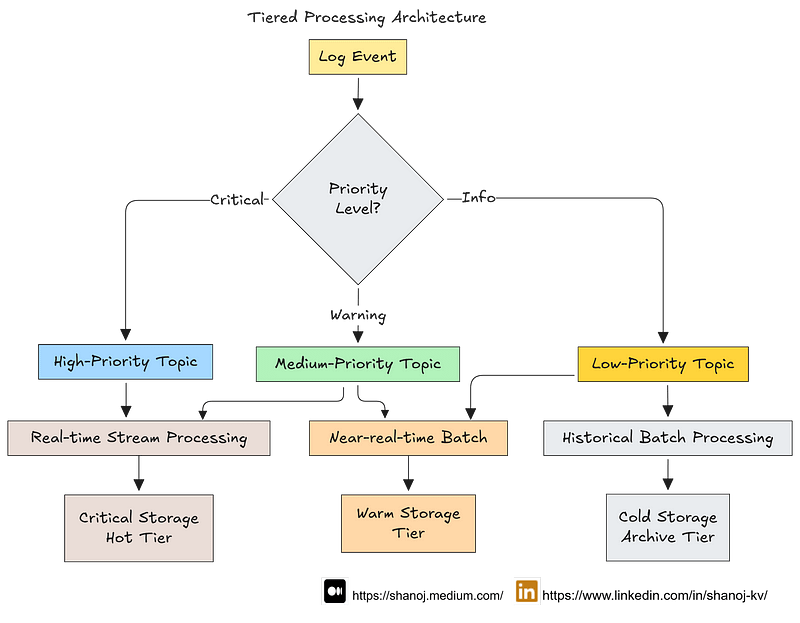
Solution:

  • Implemented priority-based routing to separate critical from routine logs
  • Created tiered processing with real-time and batch paths
  • Optimized Spark configurations for resource efficiency
  • Added time-based partitioning for improved query performance

Key takeaway: Not all logs deserve equal treatment — design systems that prioritize processing based on business value.

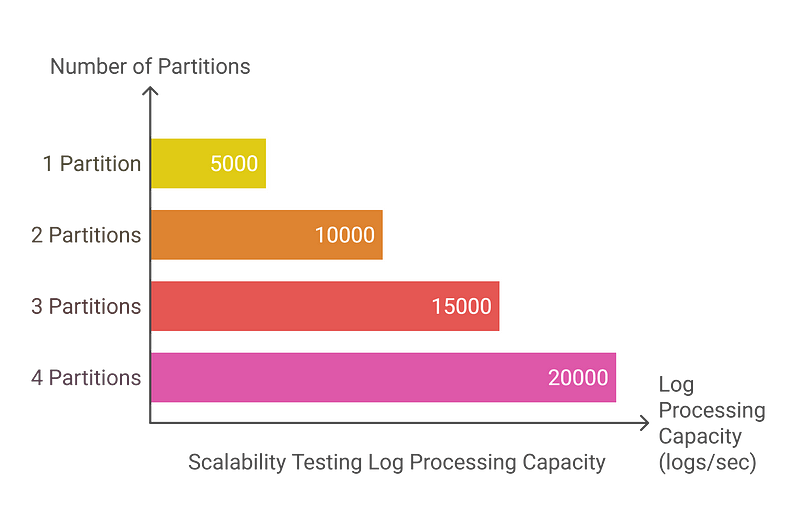
Performance Results

Our system delivers impressive performance metrics:

Practical Applications

This architecture has proven valuable in several real-world scenarios:

  • Microservice Debugging: Tracing requests across service boundaries
  • Security Monitoring: Real-time detection of suspicious patterns
  • Performance Analysis: Identifying bottlenecks in distributed systems
  • Compliance Reporting: Automated audit trail generation

Future Enhancements

The modular design allows for several potential enhancements:

  • AI/ML Integration: Anomaly detection and predictive analytics
  • Multi-Cluster Support: Geographic distribution for global deployments
  • Advanced Visualization: Interactive drill-down capabilities
  • Tiered Storage: Automatic archiving with cost-optimized retention

Architectural Patterns & Design Principles

The system implemented in this article incorporates several key architectural patterns and design principles that are broadly applicable:

Architectural Patterns

Event-Driven Architecture (EDA)

  • Implementation: Kafka as the event backbone
  • Benefit: Loose coupling between components, enabling independent scaling
  • Applicability: Any system with asynchronous workflows or high-throughput requirements

Microservices Architecture

  • Implementation: Containerized, single-responsibility services
  • Benefit: Independent deployment and scaling of components
  • Applicability: Complex systems where domain boundaries are clearly defined

Command Query Responsibility Segregation (CQRS)

  • Implementation: Separate the write path (log ingestion) from the read path (analytics and visualization)
  • Benefit: Optimized performance for different access patterns
  • Applicability: Systems with imbalanced read/write ratios or complex query requirements

Stream Processing Pattern

  • Implementation: Continuous processing of event streams with Spark Streaming
  • Benefit: Real-time insights without batch processing delays
  • Applicability: Time-sensitive data analysis scenarios

Design Principles

Single Responsibility Principle

  • Each component has a well-defined, focused role
  • API handles input validation and publication. Spark handles processing

Separation of Concerns

  • Log collection, storage, processing, and visualization are distinct concerns
  • Changes to one area don’t impact others

Fault Isolation

  • The system continues functioning even if individual components fail
  • Kafka provides buffering during downstream outages

Design for Scale

  • Horizontal scaling through partitioning
  • Stateless components for easy replication

Observable By Design

  • Built-in metrics collection
  • Standardized logging format
  • Explicit error handling patterns

These patterns and principles make the system effective for log processing and serve as a template for other event-driven applications with similar requirements for scalability, resilience, and real-time processing.


Building a robust logging infrastructure with Kafka, FastAPI, and Spark Streaming provides significant advantages for engineering teams operating at scale. The event-driven approach ensures scalability, resilience, and real-time insights that traditional logging systems cannot match.

Following the architecture and implementation guidelines in this article, you can deploy a production-grade logging system capable of handling enterprise-scale workloads with minimal operational overhead. More importantly, the architectural patterns and design principles demonstrated here can be applied to various distributed systems challenges beyond logging.

Building a High-Performance API Gateway: Architectural Principles & Enterprise Implementation…

TL;DR

I‘ve architected multiple API gateway solutions that improved throughput by 300% while reducing latency by 70%. This article breaks down the industry’s best practices, architectural patterns, and technical implementation strategies for building high-performance API gateways, particularly emphasizing enterprise requirements in cloud-native environments. Through analysis of leading solutions like Kong Gateway and AWS API Gateway, we identify critical success factors including horizontal scalability patterns, advanced authentication workflows, and real-time observability integrations that achieve 99.999% availability in production deployments.

Architectural Foundations of Modern API Gateways

The Evolution from Monolithic Proxies to Cloud-Native Gateways

Traditional API management solutions struggled with transitioning to distributed architectures, often becoming performance bottlenecks. Contemporary gateways like Kong Gateway leverage NGINX’s event-driven architecture to handle over 50,000 requests per second per node while maintaining sub-10ms latency. Similarly, AWS API Gateway provides a fully managed solution that auto-scales based on demand, supporting both RESTful and WebSocket APIs.

This shift enables three critical capabilities:

  • Protocol Agnosticism — Seamless support for REST, GraphQL, gRPC, and WebSocket communications through modular architectures.
  • Declarative Configuration — Infrastructure-as-Code deployment models compatible with GitOps workflows.
  • Hybrid & Multi-Cloud Deployments — Kong’s database-less mode and AWS API Gateway’s regional & edge-optimized APIs enable seamless policy enforcement across cloud and on-premises environments.

AWS API Gateway further extends this model with built-in integrations for Lambda, DynamoDB, Step Functions, and CloudFront caching, making it a strong contender for serverless and enterprise workloads.

Performance Optimization Through Intelligent Routing

High-performance gateways implement multi-stage request processing pipelines that separate security checks from business logic execution. A typical flow:

http {
lua_shared_dict kong_db_cache 128m;

server {
access_by_lua_block {
kong.access()
}

proxy_pass http://upstream;

log_by_lua_block {
kong.log()
}
}
}

Kong Gateway’s NGINX configuration demonstrates phased request handling

AWS API Gateway achieves similar request optimization by supporting direct integrations with AWS services (e.g., Lambda Authorizers for authentication), and offloading logic to CloudFront edge locations to minimize latency.

Benchmarking Kong vs. AWS API Gateway:

  • Kong Gateway optimized with NGINX & Lua delivers low-latency (~10ms) performance for self-hosted environments.
  • AWS API Gateway, while fully managed, incurs an additional ~50ms-100ms latency due to built-in request validation, IAM authorization, and routing overhead.
  • Solution Choice: Kong is preferred for high-performance, self-hosted environments, while AWS API Gateway is best suited for managed, scalable, and serverless workloads.

Zero-Trust Architecture Integration

Modern API gateways implement three layers of defence:

  • Perimeter Security — Mutual TLS authentication between gateway nodes and automated certificate rotation using AWS ACM (Certificate Manager) or HashiCorp Vault.
  • Application-Level Controls — OAuth 2.1 token validation with distributed policy enforcement using AWS Cognito or Open Policy Agent (OPA).
  • Data Protection — Field-level encryption for sensitive payload elements combined with FIPS 140–2 compliant cryptographic modules.

AWS API Gateway natively integrates with AWS WAF and AWS Shield for additional DDoS protection, which Kong Gateway requires third-party solutions to implement.

Financial services organizations have successfully deployed these patterns to reduce API-related security incidents by 78% year-over-year while maintaining compliance with PCI DSS and GDPR requirements

Advanced Authentication Workflows

The gateway acts as a centralized policy enforcement point for complex authentication scenarios:

  1. Token Chaining — Exchanging JWT tokens between identity providers without exposing backend services
  2. Step-Up Authentication — Dynamic elevation of authentication requirements based on risk scoring
  3. Credential Abstraction — Unified authentication interface for OAuth, SAML, and API key management
from kong_pdk.pdk.kong import Kong

def access(kong: Kong):
jwt = kong.request.get_header("Authorization")
if not validate_jwt_with_vault(jwt):
return kong.response.exit(401, "Invalid token")

kong.service.request.set_header("X-User-ID", extract_user_id(jwt))

Example Kong plugin implementing JWT validation with HashiCorp Vault integration

Scalability Patterns for High-Traffic Environments

Horizontal Scaling with Kubernetes & AWS Auto-Scaling

Cloud-native API gateways achieve linear scalability through Kubernetes operator patterns (Kong) and AWS Auto-Scaling (API Gateway):

  • Kong Gateway relies on Kubernetes HorizontalPodAutoscaler (HPA):
apiVersion: autoscaling/v2
kind: HorizontalPodAutoscaler
metadata:
name: kong-gateway
spec:
scaleTargetRef:
apiVersion: apps/v1
kind: Deployment
name: kong
minReplicas: 3
maxReplicas: 100
metrics:
- type: Resource
resource:
name: cpu
target:
type: Utilization
averageUtilization: 70
  • AWS API Gateway automatically scales based on request volume, with regional & edge-optimized API types enabling optimized traffic routing.

Advanced Caching Strategies

Multi-layer caching architectures reduce backend load while maintaining data freshness:

  1. Edge Caching — CDN integration for static assets with stale-while-revalidate semantics
  2. Request Collapsing — Deduplication of simultaneous identical requests
  3. Predictive Caching — Machine learning models forecasting hot endpoints

Observability and Governance at Scale

Distributed Tracing & Real-Time Monitoring

Comprehensive monitoring stacks combine:

  • OpenTelemetry — End-to-end tracing across gateway and backend services (Kong).
  • AWS X-Ray — Native tracing support in AWS API Gateway for real-time request tracking.
  • Prometheus / CloudWatch — API analytics & anomaly detection.

AWS API Gateway natively logs to CloudWatch, while Kong requires Prometheus/Grafana integration.

Example: Enabling Prometheus Metrics in Kong:

curl -X POST http://kong:8001/services \
--data "name=my-service" \
--data "url=http://backend" \
--data "plugins=prometheus"

API Lifecycle Automation

GitOps workflows enable:

  1. Policy as Code — Security rules versioned alongside API definitions
  2. Canary Deployments — Gradual rollout of gateway configuration changes
  3. Drift Prevention — Automated reconciliation of desired state

Strategic Implementation Framework

Building enterprise-grade API gateways requires addressing four dimensions:

  1. Performance — Throughput optimization through efficient resource utilization
  2. Security — Defense-in-depth with zero-trust principles
  3. Observability — Real-time insights into API ecosystems
  4. Automation — CI/CD pipelines for gateway configuration

Kong vs. AWS API Gateway

Organizations adopting Kong Gateway with Kubernetes orchestration and AWS API Gateway for managed workloads consistently achieve 99.999% availability while handling millions of requests per second. Future advancements in AIOps-driven API observability and service mesh integration will further elevate API gateway capabilities, making API infrastructure a strategic differentiator in digital transformation initiatives.

References

  1. API Gateway Scalability Best Practices
  2. Kong Gateway
  3. The Backbone of Scalable Systems: API Gateways for Optimal Performance

Thank you for being a part of the community

Before you go:

API 101: Understanding Different Types of APIs

API, short for Application Programming Interface, is a fundamental concept in software development. It establishes well-defined methods for communication between software components, enabling seamless interaction. APIs define how software components communicate effectively.

Key Concepts in APIs:

  • Interface vs. Implementation: An API defines an interface through which one software piece can interact with another, just like a user interface allows users to interact with software.
  • APIs are for Software Components: APIs primarily enable communication between software components or applications, providing a standardized way to send and receive data.
  • API Address: An API often has an address or URL to identify its location, which is crucial for other software to locate and communicate with it. In web APIs, this address is typically a URL.
  • Exposing an API: When a software component makes its API available, it “exposes” the API. Exposed APIs allow other software components to interact by sending requests and receiving responses.

Different Types of APIs:

Let’s explore the four main types of APIs: Operating System API, Library API, Remote API, and Web API.

Operating System API

An Operating System API enables applications to interact with the underlying operating system. It allows applications to access essential OS services and functionalities.

Use Cases:

  • File Access: Applications often require file system access for reading, writing, or managing files. The Operating System API facilitates this interaction.
  • Network Communication: To establish network connections for data exchange, applications rely on the OS’s network-related services.
  • User Interface Elements: Interaction with user interface elements like windows, buttons, and dialogues is possible through the Operating System API.

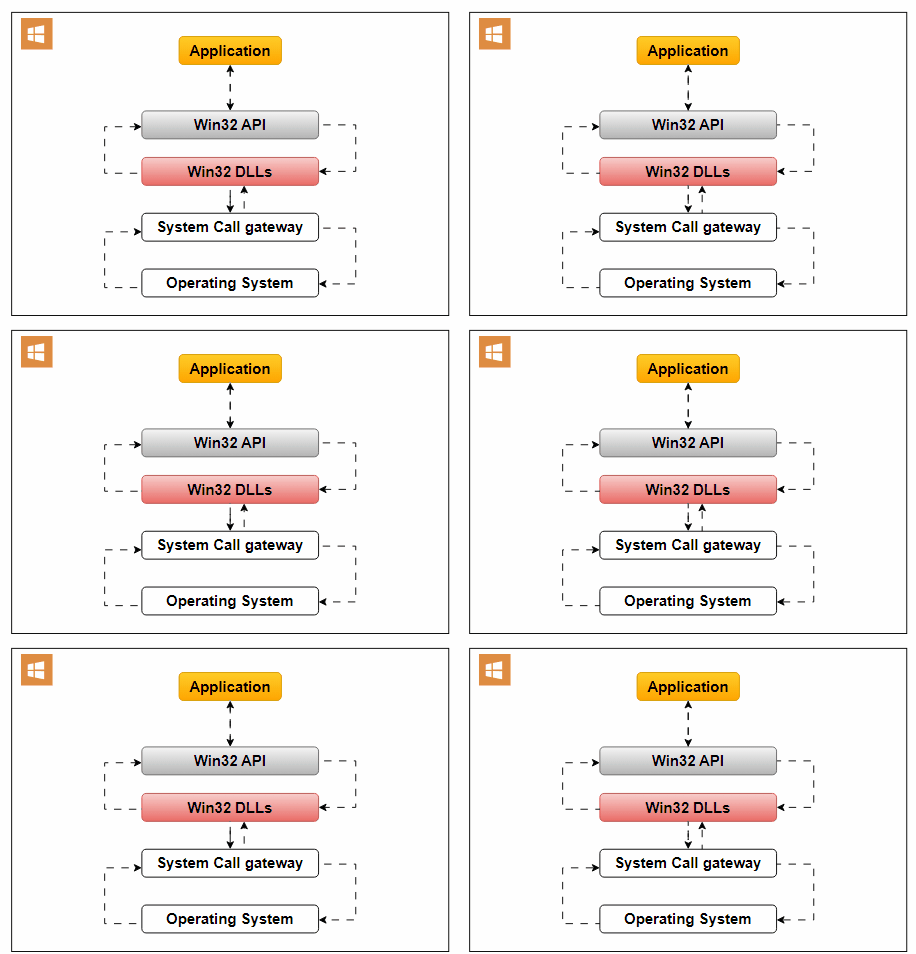
An example of an Operating System API is the Win32 API, designed for Windows applications. It offers functions for handling user interfaces, file operations, and system settings.

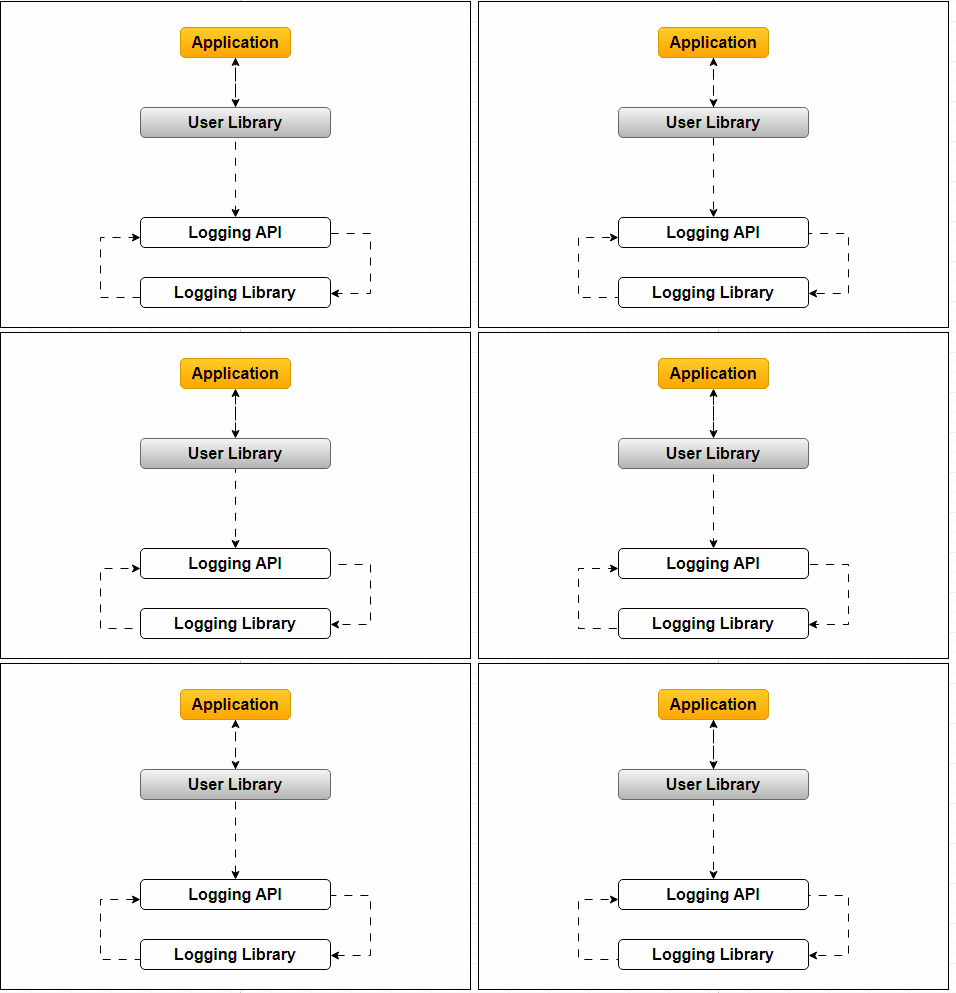
Library API

Library APIs allow applications to utilize external libraries or modules simultaneously. These libraries provide additional functionalities, enhancing applications.

Use Cases:

  • Extending Functionality: Applications often require specialized functionalities beyond their core logic. Library APIs enable the inclusion of these functionalities.
  • Code Reusability: Developers can reuse pre-built code components by using libraries, saving time and effort.
  • Modularity: Library APIs promote modularity in software development by separating core functionality from auxiliary features.

For example, an application with a User library may incorporate logging capabilities through a Logging library’s API.

Remote API

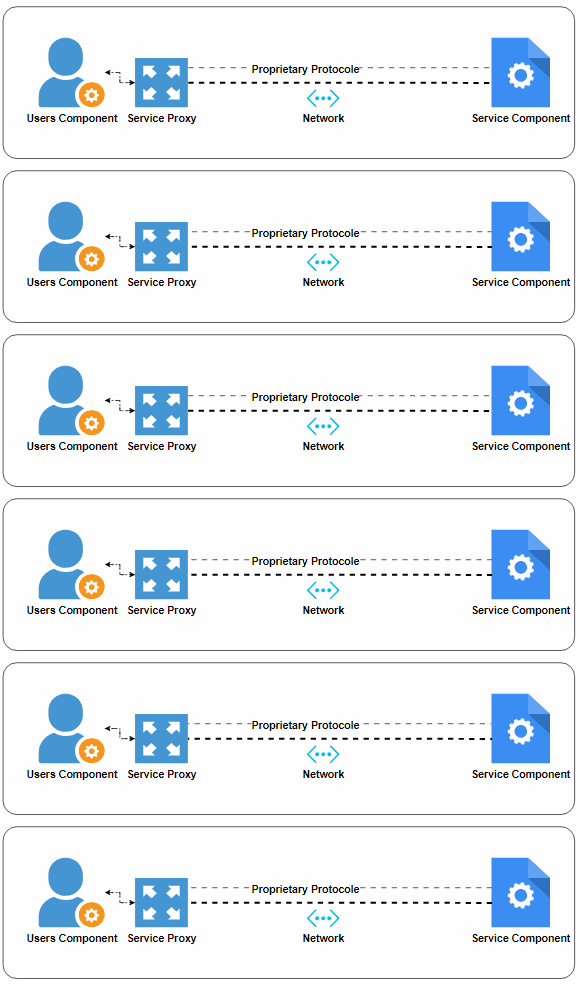
Remote APIs enable communication between software components or applications distributed over a network. These components may not run in the same process or server.

Key Features:

  • Network Communication: Remote APIs facilitate communication between software components on different machines or servers.
  • Remote Proxy: One component creates a proxy (often called a Remote Proxy) to communicate with the remote component. This proxy handles network protocols, addressing, method signatures, and authentication.
  • Platform Consistency: Client and server components using a Remote API must often be developed using the same platform or technology stack.

Examples of Remote APIs include DCOM, .NET Remoting, and Java RMI (Remote Method Invocation).

Web API

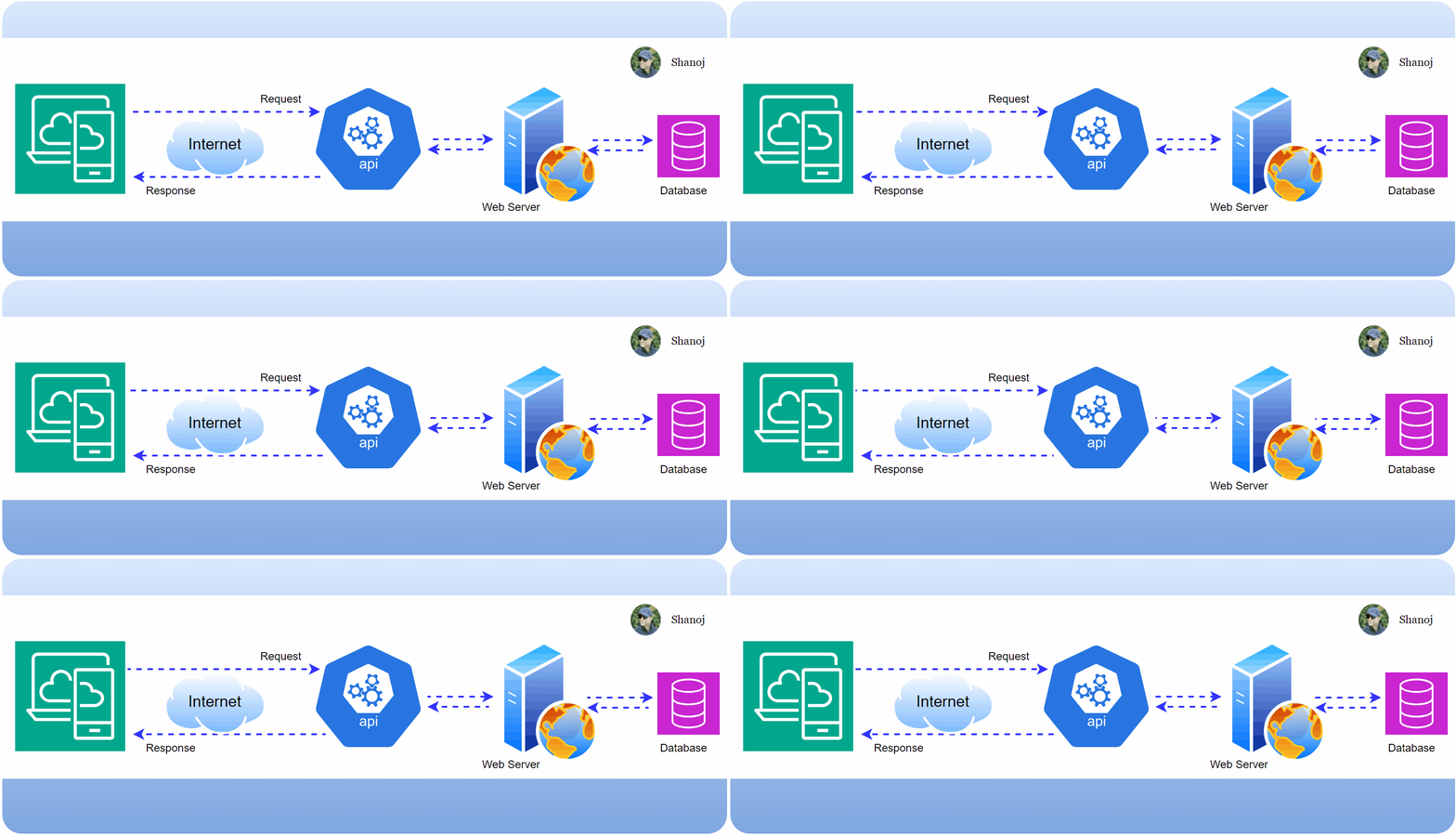
Web APIs allow web applications to communicate over the Internet based on standard protocols, making them interoperable across platforms, OSs, and programming languages.

Key Features:

  • Internet Communication: Web APIs enable web apps to interact with remote web services and exchange data over the Internet.
  • Platform-Agnostic: Web APIs support web apps developed using various technologies, promoting seamless interaction.
  • Widespread Popularity: Web APIs are vital in modern web development and integration.

Use Cases:

  • Data Retrieval: Web apps can access Web APIs to retrieve data from remote services, such as weather information or stock prices.
  • Action Execution: Web APIs allow web apps to perform actions on remote services, like posting a tweet on Twitter or updating a user’s profile on social media.

Types of Web APIs

Now, let’s explore four popular approaches for building Web APIs: SOAP, REST, GraphQL, and gRPC.

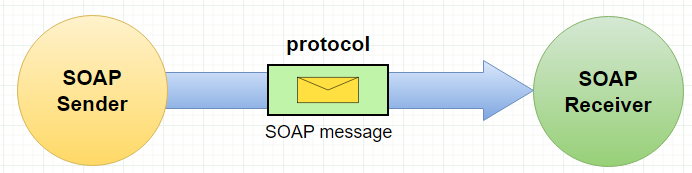
  • SOAP (Simple Object Access Protocol): Is a protocol for exchanging structured information to implement web services, relying on XML as its message format. Known for strict standards and reliability, it is suitable for enterprise-level applications requiring ACID-compliant transactions.
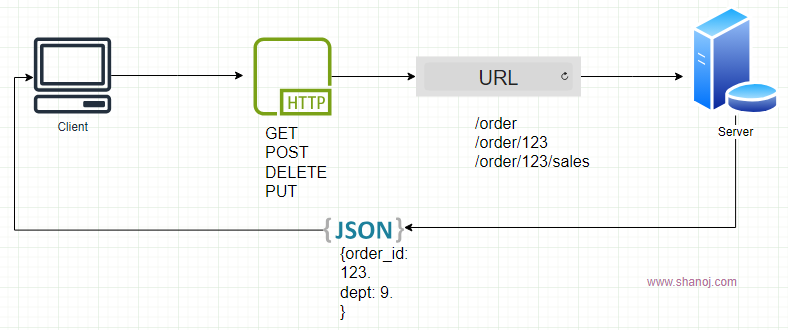
  • REST (Representational State Transfer): This architectural style uses URLs and data formats like JSON and XML for message exchange. It is simple, stateless, and widely used in web and mobile applications, emphasizing simplicity and scalability.
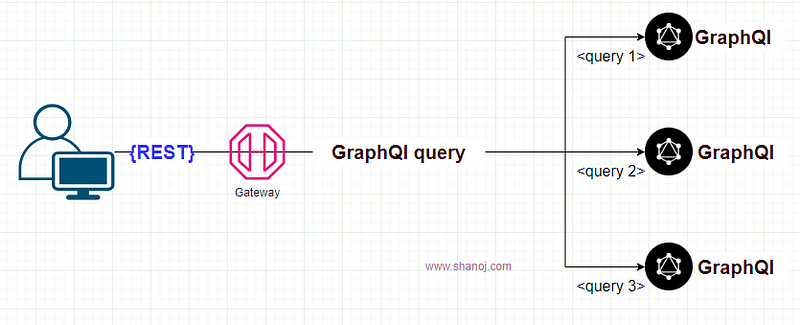
  • GraphQL: Developed by Facebook, GraphQL provides flexibility in querying and updating data. Clients can specify the fields they want to retrieve, reducing over-fetching and enabling real-time updates.
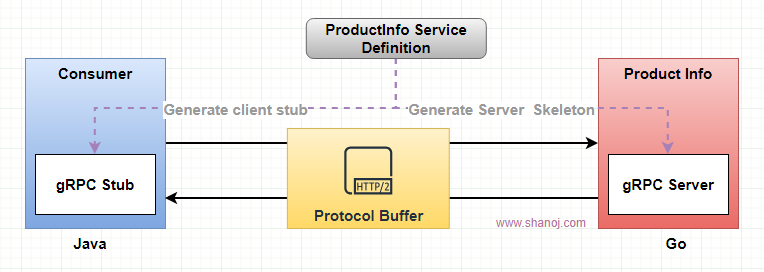
  • gRPC (Google Remote Procedure Call): Developed by Google, gRPC is based on HTTP/2 and Protocol Buffers (protobuf). It excels in microservices architectures and scenarios involving streaming or bidirectional communication.

Real-World Use Cases:

  • Operating System API: An image editing software accesses the file system for image manipulation.
  • Library API: A web application leverages the ‘TensorFlow’ library API to integrate advanced machine learning capabilities for sentiment analysis of user-generated content.
  • Remote API: A ride-sharing service connects distributed passenger and driver apps.
  • Web API: An e-commerce site provides real-time stock availability information.
  • SOAP: A banking app that handles secure financial transactions.
  • REST: A social media platform exposes a RESTful API for third-party developers.
  • GraphQL: A news content management system that enables flexible article queries.
  • gRPC: An online gaming platform that maintains real-time player-server communication.

APIs are vital for effective software development, enabling various types of communication between software components. The choice of API type depends on specific project requirements and use cases. Understanding these different API types empowers developers to choose the right tool for the job.


If you enjoyed reading this and would like to explore similar content, please refer to the following link:

REST vs. GraphQL: Tale of Two Hotel Waiters” by Shanoj Kumar V

Stackademic

Thank you for reading until the end. Before you go:

  • Please consider clapping and following the writer! 👏
  • Follow us on Twitter(X), LinkedIn, and YouTube.
  • Visit Stackademic.com to find out more about how we are democratizing free programming education around the world.