Tag Archives: Big Data

Apache Hive 101: Enabling ACID Transactions

To create ACID tables, ensure Hive is configured to support ACID transactions by setting the following properties:

SET hive.support.concurrency=true;
SET hive.txn.manager=org.apache.hadoop.hive.ql.lockmgr.DbTxnManager;
SET hive.compactor.initiator.on=true;
SET hive.compactor.worker.threads=1;

Hive Version Compatibility

ACID transactions in Hive are supported from version 0.14.0 onwards. Ensure that your Hive installation is at least this version. Hive 3.x introduced significant improvements and additional features for ACID transactions.

Creating ACID Tables

Full ACID Table

Full ACID tables support all CRUD (Create, Retrieve, Update, Delete) operations and require the ORC file format:

CREATE TABLE acidtbl (
key int,
value string
)
STORED AS ORC
TBLPROPERTIES ("transactional"="true")
;

Insert-Only ACID Table

Insert-only ACID tables support only insert operations and can use various storage formats:

CREATE TABLE acidtbl_insert_only (
key int,
value string
)
STORED AS TEXTFILE
TBLPROPERTIES ("transactional"="true", "transactional_properties"="insert_only")
;

Converting Tables to ACID

Non-ACID to Full ACID

To convert a non-ACID managed table to a full ACID table (requires ORC format):

ALTER TABLE nonacidtbl SET TBLPROPERTIES ('transactional'='true');

Non-ACID to Insert-Only ACID

To convert a non-ACID managed table to an insert-only ACID table:

ALTER TABLE nonacidtbl SET TBLPROPERTIES ('transactional'='true', 'transactional_properties'='insert_only');

Data Operations on ACID Tables

Inserting Data

INSERT INTO acidtbl VALUES (1, 'a');
INSERT INTO acidtbl VALUES (2, 'b');

Updating Data

UPDATE acidtbl SET value='updated' WHERE key=1;

Performing Merge Operations

MERGE INTO acidtbl USING src
ON acidtbl.key = src.key
WHEN MATCHED AND src.value IS NULL THEN DELETE
WHEN MATCHED AND (acidtbl.value != src.value) THEN UPDATE SET value = src.value
WHEN NOT MATCHED THEN INSERT VALUES (src.key, src.value);

Understanding Table Structures

ACID Tables (Transactional)

ACID tables have a specific directory structure in HDFS:

/user/hive/warehouse/t/
├── base_0000022/
│ └── bucket_00000
├── delta_0000023_0000023_0000/
│ └── bucket_00000
└── delta_0000024_0000024_0000/
└── bucket_00000
  • Base Directory: Contains the original data files.
  • Delta Directories: Store changes (inserts, updates, deletes).

Non-ACID Tables

Non-ACID tables have a simpler structure:

/user/hive/warehouse/table_name/
├── file1.orc
├── file2.orc
└── file3.orc

# For partitioned tables:
/user/hive/warehouse/table_name/
├── partition_column=value1/
│ ├── file1.orc
│ └── file2.orc
└── partition_column=value2/
├── file3.orc
└── file4.orc

File Format Considerations

  • Full ACID Tables: Only the ORC (Optimized Row Columnar) file format is supported for full ACID tables that allow all CRUD operations.
  • Insert-Only ACID Tables: These tables support various file formats, not limited to ORC. You can use formats like TEXTFILE, CSV, AVRO, or JSON.
  • Managed Tables: The managed table storage type is required for ACID tables.
  • External Tables: ACID properties cannot be applied to external tables, as changes to external tables are beyond Hive’s control.
  • Converting Existing Tables: When converting a non-ACID managed table to a full ACID table, the data must be in ORC format.
  • Default Format: When creating a full ACID table without specifying the storage format, Hive defaults to using ORC.

Managed vs. External Tables

  • Managed Tables: Support ACID transactions. They can be created as transactional (either full ACID or insert-only).

Example of a full ACID managed table:

CREATE TABLE managed_acid_table (
id INT,
name STRING
)
STORED AS ORC
TBLPROPERTIES ("transactional"="true");

Example of an insert-only ACID managed table:

CREATE TABLE managed_insert_only_table (
id INT,
name STRING
)
STORED AS TEXTFILE
TBLPROPERTIES ("transactional"="true", "transactional_properties"="insert_only");

External Tables: Do not support ACID transactions. These tables are used for data managed outside Hive’s control.

Example of an external table:

CREATE EXTERNAL TABLE external_table (
id INT,
name STRING
)
STORED AS TEXTFILE
LOCATION '/path/to/external/data';

Limitations of ACID Tables

  1. Performance Overhead: ACID tables introduce additional overhead due to the need for transactional logging and compaction processes.
  2. Storage Requirements: The delta files and base files can increase storage requirements.
  3. Compaction: Regular compaction is necessary to maintain performance and manage storage, which can add complexity.
  4. Version Dependency: Ensure that you are using a Hive version that supports the desired ACID features, as improvements and bug fixes are version-dependent.
  5. External Table Limitation: ACID properties cannot be applied to external tables.

Key Points

  1. Only managed tables can be converted to ACID tables.
  2. External tables cannot be made transactional.
  3. Full ACID tables require the ORC file format.
  4. Converting ACID tables back to non-ACID tables is not supported.

Stackademic 🎓

Thank you for reading until the end. Before you go:

Apache Hive 101: MSCK Repair Table

The MSCK REPAIR TABLE command in Hive is used to update the metadata in the Hive metastore to reflect the current state of the partitions in the file system. This is particularly necessary for external tables where partitions might be added directly to the file system (such as HDFS or Amazon S3) without using Hive commands.

What MSCK REPAIR TABLE Does

  1. Scans the File System: It scans the file system (e.g., HDFS or S3) for Hive-compatible partitions that were added after the table was created.
  2. Updates Metadata: It compares the partitions in the table metadata with those in the file system. If it finds new partitions in the file system that are not in the metadata, it adds them to the Hive metastore.
  3. Partition Detection: It detects partitions by reading the directory structure and creating partitions based on the folder names.

Why MSCK REPAIR TABLE is Needed

  1. Partition Awareness: Hive stores a list of partitions for each table in its metastore. When new partitions are added directly to the file system, Hive is not aware of these partitions unless the metadata is updated. Running MSCK REPAIR TABLE ensures that the Hive metastore is synchronized with the actual data layout in the file system.
  2. Querying New Data: Without updating the metadata, queries on the table will not include the data in the new partitions. By running MSCK REPAIR TABLE, you make the new data available for querying.
  3. Automated Ingestion: For workflows that involve automated data ingestion, running MSCK REPAIR TABLE after each data load ensures that the newly ingested data is recognized by Hive without manually adding each partition.

Command to Run MSCK REPAIR TABLE

MSCK REPAIR TABLE table_name;

Replace table_name with the name of your Hive table.

Considerations and Limitations

  1. Performance: The operation can be slow, especially with a large number of partitions, as it involves scanning the entire directory structure.
  2. Incomplete Updates: If the operation times out, it may leave the table in an incomplete state where only some partitions are added. It may be necessary to run the command multiple times until all partitions are included.
  3. Compatibility: MSCK REPAIR TABLE only adds partitions to metadata; it does not remove them. For removing partitions, other commands like ALTER TABLE DROP PARTITION must be used.
  4. Hive Compatibility: Partitions must be Hive-compatible. For partitions that are not, manual addition using ALTER TABLE ADD PARTITION is required.

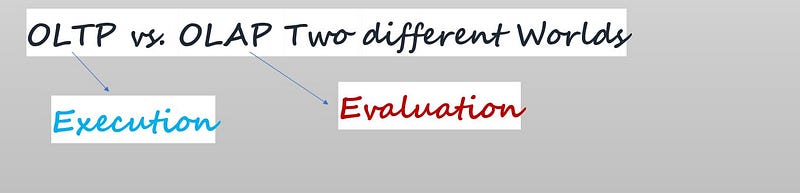
Data Modelling for Data Warehouses: Bridging OLTP and OLAP for Advanced Data Analytics

This article offers a detailed exploration of the design and implementation of bank reconciliation systems within an Online Transaction Processing (OLTP) environment and their integration with Online Analytical Processing (OLAP) systems for enhanced reporting. It navigates through the progression from transactional processing to analytical reporting, including schema designs and practical examples.

Dimensional Modeling is a data warehousing design approach that transforms complex databases into understandable schemas. It structures data using facts and dimensions, facilitating the creation of data cubes that enable sophisticated analytical queries for business intelligence and data analytics applications. This method ensures rapid data retrieval and aids in making informed decisions based on comprehensive data insights.

“Dimensional modeling is explicitly designed to address the need of users to understand the data easily and to analyze it rapidly.” — Ralph Kimball, “The Data Warehouse Toolkit”

OLTP System Schema

The Online Transaction Processing (OLTP) system is the backbone for capturing real-time banking transactions. It’s designed for high transactional volume, ensuring data integrity and quick response times.

Let’s use a fictitious use case to explain concepts and data modelling.

Core Tables Overview

  1. FinancialInstitutions: Holds details about banks, like identifiers and addresses.
  2. FinancialTransactions: Records each transaction needing reconciliation.
  3. LifecycleAssociations: Tracks the transaction’s lifecycle stages.
  4. AuditLogs: Logs all audit-related actions and changes.

Table Functions

  • FinancialInstitutions: Identifies banks involved in transactions.
  • FinancialTransactions: Central repository for transaction data.
  • LifecycleAssociations: Manages transaction progress through different stages.
  • AuditLogs: Ensures traceability and compliance through logging actions.

“In an OLTP system, the speed of transaction processing is often the key to business competitiveness.” — James Serra, in his blog on Data Warehousing

Transitioning to OLAP for Reporting

Transitioning to an Online Analytical Processing (OLAP) system involves denormalizing OLTP data to optimize for read-heavy analytical queries.

Star Schema Design for Enhanced Reporting

A star schema further refines the data structure for efficient querying, centring around FactTransactionAudit and connected to dimension tables:

  • DimBank
  • DimTransactionDetails
  • DimLifecycleStage
  • DimAuditTrail

Denormalized OLAP Schema Structure Explanation:

transaction_id: Serves as the primary key of the table, uniquely identifying each transaction in the dataset.

bank_id: Acts as a foreign key linking to the DimBank dimension table, which contains detailed information about each bank.

amount: Records the monetary value of the transaction.

transaction_date: Marks the date when the transaction occurred, useful for time-based analyses and reporting.

audit_id: A foreign key that references the DimAuditTrail dimension table, providing a link to audit information related to the transaction.

lifecycle_stage: Describes the current stage of the transaction within its lifecycle, such as “pending,” “processed,” or “reconciled,” which could be linked to the DimLifecycleStage dimension table for detailed descriptions of each stage.

is_auto_matched: A boolean or flag that indicates whether the transaction was matched automatically (AM), requiring no manual intervention. This is crucial for reporting and analyzing the efficiency of the reconciliation process.

“The objective of the data warehouse is to provide a coherent picture of the business at a point in time.” — Bill Inmon, “Building the Data Warehouse”

Reporting Use Cases: Auto Match Reporting

Identify transactions reconciled automatically. This requires joining the FactTransactionAudit table with dimension tables to filter auto-matched transactions.

Access Path for Auto Match Transactions

SELECT
dt.transaction_id,
db.name AS bank_name,
-- Additional fields
FROM
FactTransactionAudit fta
JOIN
DimTransactionDetails dt ON fta.FK_transaction_id = dt.transaction_id
-- Additional joins
WHERE
fta.is_auto_matched = TRUE;

Partitioning Strategy

Partitioning helps manage large datasets by dividing them into more manageable parts based on certain fields, often improving query performance by allowing systems to read only relevant partitions.

Suggested Partitioning Scheme:

For the ConsolidatedTransactions table in an OLAP setting like Hive:

By Date: Partitioning by transaction date (e.g., transaction_date) is a natural choice for financial data, allowing efficient queries over specific periods.

Structure: /year=YYYY/month=MM/day=DD/.

By Bank: If analyses often filter by specific banks, adding a secondary level of partitioning by bank_id can further optimize access patterns.

Structure: /year=YYYY/month=MM/bank_id=XYZ/.

CREATE TABLE ConsolidatedTransactions (
transaction_id STRING,
bank_name STRING,
transaction_description STRING,
transaction_amount FLOAT,
lifecycle_description STRING,
audit_action STRING,
audit_timestamp TIMESTAMP
)
PARTITIONED BY (year STRING, month STRING, day STRING, bank_id STRING)
STORED AS PARQUET;

Optimal Partitioning Strategy

Processing billions of transactions every month can result in generating too many small files if daily partitioning is used. However, if monthly partitioning is applied, it may lead to the creation of very large files that are inefficient to process. To strike a balance between the two, a weekly or bi-weekly partitioning scheme can be adopted. This approach can reduce the overall number of files generated and keep the file sizes manageable.

# Assuming df is your DataFrame loaded with the transaction data
df = df.withColumn("year_week", weekofyear(col("transaction_date")))

“In large databases, partitioning is critical for both performance and manageability.” — C.J. Date, “An Introduction to Database Systems”

Efficient Data Writes

Given the data volume, using repartition based on the partitioning scheme before writing can help distribute the data more evenly across the partitions, especially if the transactions are not uniformly distributed across the period.

Writing Data with Adaptive Repartitioning

Considering the volume, dynamic repartitioning based on the data characteristics of each write operation is necessary.

# Dynamically repartition based on the number of records
# Aim for partitions with around 50 million to 100 million records each

num_partitions = df.count() // 50000000
if num_partitions < 1:
num_partitions = 1 # Ensure at least one partition

df.repartition(num_partitions, "year", "year_week", "bank_id") \
.write \
.mode("overwrite") \
.partitionBy("year", "year_week", "bank_id") \
.format("parquet") \
.saveAsTable("ConsolidatedTransactions")

Dynamic Partitioning for Incremental Loads

For incremental loads, enabling dynamic partitioning in Spark is crucial to ensure that only the relevant partitions are updated without scanning or rewriting the entire dataset.

# Enable dynamic partitioning
spark.conf.set("hive.exec.dynamic.partition", "true")
spark.conf.set("hive.exec.dynamic.partition.mode", "nonstrict")

# Write incremental data
df.write \
.mode("append") \
.partitionBy("year", "year_week", "bank_id") \
.format("parquet") \
.saveAsTable("ConsolidatedTransactions")

Other Considerations

Managing Small Files Issue

Small files can degrade performance in Hadoop ecosystems by overwhelming the NameNode with metadata operations and causing excessive overhead during processing.

Solutions:

Compaction Jobs: Regularly run compaction jobs to merge small files into larger ones within each partition. Spark can be used to read in small files and coalesce them into a smaller number of larger files.

Spark Repartition/Coalesce: When writing data out from Spark, use repartition to increase the number of partitions (and thus files) if needed, or coalesce to reduce them, depending on your use case.

Writing Data with Coalesce to Avoid Small Files:

# Assuming df is your DataFrame loaded with the data ready to be written

df.coalesce(10) \ # Adjust this number based on your specific needs
.write \
.mode("overwrite") \
.partitionBy("year", "month", "day", "bank_id") \
.format("parquet") \
.saveAsTable("ConsolidatedTransactions")

Using Repartition for Better File Distribution

# Adjust the partition column names and number of partitions as needed

df.repartition(10, "year", "month", "day", "bank_id") \
.write \
.mode("overwrite") \
.partitionBy("year", "month", "day", "bank_id") \
.format("parquet") \
.saveAsTable("ConsolidatedTransactions")

Efficiently handling this data volume requires monitoring and tuning Spark’s execution parameters and memory.

  • Cluster Capacity: Ensure the underlying hardware and cluster resources are scaled appropriately to handle the data volume and processing needs.
  • Archival Strategy: Implement a data archival or purging strategy for older data that is no longer actively queried to manage overall storage requirements.

To manage billions of transactions every month, it’s necessary to plan and optimize data storage and processing strategies. You can significantly improve the performance and scalability of your big data system by utilizing partitioning schemes that balance the file size with the number of files and by dynamically adjusting to the data volume during writes.

Stackademic 🎓

Thank you for reading until the end. Before you go:

Apache Spark Aggregation Methods: Hash-based Vs. Sort-based

Apache Spark provides two primary methods for performing aggregations: Sort-based aggregation and Hash-based aggregation. These methods are optimized for different scenarios and have distinct performance characteristics.

Hash-based Aggregation

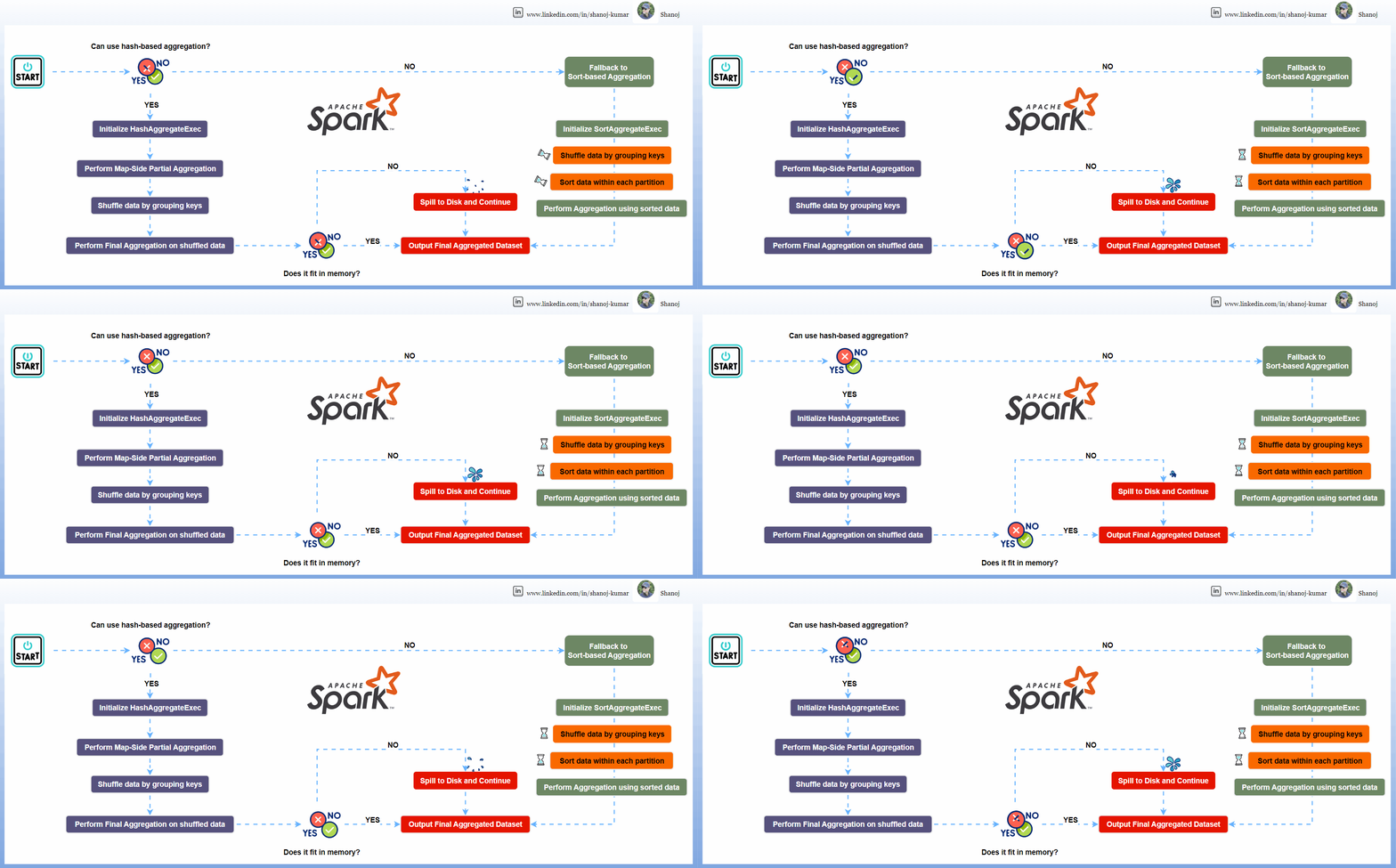
Hash-based aggregation, as implemented by HashAggregateExec, is the preferred method for aggregation in Spark SQL when the conditions allow it. This method creates a hash table where each entry corresponds to a unique group key. As Spark processes rows, it quickly uses the group key to locate the corresponding entry in the hash table and updates the aggregate values accordingly. This method is generally faster because it avoids sorting the data before aggregation. However, it requires that all intermediate aggregate values fit into memory. If the dataset is too large or there are too many unique keys, Spark might be unable to use hash-based aggregation due to memory constraints. Key points about Hash-based aggregation include:

  • It is preferred when the aggregate functions and group by keys are supported by the hash aggregation strategy.
  • It can be significantly faster than sort-based aggregation because it avoids sorting data.
  • It uses off-heap memory for storing the aggregation map.
  • It may fall back to sort-based aggregation if the dataset is too large or has too many unique keys, leading to memory pressure.

Sort-based Aggregation

Sort-based aggregation, as implemented by SortAggregateExec, is used when hash-based aggregation is not feasible, either due to memory constraints or because the aggregation functions or group by keys are not supported by the hash aggregation strategy. This method involves sorting the data based on the group by keys and then processing the sorted data to compute aggregate values. While this method can handle larger datasets since it only requires some intermediate results to fit into memory, it is generally slower than hash-based aggregation due to the additional sorting step. Key points about Sort-based aggregation include:

  • It is used when hash-based aggregation is not feasible due to memory constraints or unsupported aggregation functions or group by keys.
  • It involves sorting the data based on the group by keys before performing the aggregation.
  • It can handle larger datasets since it streams data through disk and memory.

Detailed Explanation of Hash-based Aggregation

Hash-based Aggregation in Apache Spark operates through the HashAggregateExec physical operator. This process is optimized for aggregations where the dataset can fit into memory, and it leverages mutable types for efficient in-place updates of aggregation states.

  • Initialization: When a query that requires aggregation is executed, Spark determines whether it can use hash-based aggregation. This decision is based on factors such as the types of aggregation functions (e.g., sum, avg, min, max, count), the data types of the columns involved, and whether the dataset is expected to fit into memory.
  • Partial Aggregation (Map Side): The aggregation process begins with a “map-side” partial aggregation. For each partition of the input data, Spark creates an in-memory hash map where each entry corresponds to a unique group key. As rows are processed, Spark updates the aggregation buffer for each group key directly in the hash map. This step produces partial aggregate results for each partition.
  • Shuffling: After the partial aggregation, Spark shuffles the data by the grouping keys, so that all records belonging to the same group are moved to the same partition. This step is necessary to ensure that the final aggregation produces accurate results across the entire dataset.
  • Final Aggregation (Reduce Side): Once the shuffled data is partitioned, Spark performs the final aggregation. It again uses a hash map to aggregate the partially aggregated results. This step combines the partial results from different partitions to produce the final aggregate value for each group.
  • Spill to Disk: If the dataset is too large to fit into memory, Spark’s hash-based aggregation can spill data to disk. This mechanism ensures that Spark can handle datasets larger than the available memory by using external storage.
  • Fallback to Sort-based Aggregation: In cases where the hash map becomes too large or if there are memory issues, Spark can fall back to sort-based aggregation. This decision is made dynamically based on runtime conditions and memory availability.
  • Output: The final output of the HashAggregateExec operator is a new dataset where each row represents a group along with its aggregated value(s).

The efficiency of hash-based aggregation comes from its ability to perform in-place updates to the aggregation buffer and its avoidance of sorting the data. However, its effectiveness is limited by the available memory and the nature of the dataset. For datasets that do not fit well into memory or when dealing with complex aggregation functions that are not supported by hash-based aggregation, Spark might opt for sort-based aggregation instead.

Detailed Explanation of Sort-based Aggregation

Sort-based Aggregation in Apache Spark works through a series of steps that involve shuffling, sorting, and then aggregating the data.

  • Shuffling: The data is partitioned across the cluster based on the grouping keys. This step ensures that all records with the same key end up in the same partition.
  • Sorting: Within each partition, the data is sorted by the grouping keys. This is necessary because the aggregation will be performed on groups of data with the same key, and having the data sorted ensures that all records for a given key are contiguous.
  • Aggregation: Once the data is sorted, Spark can perform the aggregation. For each partition, Spark uses a SortBasedAggregationIterator to iterate over the sorted records. This iterator maintains a buffer row to cache the aggregated values for the current group.
  • Processing Rows: As the iterator goes through the rows, it processes them one by one, updating the buffer with the aggregate values. When the end of a group is reached (i.e., the next row has a different grouping key), the iterator outputs a row with the final aggregate value for that group and resets the buffer for the next group.
  • Memory Management: Unlike hash-based aggregation, which requires a hash map to hold all group keys and their corresponding aggregate values, sort-based aggregation only needs to maintain the aggregate buffer for the current group. This means that sort-based aggregation can handle larger datasets that might not fit entirely in memory.
  • Fallback Mechanism: Although not part of the normal operation, it’s worth noting that Spark’s HashAggregateExec can theoretically fall back to sort-based aggregation if it encounters memory issues during hash-based processing.

The sort-based aggregation process is less efficient than hash-based aggregation because it involves the extra step of sorting the data, which is computationally expensive. However, it is more scalable for large datasets or when dealing with immutable types in the aggregation columns that prevent the use of hash-based aggregation.

Stackademic 🎓

Thank you for reading until the end. Before you go:

Understanding Memory Spills in Apache Spark

Memory spill in Apache Spark is the process of transferring data from RAM to disk, and potentially back again. This happens when the dataset exceeds the available memory capacity of an executor during tasks that require more memory than is available. In such cases, data is spilled to disk to free up RAM and prevent out-of-memory errors. However, this process can slow down processing due to the slower speed of disk I/O compared to memory access.

Dynamic Occupancy Mechanism

Apache Spark employs a dynamic occupancy mechanism for managing Execution and Storage memory pools. This mechanism enhances the flexibility of memory usage by allowing Execution Memory and Storage Memory to borrow from each other, depending on workload demands:

  • Execution Memory: Primarily used for computation tasks such as shuffles, joins, and sorts. When execution tasks demand more memory, they can borrow from the Storage Memory if it is underutilized.
  • Storage Memory: Used for caching and persisting RDDs, DataFrames, and Datasets. If the demand for storage memory exceeds its allocation, and Execution Memory is not fully utilized, Storage Memory can expand into the space allocated for Execution Memory.

Spark’s internal memory manager controls this dynamic sharing and is crucial for optimizing the utilization of available memory resources, significantly reducing the likelihood of memory spills.

Common Performance Issues Related to Spills

Spill(disk) and Spill(memory): When data doesn’t fit in RAM, it is temporarily written to disk. This operation, while enabling Spark to handle larger datasets, impacts computation time and efficiency because disk access is slower than memory access.

Impact on Performance: Spills to disk can negatively affect performance, increasing both the cost and operational complexity of Spark applications. The strength of Spark lies in its in-memory computing capabilities; thus, disk spills are counterproductive to its design philosophy.

Solutions for Memory Spill in Apache Spark

Mitigating memory spill issues involve several strategies aimed at optimizing memory use, partitioning data more effectively, and improving overall application performance.

Optimizing Memory Configuration

  • Adjust memory allocation settings to provide sufficient memory for both execution and storage, potentially increasing the memory per executor.
  • Tune the ratio between execution and storage memory based on the specific requirements of your workload.

Partitioning Data

  • Optimize data partitioning to ensure even data distribution across partitions, which helps in avoiding memory overloads in individual partitions.
  • Consider different partitioning strategies such as range, hash, or custom partitioning based on the nature of your data.

Caching and Persistence

  • Use caching and persistence methods (e.g., cache() or persist()) to store intermediate results or frequently accessed data in memory, reducing the need for recomputation.
  • Select the appropriate storage level for caching to balance between memory usage and CPU efficiency.

Monitoring and Tuning

  • Monitor memory usage and spills using Spark UI or other monitoring tools to identify and address bottlenecks.
  • Adjust configurations dynamically based on performance metrics and workload patterns.

Data Compression

  • Employ data compression techniques and columnar storage formats (e.g., Parquet, ORC) to reduce the memory footprint.
  • Compress RDDs using serialization mechanisms like MEMORY_ONLY_SER to minimize memory usage.

Avoiding Heavy Shuffles

  • Optimize join operations and minimize unnecessary data movement by using strategies such as broadcasting smaller tables or implementing partition pruning.
  • Reduce shuffle operations which can lead to spills by avoiding wide dependencies and optimizing shuffle operations.

Formulaic Approach to Avoid Memory Spills

Apache Spark’s memory management model is designed to balance between execution memory (used for computation like shuffles, joins, sorts) and storage memory (used for caching and persisting data). Understanding and optimizing the use of these memory segments can significantly reduce the likelihood of memory spills.

Memory Configuration Parameters:

  • Total Executor Memory (spark.executor.memory): The total memory allocated per executor.
  • Memory Overhead (spark.executor.memoryOverhead): Additional memory allocated to each executor, beyond spark.executor.memory, for Spark to execute smoothly.
  • Spark Memory Fraction (spark.memory.fraction): Specifies the proportion of the executor memory dedicated to Spark’s memory management system (default is 0.6 or 60%).

Simplified Memory Calculation:

Calculate Available Memory for Spark:

Available Memory=(Total Executor Memory−Memory Overhead)×Spark Memory FractionAvailable Memory=(Total Executor Memory−Memory Overhead)×Spark Memory Fraction

Determine Execution and Storage Memory: Spark splits the available memory between execution and storage. The division is dynamic, but under memory pressure, storage can shrink to as low as the value defined by spark.memory.storageFraction (default is 0.5 or 50% of Spark memory).

Example Calculation:

  • Suppose an executor is configured with 10GB (spark.executor.memory = 10GB) and the default overhead (10% of executor memory or at least 384MB). Let’s assume an overhead of 1GB for simplicity and the default memory fractions.
  • Total Executor Memory: 10GB
  • Memory Overhead: 1GB
  • Spark Memory Fraction: 0.6 (60%)

Available Memory for Spark=(10GB−1GB)×0.6=5.4GBAvailable Memory for Spark=(10GB−1GB)×0.6=5.4GB

  • Assuming spark.memory.storageFraction is set to 0.5, both execution and storage memory pools could use up to 2.7GB each under balanced conditions.

Strategies to Avoid Memory Spills:

  • Increase Memory Allocation: If possible, increasing spark.executor.memory ensures more memory is available for Spark processes.
  • Adjust Memory Fractions: Tweaking spark.memory.fraction and spark.memory.storageFraction can help allocate memory more efficiently based on the workload. For compute-intensive operations, you might allocate more memory for execution.

Real-life Use Case: E-commerce Sales Analysis

An e-commerce platform experienced frequent memory spills while processing extensive sales data during holiday seasons, leading to performance bottlenecks.

Problem:

Large-scale aggregations and joins were causing spills to disk, slowing down the analysis of sales data, impacting the ability to generate real-time insights for inventory and pricing adjustments.

Solution:

  • Memory Optimization: The data team increased the executor memory from 8GB to 16GB per executor and adjusted the spark.memory.fraction to 0.8 to dedicate more memory to Spark’s managed memory system.
  • Partitioning and Data Skew Management: They implemented custom partitioning strategies to distribute the data more evenly across nodes, reducing the likelihood of individual tasks running out of memory.
  • Caching Strategy: Important datasets used repeatedly across different stages of the analysis were persisted in memory, and the team carefully chose the storage levels to balance between memory usage and CPU efficiency.
  • Monitoring and Tuning: Continuous monitoring of the Spark UI and logs allowed the team to identify memory-intensive operations and adjust configurations dynamically. They also fine-tuned spark.memory.storageFraction to better balance between execution and storage memory, based on the nature of their tasks.

These strategies significantly reduced the occurrence of memory spills, improved the processing speed of sales data analysis, and enabled the e-commerce platform to adjust inventory and pricing strategies in near real-time during peak sales periods.

This example demonstrates the importance of a holistic approach to Spark memory management, including proper configuration, efficient data partitioning, and strategic use of caching, to mitigate memory spill issues and enhance application performance.

Stackademic 🎓

Thank you for reading until the end. Before you go:

Apache Spark Optimizations: Shuffle Join Vs. Broadcast Joins

Apache Spark is an analytics engine that processes large-scale data in distributed computing environments. It offers various join operations that are essential for handling big data efficiently. In this article, we will take an in-depth look at Spark joins. We will compare normal (shuffle) joins with broadcast joins and explore other available join types.

Understanding Joins in Apache Spark

Joins in Apache Spark are operations that combine rows from two or more datasets based on a common key. The way Spark processes these joins, especially in a distributed setting, significantly impacts the performance and scalability of data processing tasks.

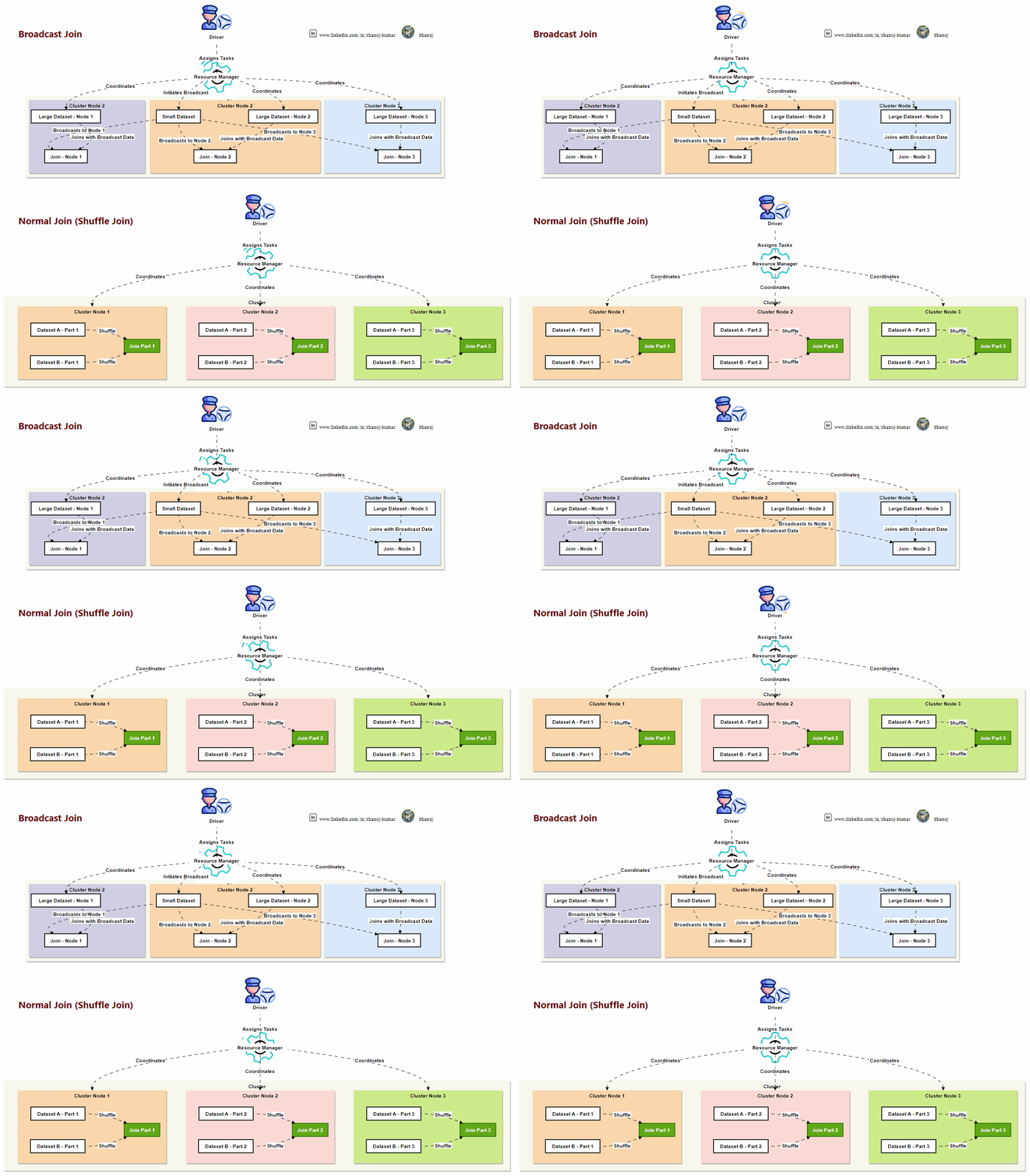
Normal Join (Shuffle Join)

Operation

  • Shuffling: Both data sets are shuffled across the cluster based on the join keys in a regular join. This process involves transferring data across different nodes, which can be network-intensive.

Use Case

  • Large Datasets: Best for large datasets where both sides of the join have substantial data. Typically used when no dataset is small enough to fit in the memory of a single worker node.

Performance Considerations

  • Speed: This can be slower due to extensive data shuffling.
  • Bottlenecks: Network I/O and disk writes during shuffling can become bottlenecks, especially for large datasets.

Scalability

  • Large Data Handling: Scales well with large datasets but can only be efficient if optimized (e.g., by partitioning).

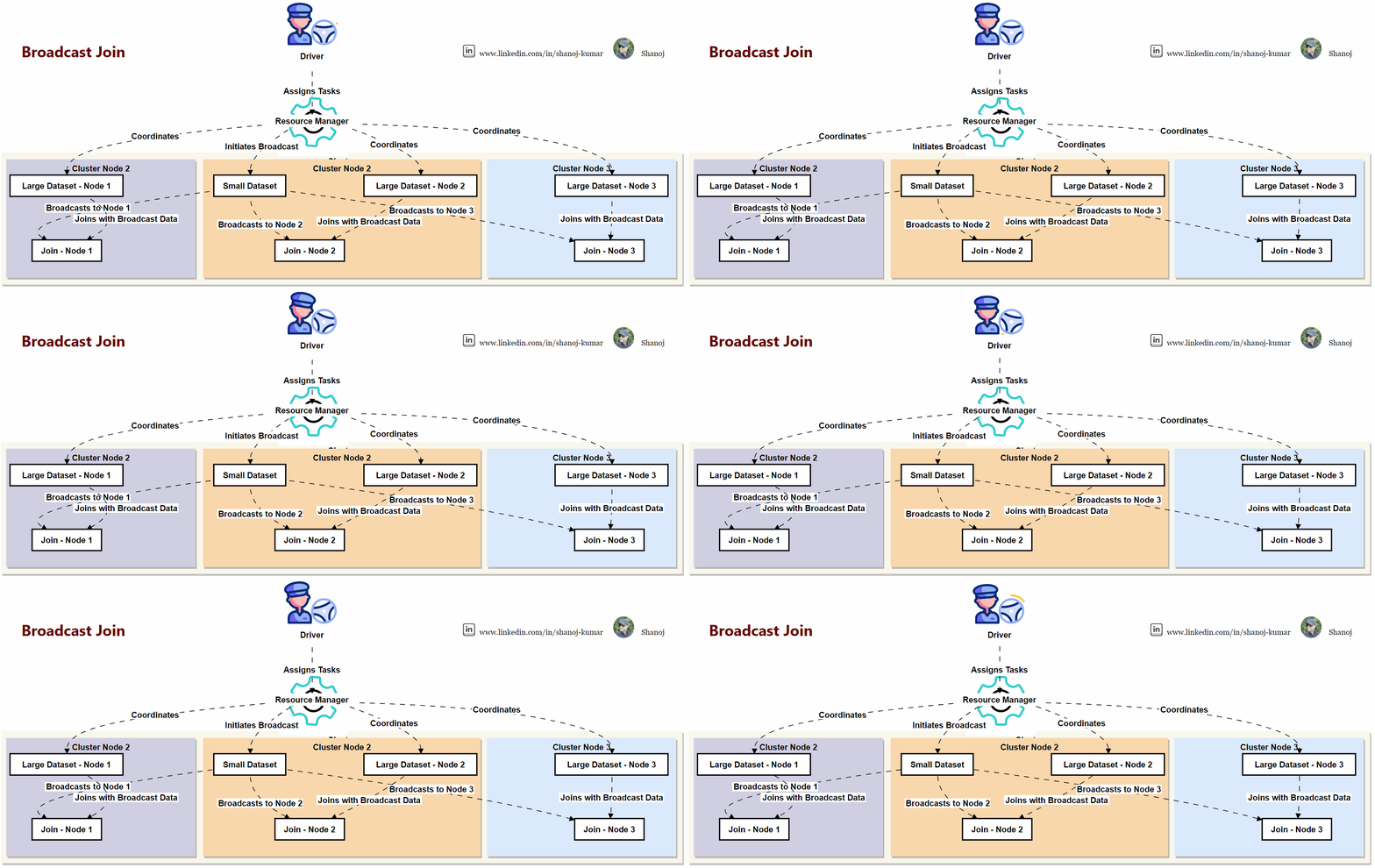
Broadcast Join

Operation

  • Broadcasting: In a broadcast join, the smaller dataset is sent (broadcast) to each node in the cluster, avoiding shuffling the larger dataset.

Use Case

  • Uneven Data Size: Ideal when one dataset is significantly smaller than the other. The smaller dataset should be small enough to fit in the memory of each worker node.

Performance Considerations

  • Speed: Typically faster than normal joins as it minimizes data shuffling.
  • Reduced Overhead: Reduces network I/O and disk write overhead.

Scalability

  • Small Dataset Joins: Works well for joins with small datasets but is not suitable for large to large dataset joins.

Choosing Between Normal and Broadcast Joins

The choice between a normal join and a broadcast join in Apache Spark largely depends on the size of the datasets involved and the resources of your Spark cluster. Here are key factors to consider:

  1. Data Size and Distribution: A broadcast join is usually more efficient if one dataset is small. For two large datasets, a normal join is more suitable.
  2. Cluster Resources: Consider the memory and network resources of your Spark cluster.
  3. Tuning and Optimization: Spark’s ability to optimize queries (e.g., Catalyst optimizer) can sometimes automatically choose the best join strategy.

The configurations that affect broadcast joins in Apache Spark:

spark.sql.autoBroadcastJoinThreshold: Sets the maximum size of a table that can be broadcast. Lowering the threshold can disable broadcast joins for larger tables, while increasing it can enable broadcast joins for bigger tables.

spark.sql.broadcastTimeout: Determines the timeout for the broadcast operation. Spark may fallback to a shuffle join if the broadcast takes longer than this.

spark.driver.memory: Allocates memory to the driver. Since the driver coordinates broadcasting, insufficient memory can hinder the broadcast join operation.


Other Types of Joins in Spark

Apart from normal and broadcast joins, Spark supports several other join types:

  1. Inner Join: Combines rows from both datasets where the join condition is met.
  2. Outer Joins: Includes left outer, right outer, and full outer joins, which retain rows from one or both datasets even when no matching join key is found.
  3. Cross Join (Cartesian Join): Produces a Cartesian product of the rows from both datasets. Every row of the first dataset is joined with every row of the second dataset, often resulting in many rows.
  4. Left Semi Join: This join type returns only the rows from the left dataset for which there is a corresponding row in the right dataset, but the columns from the right dataset are not included in the output.
  5. Left Anti Join: Opposite to the Left Semi Join, this join type returns rows from the left dataset that do not have a corresponding row in the right dataset.
  6. Self Join: This is not a different type of join per se, but rather a technique where a dataset is joined with itself. This can be useful for hierarchical or sequential data analysis.

Considerations for Efficient Use of Joins in Spark

When implementing joins in Spark, several considerations can help optimize performance:

  1. Data Skewness: Imbalanced data distribution can lead to skewed processing across the cluster. Addressing data skewness is crucial for maintaining performance.
  2. Memory Management: Ensuring that the broadcasted dataset fits into memory is crucial for broadcast joins. Out-of-memory errors can significantly impact performance.
  3. Join Conditions: Optimal use of join keys and conditions can reduce the amount of data shuffled across the network.
  4. Partitioning and Clustering: Proper partitioning and clustering of data can enhance join performance by minimizing data movement.
  5. Use of DataFrames and Datasets: Utilizing DataFrames and Datasets API for joins can leverage Spark’s Catalyst Optimizer for better execution plans.

PySpark code for the broadcast join:

from pyspark.sql import SparkSession
from pyspark.sql.functions import broadcast

# Initialize Spark Session
spark = SparkSession.builder \
.appName("BroadcastJoinExample") \
.getOrCreate()

# Sample DataFrames
df_large = spark.createDataFrame([(1, "A"), (2, "B"), (3, "C")], ["id", "value"])
df_small = spark.createDataFrame([(1, "X"), (2, "Y")], ["id", "value2"])

# Perform Broadcast Join
joined_df = df_large.join(broadcast(df_small), "id")

# Show the result
joined_df.show()

# Explain Plan
joined_df.explain()

# Stop the Spark Session
spark.stop()

Stackademic

Thank you for reading until the end. Before you go:

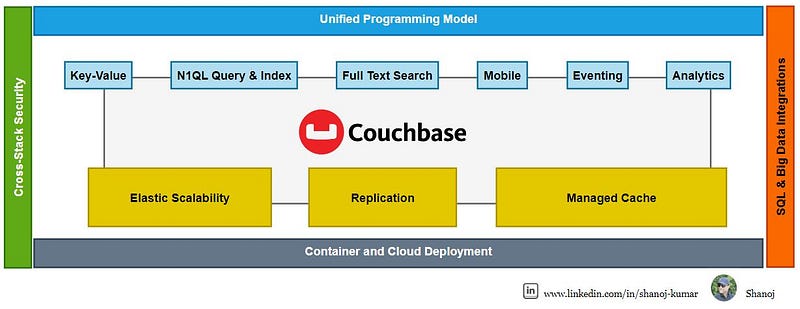
Couchbase 101: Introduction

Couchbase is the outcome of a remarkable fusion of two innovative technologies. On the one hand, there was Membase, a high-performance key-value storage engine created by the pioneers of Memcached, who worked under the NorthScale brand. On the other hand, there was CouchDB, a solution designed for document-oriented database requirements, developed by Damien Katz, the founder of CouchOne.

In February 2011, two technological forces joined together to create Couchbase, which is a comprehensive suite for NoSQL database needs. It combines a document-oriented data model with seamless indexing and querying capabilities, promising high performance and effortless scalability.

Couchbase Architecture & Features

Couchbase Server

Couchbase is built on a memory-first architecture which prioritizes in-memory processing to achieve high performance. Whenever a new item is saved, it is initially stored in memory, and associated data with Couchbase buckets is maintained persistently on disk.

Couchbase Server has a memory-first design for fast data access. Its active memory defragmenter optimizes performance. It supports a flexible JSON data model and direct in-memory access to its key-value engine for modern performance demands.

Consistency Models and N1QL Query Language

Let’s explore how Couchbase elegantly navigates the classic trade-offs in distributed systems, balancing Consistency, Availability, and Partition Tolerance, also known as the CAP theorem.

Couchbase offers a strategic shift from CP to AP, a choice that depends on your deployment topology and the desired system behaviour.

For a Single Cluster setup, Couchbase operates as a CP system, emphasizing strong consistency and partition tolerance, ensuring that your data remains accurate and synchronized across your cluster, which is ideal for scenarios where every transaction counts.

On the other hand, in a multi-cluster setup with cross-datacenter replication, abbreviated as XDCR, Couchbase adopts an AP approach, prioritizing availability over immediate consistency. This model is perfect for applications where uptime is critical, and data can eventually synchronize across clusters.

Highlighting its advanced capabilities, the N1QL Query Language in Couchbase now supports Distributed ACID Transactions.

This means you can perform complex transactions across your distributed Database with the assurance of atomicity, consistency, isolation, and durability — the cornerstone of reliable database management.

With these features, Couchbase ensures that your data is distributed, resilient and intelligently managed to meet the various demands of modern applications.

Concept 1 — Your Choice of Services

As we unfold the pages of Couchbase’s architecture, Concept 1 highlights ‘Your Choice of Services’. This high-level overview showcases the modular and resilient design of Couchbase, which empowers you to tailor your database architecture to your application’s specific needs.

Starting with Cluster Management, Couchbase offers a distributed architecture with no single point of failure, ensuring your system’s high availability. Automatic sharding through vBuckets ensures load balancing and scalability, while Cross Data Center Replication(XDCR) offers geographical redundancy.

The Data Service is the backbone, providing robust key-value storage with in-cluster and cross-data centre replication capabilities, all accelerated by a built-in cache for high performance.

Moving on to the Query Service, here we have the powerful N1QL, or SQL for JSON, for planning and executing queries, supporting JOINS, aggregations, and subqueries, giving you the flexibility of SQL with the power of JSON.

The Index Service seamlessly manages N1QL index creation, update, replication, and maintenance, while the Search Service provides comprehensive full-text indexing and search support.

Analytics Service offers isolated, distributed queries for long-running analytical operations without affecting your operational database performance.

Finally, the Eventing Service introduces event-driven data management, allowing you to respond to data mutations quickly.

Together, these services form a cohesive framework that stores and manages your data and integrates with your application logic for a seamless experience.

Image courtesy of Couchbase.

Each node or server in Couchbase is identical and capable of housing data in any configuration necessary to meet your application’s demands. As we see here, the four nodes are interconnected to form what is traditionally known as a cluster.

What’s unique about Couchbase is its flexibility in configuring these nodes. Depending on your changing capacity requirements, you can assign more or fewer resources to specific services. This adaptability is illustrated in our diagram, showing a variety of possible configurations.

In the first configuration, all services, from Data to Analytics, are distributed evenly across all nodes, ensuring a balanced workload and optimal utilization of resources.

In the second configuration, you can see that we’ve scaled up the Data Service across nodes to accommodate a heavier data load, demonstrating Couchbase’s agility in resource allocation.

The third configuration takes a specialized approach, with each node dedicated to a specific service, optimizing for intense workloads and dedicated tasks.

This level of customization ensures that as your application grows and evolves, your Couchbase cluster can adapt seamlessly, providing consistent performance and reliability.

Couchbase’s design philosophy is to provide you with the tools to build a database cluster that’s as dynamic as your business needs, without compromising on performance, availability, or scalability.

Image courtesy of Couchbase.

What is a Bucket?

In Couchbase, keys and documents are stored in a Bucket.

A Couchbase Bucket* stores data persistently, as well as in memory.
Buckets allow data to be automatically replicated for high availability and dynamically scaled across multiple databases by means of Cross Datacenter Replication (XDCR)

Bucket Storage

A Couchbase Database consists of one or more instances of Couchbase, each running a set of services, including the Data Service.

Each Bucket is sharded equally and automatically among the Servers, also known as Nodes, in the Database.

Bucket Composition

Within each Bucket are 1024 vBuckets, also known as shards, spread out equally and automatically only on Data nodes. Couchbase refers to this automatic distribution as auto-sharding.

VBuckets: Stores a subset of the total data set. Allow for horizontal scalability.

Concept 2 — Automatic Sharding

Image courtesy of Couchbase.

Concept 2 is centred on ‘Automatic Sharding’ — a pivotal feature of Couchbase that addresses the challenges of managing a growing dataset. As the volume of data increases, the need for efficient management becomes crucial. Couchbase rises to the occasion by automatically partitioning data across multiple nodes within the cluster, a technique known as sharding. This approach guarantees a balanced distribution of data, which is instrumental in enhancing both performance and scalability.

The mechanism behind this is the implementation of vBuckets or virtual buckets. These vBuckets are designed to distribute data evenly across all nodes, thus empowering horizontal scaling and bolstering fault tolerance and recovery. For developers, this means simplicity and ease of use, as the complexity of sharding is abstracted away, allowing them to concentrate on what they do best — building outstanding applications, assured that the data layer will scale as needed without any extra intervention.

Concept 3 — Database Change Protocol

Core Function: DCP (Database Change Protocol) is a key replication protocol in Couchbase Server, connecting nodes and clusters across different data centres.

DCP (Database Change Protocol)

Key Features: Includes ordered mutations, optimized restarts post-failures, efficient, consistent snapshot production, and eager changes streaming.

Concept 3 introduces the ‘Database Change Protocol’ at the heart of Couchbase’s real-time replication and synchronization capabilities. This protocol ensures that changes made to the Database are captured and communicated efficiently across different system parts.

Whether for cache invalidation, index maintenance, or cross-data centre replication, the Database Change Protocol ensures that all components of your Couchbase deployment stay in sync. This mechanism is crucial for maintaining data consistency, especially in distributed environments, and it supports Couchbase’s high availability and resilience promises to your applications.

Stackademic

Thank you for reading until the end. Before you go:

  • Please consider clapping and following the writer! 👏
  • Follow us on Twitter(X), LinkedIn, and YouTube.
  • Visit Stackademic.com to find out more about how we are democratizing free programming education around the world.

Apache Spark 101: Dynamic Allocation, spark-submit Command and Cluster Management

This diagram shows Apache Spark’s executor memory model in a YARN-managed cluster. Executors are allocated a specific amount of Heap and Off-Heap memory. Heap memory is divided into Execution Memory, Storage Memory, and User Memory. A small portion is reserved as Reserved Memory. Off-Heap memory is utilized for data not stored in the JVM heap and Overhead accounts for additional memory allocations beyond the executor memory. This allocation optimizes memory usage and performance in Spark applications while ensuring system resources are not exhausted.

Apache Spark’s dynamic allocation feature enables it to automatically adjust the number of executors used in a Spark application based on the workload. This feature is handy in shared cluster environments where resources must be efficiently allocated across multiple applications. Here’s an overview of the critical aspects:

  • Purpose: Automatically scales the number of executors up or down depending on the application’s needs.
  • Benefit: Improves resource utilization and handles varying workloads efficiently.

How It Works

  • Adding Executors: Spark requests more executors when tasks are pending, and resources are underutilized.
  • Removing Executors: Spark releases them back to the cluster if executors are idle for a certain period.
  • Resource Consideration: Takes into account the total number of cores and memory available in the cluster.

Configuration

  • spark.dynamicAllocation.enabled: Must be set to true allow for dynamic allocation.
  • spark.dynamicAllocation.minExecutors: Minimum number of executors Spark will retain.
  • spark.dynamicAllocation.maxExecutors: Maximum number of executors Spark can acquire.
  • spark.dynamicAllocation.initialExecutors: Initial number of executors to run if dynamic allocation is enabled.
  • spark.dynamicAllocation.executorIdleTimeout: Duration after which idle executors are removed.
  • spark.dynamicAllocation.schedulerBacklogTimeout: The time after which Spark will start adding new executors if there are pending tasks.

Integration with External Shuffle Service

  • Necessity: Essential for dynamic allocation to work effectively.
  • Function: Maintains shuffle data after executors are terminated, ensuring data is not lost when executors are dynamically removed.

Advantages

  • Efficient Resource Usage: Only uses resources as needed, freeing them when unused.
  • Adaptability: Adjusts to varying workloads without manual intervention.
  • Cost-Effective: In cloud environments, costs can be reduced by using fewer resources.

Considerations and Best Practices

  • Workload Characteristics: Best suited for jobs with varying stages and resource requirements.
  • Fine-tuning: Requires careful configuration to ensure optimal performance.
  • Monitoring: Keep an eye on application performance and adjust configurations as necessary.

Limitations

  • Not Ideal for All Workloads: It may not benefit applications with stable or predictable resource requirements.
  • Delay in Scaling: There can be a delay in executor allocation and deallocation, which might affect performance.

Use Cases

  • Variable Data Loads: Ideal for applications that experience fluctuating amounts of data.
  • Shared Clusters: Maximizes resource utilization in environments where multiple applications run concurrently.
  • Setup Spark Session with Dynamic Allocation Enabled This assumes Spark is set up with dynamic allocation enabled by default. You can create a Spark session like this:
from pyspark.sql import SparkSession

spark = SparkSession.builder \
.appName("DynamicAllocationDemo") \
.getOrCreate()
  • Run a Spark Job Now, run a simple Spark job to see dynamic allocation in action. For example, you can read a large dataset and perform some transformations or actions on it.
# Example: Load a dataset and perform an action
df = spark.read.csv("path_to_large_dataset.csv")
df.count()
  • Monitor Executors While the job is running, you can monitor the Spark UI (usually available at http://[driver-node]:4040) to see how executors are dynamically allocated and released based on the workload.

Turning Off Dynamic Allocation

To turn off dynamic allocation, you need to set spark.dynamicAllocation.enabled to false. This is how you can do it:

  • Modify Spark Session Configuration
spark.conf.set("spark.dynamicAllocation.enabled", "false")
  • Restart the Spark Session Restarting the Spark session is necessary for the configuration changes to take effect.
  • Verify the Setting You can verify if the dynamic allocation is turned off by checking the configuration:
print(spark.conf.get("spark.dynamicAllocation.enabled"))

Checking if Dynamic Allocation is Enabled

To check if dynamic allocation is currently enabled in your Spark session, you can use the following command:

print(spark.conf.get("spark.dynamicAllocation.enabled"))

This will print true if dynamic allocation is enabled and false if it is disabled.

Important Notes

  • Environment Setup: Ensure your Spark environment (like YARN or standalone cluster) supports dynamic allocation.
  • External Shuffle Service: An external shuffle service must be enabled in your cluster for dynamic allocation to work properly, especially when decreasing the number of executors.
  • Resource Manager: This demo assumes you have a resource manager (like YARN) that supports dynamic allocation.
  • Data and Resources: The effectiveness of the demo depends on the size of your data and the resources of your cluster. You might need a sufficiently large dataset and a cluster setup to observe dynamic allocation effectively.

spark-submit is a powerful tool used to submit Spark applications to a cluster for execution. It’s essential in the Spark ecosystem, especially when working with large-scale data processing. Let’s dive into both a high-level overview and a detailed explanation of spark-submit.

Spark Submit:

High-Level Overview

  • Purpose: spark-submit is the command-line interface for running Spark applications. It handles the packaging of your application, distributing it across the cluster, and executing it.
  • Usage: It’s typically used in environments where Spark is running in standalone cluster mode, Mesos, YARN, or Kubernetes. It’s not used in interactive environments like a Jupyter Notebook.
  • Flexibility: It supports submitting Scala, Java, and Python applications.
  • Cluster Manager Integration: It integrates seamlessly with various cluster managers to allocate resources and manage and monitor Spark jobs.

Detailed Explanation

Command Structure:

  • Basic Syntax: spark-submit [options] <app jar | python file> [app arguments]
  • Options: These include configurations for the Spark application, such as memory size, the number of executors, properties files, etc.
  • App Jar / Python File: The path to a bundled JAR file for Scala/Java applications or a .py file for Python applications.
  • App Arguments: Arguments that need to be passed to the primary method of your application.

Key Options:

  • --class: For Java/Scala applications, the entry point class.
  • --master: The master URL for the cluster (e.g., spark://23.195.26.187:7077, yarn, mesos://, k8s://).
  • --deploy-mode: Whether to deploy your driver on the worker nodes (cluster) or locally as an external client (client).
  • --conf: Arbitrary Spark configuration property in key=value format.
  • Resource Options: Like --executor-memory, --driver-memory, --executor-cores, etc.

Working with Cluster Managers:

  • In YARN mode, spark-submit can dynamically allocate resources based on demand.
  • For Mesos, it can run in either fine-grained mode (lower latency) or coarse-grained mode (higher throughput).
  • In Kubernetes, it can create containers for Spark jobs directly in a Kubernetes cluster.

Environment Variables:

  • Spark uses several environmental variables like SPARK_HOME, JAVA_HOME, etc. These need to be correctly set up.

Advanced Features:

  • Dynamic Allocation: This can allocate or deallocate resources dynamically based on the workload.
  • Logging and Monitoring: Integration with tools like Spark History Server for job monitoring and debugging.
spark-submit \
--class com.example.MyApp \
--master yarn \
--deploy-mode cluster \
--executor-memory 4g \
--total-executor-cores 4 \
/path/to/myApp.jar \
arg1 arg2

Usage Considerations

  • Application Packaging: Applications should be assembled into a fat JAR with all dependencies for Scala and Java.
  • Python Applications: Python dependencies should be managed carefully, especially when working with a cluster.
  • Testing: It’s good practice to test Spark applications locally in --master local mode before deploying to a cluster.
  • Debugging: Since applications are submitted to a cluster, debugging can be more challenging and often relies on log analysis.

Stackademic

Thank you for reading until the end. Before you go:

  • Please consider clapping and following the writer! 👏
  • Follow us on Twitter(X), LinkedIn, and YouTube.
  • Visit Stackademic.com to find out more about how we are democratizing free programming education around the world.

Apache Spark 101: Understanding DataFrame Write API Operation

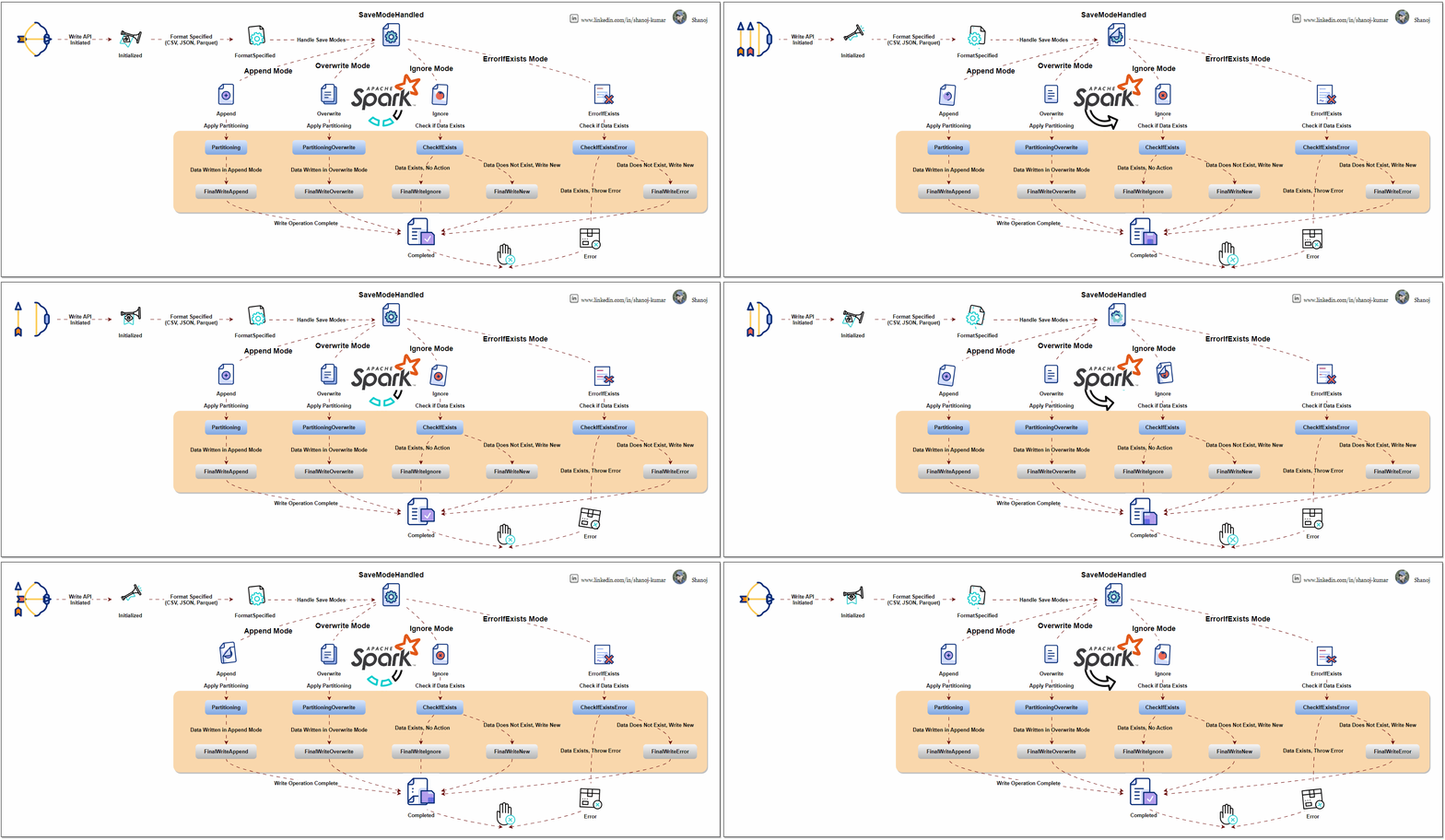
This diagram explains the Apache Spark DataFrame Write API process flow. It starts with an API call to write data in formats like CSV, JSON, or Parquet. The process diverges based on the save mode selected (append, overwrite, ignore, or error). Each mode performs necessary checks and operations, such as partitioning and data write handling. The process ends with either the final write of data or an error, depending on the outcome of these checks and operations.

Apache Spark is an open-source distributed computing system that provides a robust platform for processing large-scale data. The Write API is a fundamental component of Spark’s data processing capabilities, which allows users to write or output data from their Spark applications to different data sources.

Understanding the Spark Write API

Data Sources: Spark supports writing data to a variety of sources, including but not limited to:

  • Distributed file systems like HDFS
  • Cloud storage like AWS S3, Azure Blob Storage
  • Traditional databases (both SQL and NoSQL)
  • Big Data file formats (Parquet, Avro, ORC)

DataFrameWriter: The core class for the Write API is DataFrameWriter. It provides functionality to configure and execute write operations. You obtain a DataFrameWriter by calling the .write method on a DataFrame or Dataset.

Write Modes: Specify how Spark should handle existing data when writing data. Common modes are:

  • append: Adds the new data to the existing data.
  • overwrite: Overwrites existing data with new data.
  • ignore: If data already exists, the write operation is ignored.
  • errorIfExists (default): Throws an error if data already exists.

Format Specification: You can specify the format of the output data, like JSON, CSV, Parquet, etc. This is done using the .format("formatType") method.

Partitioning: For efficient data storage, you can partition the output data based on one or more columns using .partitionBy("column").

Configuration Options: You can set various options specific to the data source, like compression, custom delimiters for CSV files, etc., using .option("key", "value").

Saving the Data: Finally, you use .save("path") to write the DataFrame to the specified path. Other methods .saveAsTable("tableName") are also available for different writing scenarios.

from pyspark.sql import SparkSession
from pyspark.sql import Row
import os

# Initialize a SparkSession
spark = SparkSession.builder \
.appName("DataFrameWriterSaveModesExample") \
.getOrCreate()

# Sample data
data = [
Row(name="Alice", age=25, country="USA"),
Row(name="Bob", age=30, country="UK")
]

# Additional data for append mode
additional_data = [
Row(name="Carlos", age=35, country="Spain"),
Row(name="Daisy", age=40, country="Australia")
]

# Create DataFrames
df = spark.createDataFrame(data)
additional_df = spark.createDataFrame(additional_data)

# Define output path
output_path = "output/csv_save_modes"

# Function to list files in a directory
def list_files_in_directory(path):
files = os.listdir(path)
return files

# Show initial DataFrame
print("Initial DataFrame:")
df.show()

# Write to CSV format using overwrite mode
df.write.csv(output_path, mode="overwrite", header=True)
print("Files after overwrite mode:", list_files_in_directory(output_path))

# Show additional DataFrame
print("Additional DataFrame:")
additional_df.show()

# Write to CSV format using append mode
additional_df.write.csv(output_path, mode="append", header=True)
print("Files after append mode:", list_files_in_directory(output_path))

# Write to CSV format using ignore mode
additional_df.write.csv(output_path, mode="ignore", header=True)
print("Files after ignore mode:", list_files_in_directory(output_path))

# Write to CSV format using errorIfExists mode
try:
additional_df.write.csv(output_path, mode="errorIfExists", header=True)
except Exception as e:
print("An error occurred in errorIfExists mode:", e)


# Stop the SparkSession
spark.stop()

Spark’s Architecture Overview

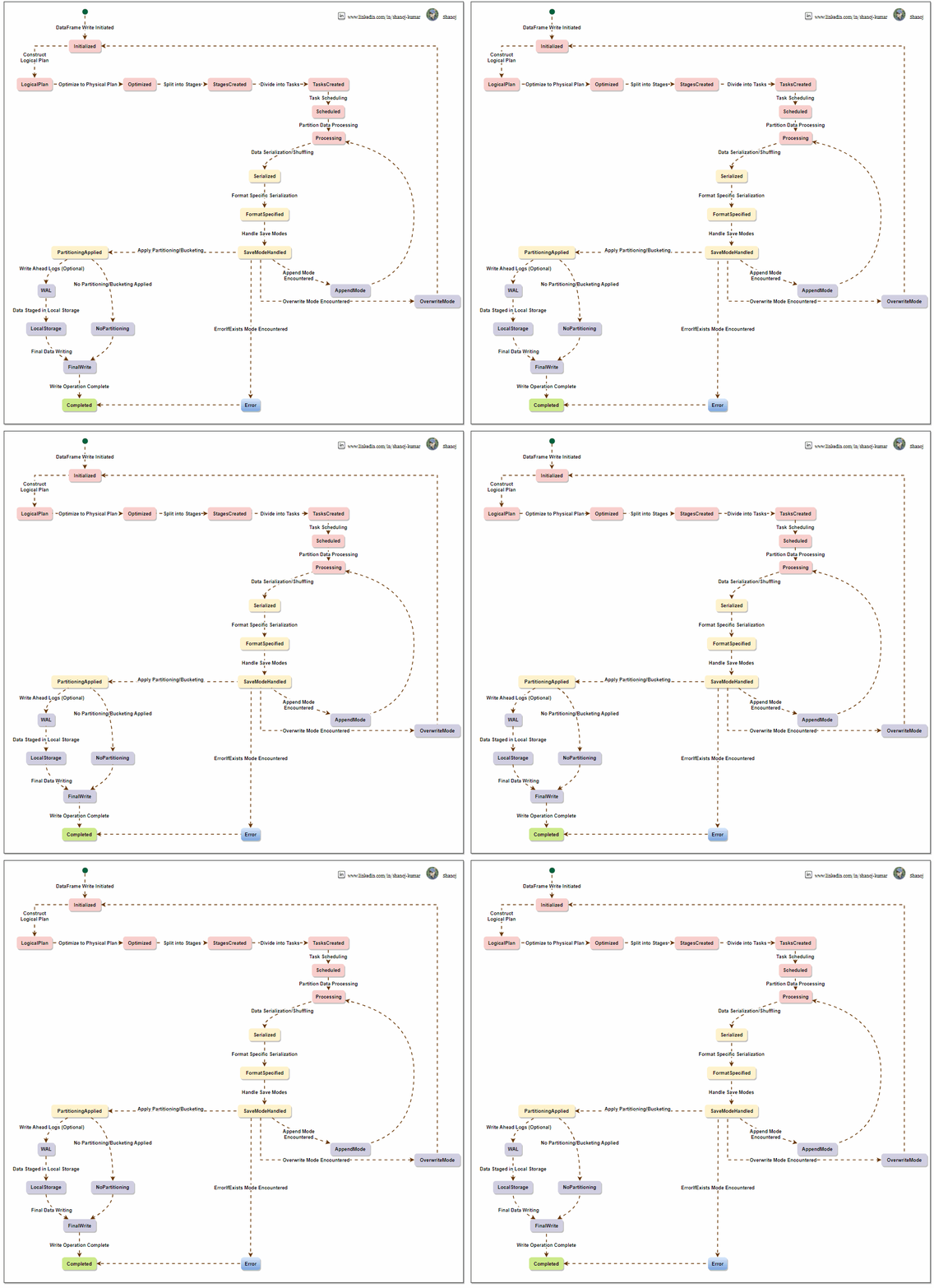
To write a DataFrame in Apache Spark, a sequential process is followed. Spark creates a logical plan based on the user’s DataFrame operations, which is optimized into a physical plan and divided into stages. The system processes data partition-wise, logs it for reliability, and writes it to local storage with defined partitioning and write modes. Spark’s architecture ensures efficient management and scaling of data writing tasks across a computing cluster.

The Apache Spark Write API, from the perspective of Spark’s internal architecture, involves understanding how Spark manages data processing, distribution, and writing operations under the hood. Let’s break it down:

Spark’s Architecture Overview

  1. Driver and Executors: Spark operates on a master-slave architecture. The driver node runs the main() function of the application and maintains information about the Spark application. Executor nodes perform the data processing and write operations.
  2. DAG Scheduler: When a write operation is triggered, Spark’s DAG (Directed Acyclic Graph) Scheduler translates high-level transformations into a series of stages that can be executed in parallel across the cluster.
  3. Task Scheduler: The Task Scheduler launches tasks within each stage. These tasks are distributed among executors.
  4. Execution Plan and Physical Plan: Spark uses the Catalyst optimizer to create an efficient execution plan. This includes converting the logical plan (what to do) into a physical plan (how to do it), considering partitioning, data locality, and other factors.

Writing Data Internally in Spark

Data Distribution: Data in Spark is distributed across partitions. When a write operation is initiated, Spark first determines the data layout across these partitions.

Task Execution for Write: Each partition’s data is handled by a task. These tasks are executed in parallel across different executors.

Write Modes and Consistency:

  • For overwrite and append modes, Spark ensures consistency by managing how data files are replaced or added to the data source.
  • For file-based sources, Spark writes data in a staged approach, writing to temporary locations before committing to the final location, which helps ensure consistency and handling failures.

Format Handling and Serialization: Depending on the specified format (e.g., Parquet, CSV), Spark uses the respective serializer to convert the data into the required format. Executors handle this process.

Partitioning and File Management:

  • If partitioning is specified, Spark sorts and organizes data accordingly before writing. This often involves shuffling data across executors.
  • Spark tries to minimize the number of files created per partition to optimize for large file sizes, which are more efficient in distributed file systems.

Error Handling and Fault Tolerance: In case of a task failure during a write operation, Spark can retry the task, ensuring fault tolerance. However, not all write operations are fully atomic, and specific scenarios might require manual intervention to ensure data integrity.

Optimization Techniques:

  • Catalyst Optimizer: Optimizes the write plan for efficiency, e.g., minimizing data shuffling.
  • Tungsten: Spark’s Tungsten engine optimizes memory and CPU usage during data serialization and deserialization processes.

Write Commit Protocol: Spark uses a write commit protocol for specific data sources to coordinate the process of task commits and aborts, ensuring a consistent view of the written data.


Efficient and reliable data writing is the ultimate goal of Spark’s Write API, which orchestrates task distribution, data serialization, and file management in a complex manner. It utilizes Spark’s core components, such as the DAG scheduler, task scheduler, and Catalyst optimizer, to perform write operations effectively.

Stackademic

Thank you for reading until the end. Before you go:

  • Please consider clapping and following the writer! 👏
  • Follow us on Twitter(X), LinkedIn, and YouTube.
  • Visit Stackademic.com to find out more about how we are democratizing free programming education around the world.

Apache Spark 101: Window Functions

The process begins with data partitioning to enable distributed processing, followed by shuffling and sorting data within partitions and executing partition-level operations. Spark employs a lazy evaluation strategy that postpones the actual computation until an action triggers it. At this point, the Catalyst Optimizer refines the execution plan, including specific optimizations for window functions. The Tungsten Execution Engine executes the plan, optimizing for memory and CPU usage and completing the process.

Apache Spark offers a robust collection of window functions, allowing users to conduct intricate calculations and analysis over a set of input rows. These functions improve the flexibility of Spark’s SQL and DataFrame APIs, simplifying the execution of advanced data manipulation and analytics.

Understanding Window Functions

Window functions in Spark allow users to perform calculations across a set of rows related to the current row. These functions operate on a window of input rows and are particularly useful for ranking, aggregation, and accessing data from adjacent rows without using self-joins.

Common Window Functions

Rank:

  • Assigns a ranking within a window partition, with gaps for tied values.
  • If two rows are tied for rank 1, the next rank will be 3, reflecting the ties in the sequence.

Advantages: Handles ties and provides a clear ranking context.

Disadvantages: Gaps may cause confusion; less efficient on larger datasets due to ranking calculations.

Dense Rank:

  • Operates like rank but without gaps in the ranking order.
  • Tied rows receive the same rank, and the subsequent rank number is consecutive.

Advantages: No gaps in ranking, continuous sequence.

Disadvantages: Less distinction in ties; can be computationally intensive.

Row Number:

  • Gives a unique sequential identifier to each row in a partition.
  • It does not account for ties, as each row is given a distinct number.

Advantages: Assigns a unique identifier; generally faster than rank and dense_rank.

Disadvantages: No tie handling; sensitive to order, which can affect the outcome.

Lead:

  • Provides access to subsequent row data, valid for comparisons with the current row.
  • lead(column, 1) returns the value of column from the next row.

Lag:

  • Retrieves data from the previous row, allowing for retrospective comparison.
  • lag(column, 1) fetches the value of column from the preceding row.

Advantages: Allows for forward and backward analysis; the number of rows to look ahead or back can be specified.

Disadvantages: Edge cases where null is returned for rows without subsequent or previous data; dependent on row order.

These functions are typically used with the OVER clause to define the specifics of the window, such as partitioning and ordering of the rows.

Here’s a simple example to illustrate:

from pyspark.sql import SparkSession
from pyspark.sql.window import Window
import pyspark.sql.functions as F

# Initialize Spark session
spark = SparkSession.builder.appName("windowFunctionsExample").getOrCreate()

# Sample data
data = [("Alice", "Sales", 3000),
("Bob", "Sales", 4600),
("Charlie", "Finance", 5200),
("David", "Sales", 3000),
("Edward", "Finance", 4100)]

# Create DataFrame
columns = ["EmployeeName", "Department", "Salary"]
df = spark.createDataFrame(data, columns)

# Define window specification
windowSpec = Window.partitionBy("Department").orderBy("Salary")

# Apply window functions
df.withColumn("rank", F.rank().over(windowSpec)) \
.withColumn("dense_rank", F.dense_rank().over(windowSpec)) \
.withColumn("row_number", F.row_number().over(windowSpec)) \
.withColumn("lead", F.lead("Salary", 1).over(windowSpec)) \
.withColumn("lag", F.lag("Salary", 1).over(windowSpec)) \
.show()

Common Elements in Spark’s Architecture for Window Functions:

Lazy Evaluation:

Spark’s transformation operations, including window functions, are lazily evaluated. This means the actual computation happens only when an action (like collect or show) is called. This approach allows Spark to optimize the execution plan.

Lazy evaluation in Spark’s architecture allows for the postponement of computations until they are required, enabling the system to optimize the execution plan and minimize unnecessary processing. This approach is particularly beneficial when working with window functions, as it allows Spark to efficiently handle complex calculations and analysis over a range of input rows. The benefits of lazy evaluation in the context of window functions include reduced unnecessary computations, optimized query plans, minimized data movement, and the ability to enable pipelining for efficient task scheduling.

Catalyst Optimizer:

The Catalyst Optimizer applies a series of optimization techniques to enhance query execution time, some particularly relevant to window functions. These optimizations include but are not limited to:

  • Predicate Pushdown: This optimization pushes filters and predicates closer to the data source, reducing the amount of unnecessary data that needs to be processed. When applied to window functions, predicate pushdown can optimize data filtering within the window, leading to more efficient processing.
  • Column Pruning: It eliminates unnecessary columns from being read or loaded during query execution, reducing I/O and memory usage. This optimization can be beneficial when working with window functions, as it minimizes the amount of data that needs to be processed within the window.
  • Constant Folding: This optimization identifies and evaluates constant expressions during query analysis, reducing unnecessary computations during query execution. While not directly related to window functions, constant folding contributes to overall query efficiency.
  • Cost-Based Optimization: It leverages statistics and cost models to estimate the cost of different query plans and selects the most efficient plan based on these estimates. This optimization can help select the most efficient execution plan for window function queries.

The Catalyst Optimizer also involves code generation, where it generates an efficient Java bytecode or optimizes Spark SQL code for executing the query. This code generation process further improves the performance by leveraging the optimizations provided by the underlying execution engine.

In the context of window functions, the Catalyst Optimizer aims to optimize the processing of window operations, including ranking, aggregation, and data access within the window. By applying these optimization techniques, the Catalyst Optimizer contributes to improved performance and efficient execution of Spark SQL queries involving window functions.

Tungsten Execution Engine:

The Tungsten Execution Engine is designed to optimize Spark jobs for CPU and memory efficiency, focusing on the hardware architecture of Spark’s platform. By leveraging off-heap memory management, cache-aware computation, and whole-stage code generation, Tungsten aims to substantially reduce the usage of JVM objects, improve cache locality, and generate efficient code for accessing memory structures.

Integrating the Tungsten Execution Engine with the Catalyst Optimizer allows Spark to handle complex calculations and analysis efficiently, including those involving window functions. This leads to improved performance and optimized data processing.

In the context of window functions, the Catalyst Optimizer generates an optimized physical query plan from the logical query plan by applying a series of transformations. This optimized query plan is then used by the Tungsten Execution Engine to generate optimized code, leveraging the Whole-Stage Codegen functionality introduced in Spark 2.0. The Tungsten Execution Engine focuses on optimizing Spark jobs for CPU and memory efficiency, and it leverages the optimized physical query plan generated by the Catalyst Optimizer to generate efficient code that resembles hand-written code.

Window functions within Spark’s architecture involve several stages:

Data Partitioning:

  • Data is divided into partitions for parallel processing across cluster nodes.
  • For window functions, partitioning is typically done based on specified columns.

Shuffle and Sort:

  • Spark may shuffle data to ensure all rows for a partition are on the same node.
  • Data is then sorted within each partition to prepare for rank calculations.

Rank Calculation and Ties Handling:

  • Ranks are computed within each partition, allowing nodes to process data independently.
  • Ties are managed during sorting, which is made efficient by Spark’s partitioning mechanism.

Lead and Lag Operations:

  • These functions work row-wise within partitions, processing rows in the context of their neighbours.
  • Data locality within partitions minimizes network data transfer, which is crucial for performance.

Execution Plan Optimization:

  • Spark employs lazy evaluation, triggering computations only upon an action request.
  • The Catalyst Optimizer refines the execution plan, aiming to minimize data shuffles.
  • The Tungsten Execution Engine optimizes memory and CPU resources, enhancing the performance of window function calculations.

Apache Spark window functions are a powerful tool for advanced data manipulation and analysis. They enable efficient ranking, aggregation, and access to adjacent rows without complex self-joins. By using these functions effectively, users can unlock the full potential of Apache Spark for analytical and processing needs and derive valuable insights from their data.

Stackademic

Thank you for reading until the end. Before you go:

  • Please consider clapping and following the writer! 👏
  • Follow us on Twitter(X), LinkedIn, and YouTube.
  • Visit Stackademic.com to find out more about how we are democratizing free programming education around the world.