
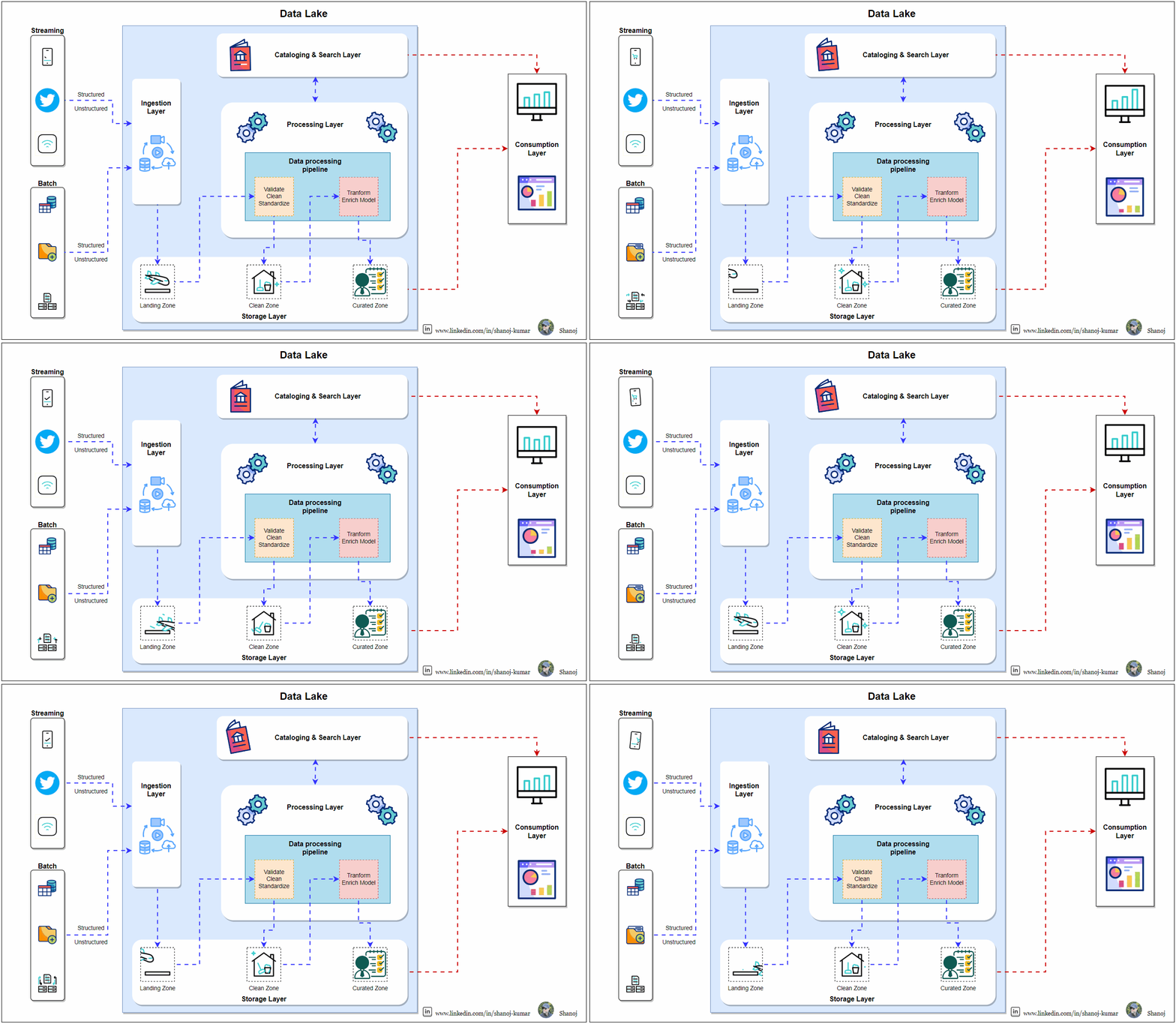
A Data Lake is a centralized location designed to store, process, and protect large amounts of data from various sources in its original format. It is built to manage the scale, versatility, and complexity of big data, which includes structured, semi-structured, and unstructured data. It provides extensive data storage, efficient data management, and advanced analytical processing across different data types. The logical architecture of a Data Lake typically consists of several layers, each with a distinct purpose in the data lifecycle, from data intake to utilization.
Data Delivery Type and Production Cadence
Data within the Data Lake can be delivered in multiple forms, including table rows, data streams, and discrete data files. It supports various production cadences, catering to batch processing and real-time streaming, to meet different operational and analytical needs.
Landing / Raw Zone The Landing or Raw Zone
Is the initial repository for all incoming data, where it is stored in its original, unprocessed form. This area serves as the data’s entry point, maintaining its integrity and ensuring traceability by preserving it immutable.
Clean/Transform Zone
Following the landing zone, data is moved to the Clean/Transform Zone, where it undergoes cleaning, normalization, and transformation. This step prepares the data for analysis by standardizing its format and structure, enhancing data quality and usability.
Cataloguing & Search Layer
The Ingestion Layer manages data entry into the Data Lake, capturing essential metadata and categorizing data appropriately. It supports various data ingestion methods, including batch and real-time streams, facilitating efficient data discovery and management.
Data Structure
The Data Lake accommodates a wide range of data structures, from structured, such as databases and CSV files, to semi-structured, like JSON and XML, and unstructured data, including text documents and multimedia files.
Processing Layer
The Processing Layer is at the heart of the Data Lake, equipped with powerful tools and engines for data manipulation, transformation, and analysis. It facilitates complex data processing tasks, enabling advanced analytics and data science projects.
Curated/Enriched Zone
Data that has been cleaned and transformed is further refined in the Curated/Enriched Zone. It is enriched with additional context or combined with other data sources, making it highly valuable for analytical and business intelligence purposes. This zone hosts data ready for consumption by end-users and applications.
Consumption Layer
Finally, the Consumption Layer provides mechanisms for end-users to access and utilize the data. Through various tools and applications, including business intelligence platforms, data visualization tools, and APIs, users can extract insights and drive decision-making processes based on the data stored in the Data Lake.
AWS Data Lakehouse Architecture

An AWS Data Lakehouse is a powerful combination of data lakes and data warehouses, which utilizes Amazon Web Services to establish a centralized data storage solution. This solution caters to both raw data in its primitive form and the precision required for intricate analysis. By breaking down data silos, a Data Lakehouse strengthens data governance and security while simplifying advanced analytics. It offers businesses an opportunity to uncover new insights while preserving the flexibility of data management and analytical capabilities.
Kinesis Firehose
Amazon Kinesis Firehose is a fully managed service provided by Amazon Web Services (AWS) that enables you to easily capture and load streaming data into data stores and analytics tools. With Kinesis Firehose, you can ingest, transform, and deliver data in real time to various destinations such as Amazon S3, Amazon Redshift, and Amazon Elasticsearch Service. The service is designed to scale automatically to handle any amount of streaming data and requires no administration. Kinesis Firehose supports data formats such as JSON, CSV, and Apache Parquet, among others, and provides built-in data transformation capabilities to prepare data for analysis. With Kinesis Firehose, you can focus on your data processing logic and leave the data delivery infrastructure to AWS.
Amazon CloudWatch
Amazon CloudWatch is a monitoring service that helps you keep track of your operational metrics and logs and sends alerts to optimize performance. It enables you to monitor and collect data on various resources like EC2 instances, RDS databases, and Lambda functions, in real-time. With CloudWatch, you can gain insights into your application’s performance and troubleshoot issues quickly.
Amazon S3 for State Backend
The Amazon S3 state backend serves as the backbone of the Data Lakehouse. It acts as a repository for the state of streaming data, eternally preserving it.
Amazon Kinesis Data Analytics
Amazon Kinesis Data Analytics uses SQL and Apache Flink to provide real-time analytics on streaming data with precision.
Amazon S3
Amazon S3 is a secure, scalable, and resilient storage for the Data Lakehouse’s data.
AWS Glue Data Catalog
The AWS Glue Data Catalog is a fully managed metadata repository that enables easy data discovery, organization, and management for streamlined analytics and processing in the Data Lakehouse. It provides a unified view of all data assets, including databases, tables, and partitions, making it easier for data engineers, analysts, and scientists to find and use the data they need. The AWS Glue Data Catalog also supports automatic schema discovery and inference, making it easier to maintain accurate and up-to-date metadata for all data assets. With the AWS Glue Data Catalog, organizations can improve data governance and compliance, reduce data silos, and accelerate time-to-insight.
Amazon Athena
Amazon Athena enables users to query data in Amazon S3 using standard SQL without ETL complexities, thanks to its serverless and interactive architecture.
Amazon Redshift
Amazon Redshift is a highly efficient and scalable data warehouse service that streamlines the process of data analysis. It is designed to enable users to query vast amounts of structured and semi-structured data stored across their data warehouse, operational database, and data lake using standard SQL. With Amazon Redshift, users can gain valuable insights and make data-driven decisions quickly and easily. Additionally, Amazon Redshift is fully managed, allowing users to focus on their data analysis efforts rather than worrying about infrastructure management. Its flexible pricing model, based on usage, makes it a cost-effective solution for businesses of all sizes.
Consumption Layer
The Consumption Layer includes business intelligence tools and applications like Amazon QuickSight. This layer allows end-users to visualize, analyze, and interpret the processed data to derive actionable business insights.
In Plain English 🚀
Thank you for being a part of the In Plain English community! Before you go:
- Be sure to clap and follow the writer ️👏️️
- Follow us: X | LinkedIn | YouTube | Discord | Newsletter
- Visit our other platforms: Stackademic | CoFeed | Venture
- More content at PlainEnglish.io



 Shanoj