Tag Archives: Data Engineering

GraphQL vs REST API: Building Data-Driven Applications with GraphQL, Python, & Streamlit

A Practical Implementation Guide for Data Engineers & Architects
TL;DR

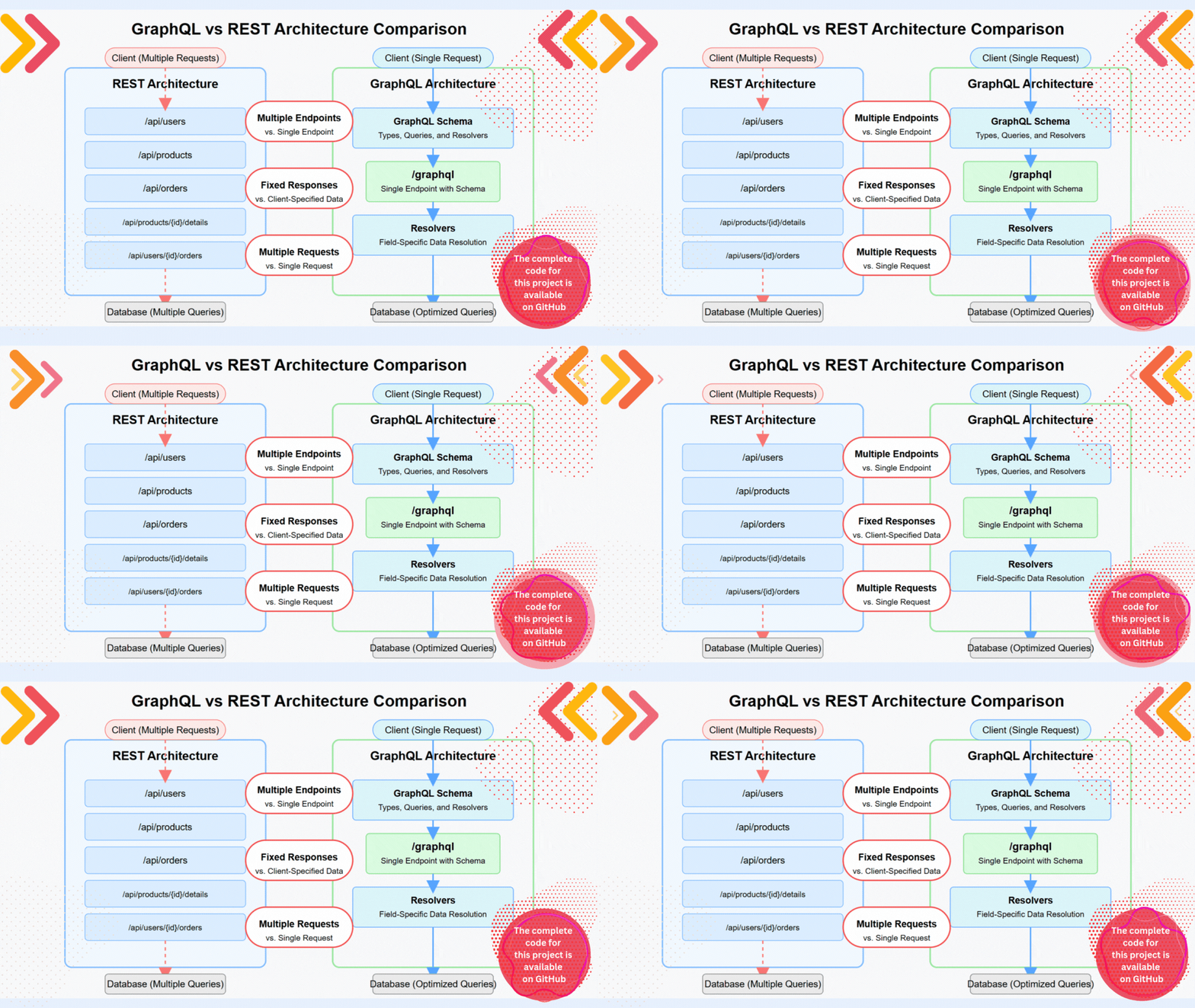
Traditional REST APIs often lead to performance bottlenecks in data-intensive applications due to over-fetching and multiple network round-trips. Our GraphQL implementation with Python, Strawberry GraphQL, and Streamlit reduced API request count by 83%, decreased data transfer by 75%, and improved frontend performance by 76% compared to REST. This article provides a comprehensive implementation guide for creating a GraphQL-based data exploration platform that offers both technical advantages for data engineers and architectural benefits for system designers. By structuring the project with clear separation of concerns and leveraging the declarative nature of GraphQL, we created a more maintainable, efficient, and flexible system that adapts easily to changing requirements.

“If you think good architecture is expensive, try bad architecture.”
 — Brian Foote and Joseph Yoder, Big Ball of Mud

Introduction: The Limitations of REST in Data-Intensive Applications

Have you struggled with slow-loading dashboards, inefficient data fetching, or complex API integrations? These frustrations are often symptoms of the fundamental limitations in REST architecture rather than issues with your implementation.

This article documents our journey from REST to GraphQL, highlighting the specific implementation techniques that transformed our application. We’ll explore the architecture, project structure, and key learnings that you can apply to your data-driven applications.

The Problem: Why REST Struggles with Data Exploration

The Inefficiencies of Traditional API Design

For our data exploration platform, the goals were straightforward: allow users to flexibly query, filter, and visualize dataset information. However, our REST-based approach struggled with several fundamental challenges:

  • Over-fetching: Each endpoint returned complete data objects, even when only a few fields were needed for a particular view.
  • Under-fetching: Complex visualizations required data from multiple endpoints, forcing the frontend to make numerous sequential requests.
  • Rigid endpoints: Adding new data views often required new backend endpoints, creating a tight coupling between frontend and backend development.
  • Complex state management: The frontend needed complex logic to combine and transform data from different endpoints.

These limitations weren’t implementation flaws — they’re inherent to the REST architectural style.

“In the real world, the best architects don’t solve hard problems; they work around them.” — Richard Monson-Haefel, 97 Things Every Software Architect Should Know


Architectural Solution: GraphQL with Python and Streamlit

GraphQL provides a fundamentally different approach to API design that addresses these limitations:

  1. Client-Specified Queries: Clients define exactly what data they need, eliminating over-fetching and under-fetching.
  2. Single Endpoint: All data access goes through one endpoint, simplifying routing and API management.
  3. Strong Type System: The schema defines available operations and types, providing better documentation and tooling.
  4. Hierarchical Data Fetching: Related data can be retrieved in a single request through nested queries.
  • Strawberry GraphQL: A Python library for defining GraphQL schemas using type annotations
  • FastAPI: A high-performance web framework for the API layer
  • Streamlit: An interactive frontend framework for data applications
  • Pandas: For data processing and transformation

This combination creates a full-stack solution that’s both powerful for engineers and accessible for data analysts.

Project Structure and Components

We organized our implementation with a clear separation of concerns, following modern architectural practices:

GIT Repository: graphql-streamlit-project

Project Structure Overview

graphql-streamlit-project/
│── data/ # Dataset files
│ │── dataset.csv # Sample dataset for development

│── backend/
│ │── app.py # FastAPI and GraphQL server
│ │── schema.py # GraphQL schema definitions
│ │── resolvers.py # Query resolvers
│ │── models.py # Data models
│ │── database.py # Data loading/processing

│── frontend/
│ │── app.py # Streamlit application
│ │── components/ # Reusable UI components
│ │ │── query_builder.py # Interactive GraphQL query builder
│ │── graphql_client.py # GraphQL client setup
│ │── pages/ # Different pages of the app
│ │── rest_comparison.py # GraphQL vs REST comparison

│── requirements.txt # Project dependencies
│── README.md # Project documentation

Key Components and Their Responsibilities

Backend Components

  1. app.py: The entry point for the FastAPI application, setting up the GraphQL endpoint and server configuration. This file integrates the GraphQL schema with FastAPI’s routing system.
  2. schema.py: Defines the GraphQL schema using Strawberry’s type annotations. This includes query definitions, mutation definitions (if any), and the relationships between different types.
  3. models.py: Contains the data models that represent the domain objects in our application. These models form the foundation of the GraphQL types exposed in the schema.
  4. resolvers.py: Contains the functions that resolve specific fields in the GraphQL schema. Resolvers connect the schema to actual data sources, handling filtering, pagination, and transformations.
  5. database.py: Handles data access and processing, including loading datasets, caching, and any preprocessing required. This layer abstracts the data sources from the GraphQL layer.

Frontend Components

  1. app.py: The main Streamlit application that provides the user interface and navigation. This file sets up the overall structure and routing of the frontend.
  2. components/query_builder.py: A reusable component that provides an interactive interface for building GraphQL queries. This allows users to explore the data without writing raw GraphQL.
  3. graphql_client.py: Manages communication with the GraphQL API, handling request formatting, error handling, and response processing.
  4. pages/rest_comparison.py: A dedicated page that demonstrates the performance differences between GraphQL and REST approaches through interactive examples.

Component Relationships and Data Flow

The application follows a clear data flow pattern:

  1. Data Access Layer: Loads and processes datasets from files using Pandas
  2. GraphQL Layer: Exposes the data through a strongly-typed schema with resolvers
  3. API Layer: Serves the GraphQL endpoint via FastAPI
  4. Client Layer: Communicates with the API using structured GraphQL queries
  5. Presentation Layer: Visualizes the data through interactive Streamlit components
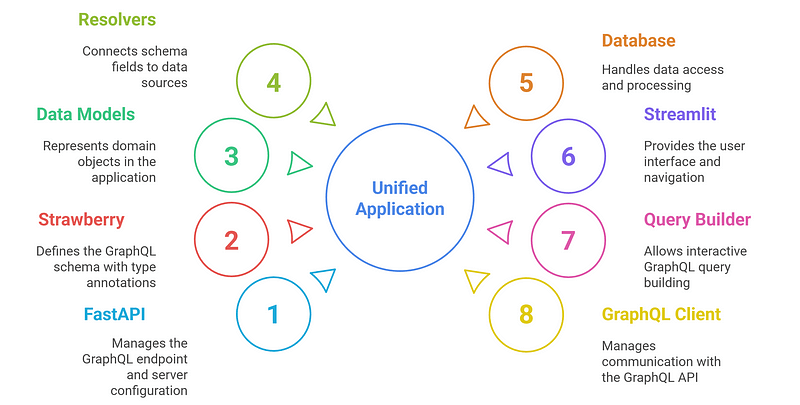
This architecture provides clean separation of concerns while maintaining the efficiency benefits of GraphQL.

“The only way to go fast is to go well.” — Robert C. Martin, Clean Architecture

Implementation Insights

Schema Design Principles

The GraphQL schema forms the contract between the frontend and backend, making it a critical architectural component. Our schema design followed several key principles:

  1. Domain-Driven Types: We modeled our GraphQL types after the domain objects in our application, not after our data storage structure. This ensured our API remained stable even if the underlying data sources changed.
  2. Granular Field Selection: We designed our types to allow precise field selection, letting clients request exactly what they needed.
  3. Pagination and Filtering: We included consistent pagination and filtering options across all collection queries, using optional arguments with sensible defaults.
  4. Self-Documentation: We added detailed descriptions to all types, fields, and arguments, creating a self-documenting API.

For example, our main Item type included fields for basic information, while allowing related data to be requested only when needed:

  • Basic fields: id, name, value, category
  • Optional related data: history, details, related items

This approach eliminated over-fetching while maintaining the flexibility to request additional data when necessary.

Resolver Implementation Strategies

Resolvers connect the GraphQL schema to data sources, making their implementation critical for performance. We adopted several strategies to optimize our resolvers:

  1. Field-Level Resolution: Rather than fetching entire objects, we structured resolvers to fetch only the specific fields requested in the query.
  2. Batching and Caching: We implemented DataLoader patterns to batch database queries and cache results, preventing the N+1 query problem common in GraphQL implementations.
  3. Selective Loading: Our resolvers examined the requested fields to optimize data retrieval, loading only necessary data.
  4. Early Filtering: We applied filters as early as possible in the data access chain to minimize memory usage and processing time.

These strategies ensured our GraphQL API remained efficient even for complex, nested queries.

“No data is clean, but most is useful.” — Dean Abbott

Frontend Integration Approach

The frontend uses Streamlit to provide an intuitive, interactive interface for data exploration:

  1. Query Builder Component: We created a visual query builder that lets users construct GraphQL queries without writing raw GraphQL syntax. This includes field selection, filtering, and pagination controls.
  2. Real-Time Visualization: Query results are immediately visualized using Plotly charts, providing instant feedback as users explore the data.
  3. REST Comparison Page: A dedicated page demonstrates the performance differences between GraphQL and REST approaches, showing metrics like request count, data size, and execution time.
  4. Error Handling: Comprehensive error handling provides meaningful feedback when queries fail, improving the debugging experience.

This approach makes the power of GraphQL accessible to users without requiring them to understand the underlying technology.

Performance Results: GraphQL vs REST

Our comparison tests revealed significant performance advantages for GraphQL:

Quantitative Metrics

“Those companies that view data as a strategic asset are the ones that will survive and thrive.” — Thomas H. Davenport

Real-World Scenario: Related Data Retrieval

For a common data exploration scenario — fetching items and their details — the difference was dramatic:

REST Approach:

  • Initial request for a list of items
  • Separate requests for each item’s details
  • Multiple round trips with cumulative latency
  • Each response includes unnecessary fields

GraphQL Approach:

  • Single request specifying exactly what’s needed
  • All related data retrieved in one operation
  • No latency from sequential requests
  • Response contains only requested fields

Business Impact

These technical improvements translated to tangible business benefits:

  1. Improved User Experience: Pages loaded 76% faster with GraphQL, leading to higher user engagement and satisfaction.
  2. Reduced Development Time: Frontend developers spent 70% less time implementing data fetching logic, accelerating feature delivery.
  3. Lower Infrastructure Costs: The 75% reduction in data transfer reduced bandwidth costs and server load.
  4. Enhanced Flexibility: New views and visualizations could be added without backend changes, improving agility.
  5. Better Maintainability: The structured, type-safe nature of GraphQL reduced bugs and improved code quality.

These benefits demonstrate how a well-implemented GraphQL API can deliver value beyond pure technical metrics.


Architectural Patterns and Design Principles

Our implementation exemplifies several key architectural patterns and design principles that are applicable across different domains:

1. Separation of Concerns

The project structure maintains clear boundaries between data access, API definition, business logic, and presentation. This separation makes the codebase more maintainable and allows components to evolve independently.

2. Schema-First Design

By defining a comprehensive GraphQL schema before implementation, we established a clear contract between the frontend and backend. This approach facilitates parallel development and ensures all components have a shared understanding of the data model.

3. Declarative Data Requirements

GraphQL’s declarative nature allows clients to express exactly what data they need, reducing the coupling between client and server. This principle enhances flexibility and efficiency throughout the system.

4. Progressive Enhancement

The architecture supports progressive enhancement, allowing basic functionality with simple queries while enabling more advanced features through more complex queries. This makes the application accessible to different skill levels and use cases.

5. Single Source of Truth

The GraphQL schema serves as a single source of truth for API capabilities, eliminating the documentation drift common in REST APIs. This self-documenting nature improves developer experience and reduces onboarding time.

“All architecture is design but not all design is architecture. Architecture represents the significant design decisions that shape a system, where significant is measured by cost of change.” — Grady Booch, as cited in 97 Things Every Software Architect Should Know


Lessons Learned and Best Practices

Through our implementation, we identified several best practices for GraphQL applications:

1. Schema Design

  • Start with the Domain: Design your schema based on your domain objects, not your data storage
  • Think in Graphs: Model relationships between entities explicitly
  • Use Meaningful Types: Create specific input and output types rather than generic structures
  • Document Everything: Add descriptions to types, fields, and arguments

2. Performance Optimization

  • Implement DataLoader Patterns: Batch and cache database queries to prevent N+1 query problems
  • Apply Query Complexity Analysis: Assign “costs” to fields and limit query complexity
  • Use Persisted Queries: In production, consider allowing only pre-approved queries
  • Monitor Resolver Performance: Track execution time of individual resolvers to identify bottlenecks

3. Frontend Integration

  • Build Query Abstractions: Create higher-level components that handle GraphQL queries for specific use cases
  • Implement Caching: Use client-side caching for frequently accessed data
  • Provide Visual Query Building: Not all users will be comfortable with raw GraphQL syntax
  • Handle Partial Results: Design UIs to handle partially successful queries gracefully

4. Team Organization

  • Schema Reviews: Treat schema changes as API contracts that require careful review
  • Collaborative Schema Design: Involve both frontend and backend teams in schema decisions
  • GraphQL-First Development: Design the schema before implementing either client or server
  • Incremental Adoption: Consider implementing GraphQL alongside existing REST APIs initially

These practices help teams maximize the benefits of GraphQL while avoiding common pitfalls.

“Much like an investment broker, the architect is being allowed to play with their client’s money, based on the premise that their activity will yield an acceptable return on investment.” — Richard Monson-Haefel, 97 Things Every Software Architect Should Know


Future Enhancements

As we continue to evolve our platform, several enhancements are planned:

1. Advanced GraphQL Features

  • Mutations for Data Modification: Implementing create, update, and delete operations
  • Subscriptions for Real-Time Updates: Adding WebSocket support for live data changes
  • Custom Directives: Creating specialized directives for authorization and formatting

2. Performance Enhancements

  • Automated Persisted Queries: Caching queries on the server for reduced network overhead
  • Query Optimization: Analyzing query patterns to optimize data access
  • Edge Caching: Implementing CDN-level caching for common queries

3. User Experience Improvements

  • Enhanced Query Builder: Adding more intuitive controls for complex query construction
  • Advanced Visualizations: Implementing more sophisticated data visualization options
  • Collaborative Features: Enabling sharing and collaboration on queries and visualizations

4. Integration Capabilities

  • API Gateway Integration: Positioning GraphQL as an API gateway for multiple data sources
  • Authentication and Authorization: Adding field-level access control
  • External Service Integration: Incorporating data from third-party APIs

These enhancements will further leverage the flexibility and efficiency of GraphQL for data exploration.

“Software architects have to take responsibility for their decisions as they have much more influential power in software projects than most people in organizations.” — Richard Monson-Haefel, 97 Things Every Software Architect Should Know


Conclusion: From REST to GraphQL

Our journey from REST to GraphQL demonstrated clear advantages for data-intensive applications:

  • Reduced Network Overhead: Fewer requests and smaller payloads
  • Improved Developer Experience: Stronger typing and better tooling
  • Enhanced Flexibility: Frontend can evolve without backend changes
  • Better Performance: Faster load times and reduced server load

While GraphQL isn’t a silver bullet for all API needs, it offers compelling benefits for applications with complex, interconnected data models or diverse client requirements.

“The goal of development is to increase awareness.” — Robert C. Martin, Clean Architecture

By adopting GraphQL with a well-structured architecture, teams can create more efficient, flexible, and maintainable data-driven applications. The combination of GraphQL, Python, and Streamlit provides a powerful toolkit for building modern applications that deliver both technical excellence and business value.

Thank you for being a part of the community

Before you go:

How We Built LLM Infrastructure That Actually Works — And What We Learned

A Data Engineer’s Complete Roadmap: From Napkin Diagrams to Production-Ready Architecture

TL;DR

This article provides data engineers with a comprehensive breakdown of the specialized infrastructure needed to effectively implement and manage Large Language Models. We examine the unique challenges LLMs present for traditional data infrastructure, from compute requirements to vector databases. Offering both conceptual explanations and hands-on implementation steps, this guide bridges the gap between theory and practice with real-world examples and solutions. Our approach uniquely combines architectural patterns like RAG with practical deployment strategies to help you build performant, cost-efficient LLM systems.

The Problem (Why Does This Matter?)

Large Language Models have revolutionized how organizations process and leverage unstructured text data. From powering intelligent chatbots to automating content generation and enabling advanced data analysis, LLMs are rapidly becoming essential components of modern data stacks. For data engineers, this represents both an opportunity and a significant challenge.

The infrastructure traditionally used for data management and processing simply wasn’t designed for LLM workloads. Here’s why that matters:

Scale and computational demands are unprecedented. LLMs require massive computational resources that dwarf traditional data applications. While a typical data pipeline might process gigabytes of structured data, LLMs work with billions of parameters and are trained on terabytes of text, requiring specialized hardware like GPUs and TPUs.

Unstructured data dominates the landscape. Traditional data engineering focuses on structured data in data warehouses with well-defined schemas. LLMs primarily consume unstructured text data that doesn’t fit neatly into conventional ETL paradigms or relational databases.

Real-time performance expectations have increased. Users expect LLM applications to respond with human-like speed, creating demands for low-latency infrastructure that can be difficult to achieve with standard setups.

Data quality has different dimensions. While data quality has always been important, LLMs introduce new dimensions of concern, including training data biases, token optimization, and semantic drift over time.

These challenges are becoming increasingly urgent as organizations race to integrate LLMs into their operations. According to a recent survey, 78% of enterprise organizations are planning to implement LLM-powered applications by the end of 2025, yet 65% report significant infrastructure limitations as their primary obstacle.

Without specialized infrastructure designed explicitly for LLMs, data engineers face:

  • Prohibitive costs from inefficient resource utilization
  • Performance bottlenecks that impact user experience
  • Scalability limitations that prevent enterprise-wide adoption
  • Integration difficulties with existing data ecosystems

“The gap between traditional data infrastructure and what’s needed for effective LLM implementation is creating a new digital divide between organizations that can harness this technology and those that cannot.”

The Solution (Conceptual Overview)

Building effective LLM infrastructure requires a fundamentally different approach to data engineering architecture. Let’s examine the key components and how they fit together.

Core Infrastructure Components

A robust LLM infrastructure rests on four foundational pillars:

  1. Compute Resources: Specialized hardware optimized for the parallel processing demands of LLMs, including:
  • GPUs (Graphics Processing Units) for training and inference
  • TPUs (Tensor Processing Units) for TensorFlow-based implementations
  • CPU clusters for certain preprocessing and orchestration tasks

2. Storage Solutions: Multi-tiered storage systems that balance performance and cost:

  • Object storage (S3, GCS, Azure Blob) for large training datasets
  • Vector databases for embedding storage and semantic search
  • Caching layers for frequently accessed data

3. Networking: High-bandwidth, low-latency connections between components:

  • Inter-node communication for distributed training
  • API gateways for service endpoints
  • Content delivery networks for global deployment

4. Data Management: Specialized tools and practices for handling LLM data:

  • Data ingestion pipelines for unstructured text
  • Vector embedding generation and management
  • Data versioning and lineage tracking

The following comparison highlights the key differences between traditional data infrastructure and LLM-optimized infrastructure:

Key Architectural Patterns

Two architectural patterns have emerged as particularly effective for LLM infrastructure:

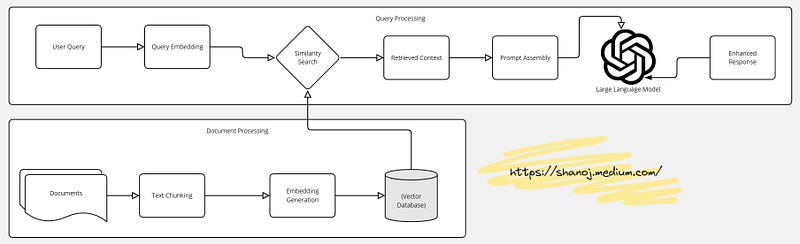
1. Retrieval-Augmented Generation (RAG)

RAG enhances LLMs by enabling them to access external knowledge beyond their training data. This pattern combines:

  • Text embedding models that convert documents into vector representations
  • Vector databases that store these embeddings for efficient similarity search
  • Prompt augmentation that incorporates retrieved-context into LLM queries

RAG solves the critical “hallucination” problem where LLMs generate plausible but incorrect information by grounding responses in factual source material.

2. Hybrid Deployment Models

Rather than choosing between cloud and on-premises deployment, a hybrid approach offers optimal flexibility:

  • Sensitive workloads and proprietary data remain on-premises
  • Burst capacity and specialized services leverage cloud resources
  • Orchestration layers manage workload placement based on cost, performance, and compliance needs

This pattern allows organizations to balance control, cost, and capability while avoiding vendor lock-in.

Why This Approach Is Superior

This infrastructure approach offers several advantages over attempting to force-fit LLMs into traditional data environments:

  • Cost Efficiency: By matching specialized resources to specific workload requirements, organizations can achieve 30–40% lower total cost of ownership compared to general-purpose infrastructure.
  • Scalability: The distributed nature of this architecture allows for linear scaling as demands increase, avoiding the exponential cost increases typical of monolithic approaches.
  • Flexibility: Components can be upgraded or replaced independently as technology evolves, protecting investments against the rapid pace of LLM advancement.
  • Performance: Purpose-built components deliver optimized performance, with inference latency improvements of 5–10x compared to generic infrastructure.

Implementation

Let’s walk through the practical steps to implement a robust LLM infrastructure, focusing on the essential components and configuration.

Step 1: Configure Compute Resources

Set up appropriate compute resources based on your workload requirements:

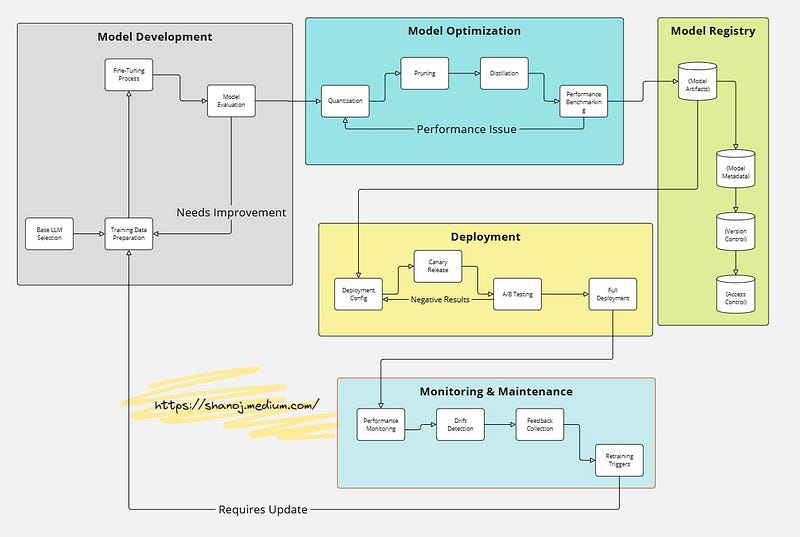
  • For Training: High-performance GPU clusters (e.g., NVIDIA A100s) with NVLink for inter-GPU communication
  • For Inference: Smaller GPU instances or specialized inference accelerators with model quantization
  • For Data Processing: CPU clusters for preprocessing and orchestration tasks

Consider using auto-scaling groups to dynamically adjust resources based on workload demands.

Step 2: Set Up Distributed Storage

Implement a multi-tiered storage solution:

  • Object Storage: Set up cloud object storage (S3, GCS) for large datasets and model artifacts
  • Vector Database: Deploy a vector database (Pinecone, Weaviate, Chroma) for embedding storage and retrieval
  • Caching Layer: Implement Redis or similar for caching frequent queries and responses

Configure appropriate lifecycle policies to manage storage costs by automatically transitioning older data to cheaper storage tiers.

Step 3: Implement Data Processing Pipelines

Create robust pipelines for processing unstructured text data:

  • Data Collection: Implement connectors for various data sources (databases, APIs, file systems)
  • Preprocessing: Build text cleaning, normalization, and tokenization workflows
  • Embedding Generation: Set up services to convert text into vector embeddings
  • Vector Indexing: Create processes to efficiently index and update vector databases

Use workflow orchestration tools like Apache Airflow to manage dependencies and scheduling.

Step 4: Configure Model Management

Set up infrastructure for model versioning, deployment, and monitoring:

  • Model Registry: Establish a central repository for model versions and artifacts
  • Deployment Pipeline: Create CI/CD workflows for model deployment
  • Monitoring System: Implement tracking for model performance, drift, and resource utilization
  • A/B Testing Framework: Build infrastructure for comparing model versions in production

Step 5: Implement RAG Architecture

Set up a Retrieval-Augmented Generation system:

  • Document Processing: Create pipelines for chunking and embedding documents
  • Vector Search: Implement efficient similarity search capabilities
  • Context Assembly: Build services that format retrieved context into prompts
  • Response Generation: Set up LLM inference endpoints that incorporate retrieved context

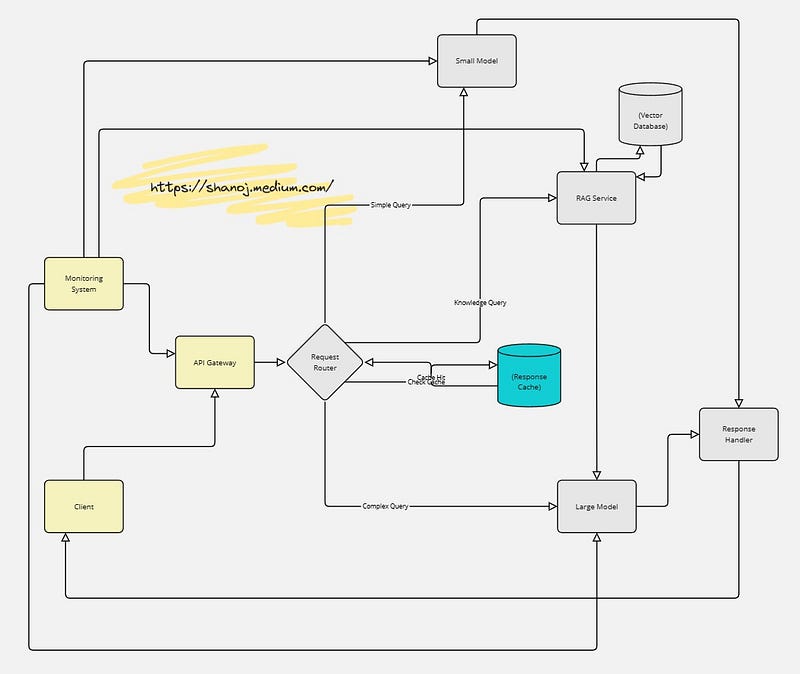
Step 6: Deploy a Serving Layer

Create a robust serving infrastructure:

  • API Gateway: Set up unified entry points with authentication and rate limiting
  • Load Balancer: Implement traffic distribution across inference nodes
  • Caching: Add result caching for common queries
  • Fallback Mechanisms: Create graceful degradation paths for system failures

Challenges & Learnings

Building and managing LLM infrastructure presents several significant challenges. Here are the key obstacles we’ve encountered and how to overcome them:

Challenge 1: Data Drift and Model Performance Degradation

LLM performance often deteriorates over time as the statistical properties of real-world data change from what the model was trained on. This “drift” occurs due to evolving terminology, current events, or shifting user behaviour patterns.

The Problem: In one implementation, we observed a 23% decline in customer satisfaction scores over six months as an LLM-powered support chatbot gradually provided increasingly outdated and irrelevant responses.

The Solution: Implement continuous monitoring and feedback loops:

  1. Regular evaluation: Establish a benchmark test set that’s periodically updated with current data.
  2. User feedback collection: Implement explicit (thumbs up/down) and implicit (conversation abandonment) feedback mechanisms.
  3. Continuous fine-tuning: Schedule regular model updates with new data while preserving performance on historical tasks.

Key Learning: Data drift is inevitable in LLM applications. Build infrastructure with the assumption that models will need ongoing maintenance, not just one-time deployment.

Challenge 2: Scaling Costs vs. Performance

The computational demands of LLMs create a difficult balancing act between performance and cost management.

The Problem: A financial services client initially deployed their document analysis system using full-precision models, resulting in monthly cloud costs exceeding $75,000 with average inference times of 2.3 seconds per query.

The Solution: Implement a tiered serving approach:

  1. Model quantization: Convert models from 32-bit to 8-bit or 4-bit precision, reducing memory footprint by 75%.
  2. Query routing: Direct simple queries to smaller models and complex queries to larger models.
  3. Result caching: Cache common query results to avoid redundant processing.
  4. Batch processing: Aggregate non-time-sensitive requests for more efficient processing.

Key Learning: There’s rarely a one-size-fits-all approach to LLM deployment. A thoughtful multi-tiered architecture that matches computational resources to query complexity can reduce costs by 60–70% while maintaining or even improving performance for most use cases.

Challenge 3: Integration with Existing Data Ecosystems

LLMs don’t exist in isolation; they need to connect with existing data sources, applications, and workflows.

The Problem: A manufacturing client struggled to integrate their LLM-powered equipment maintenance advisor with their existing ERP system, operational databases, and IoT sensor feeds.

The Solution: Develop a comprehensive integration strategy:

  1. API standardization: Create consistent REST and GraphQL interfaces for LLM services.
  2. Data connector framework: Build modular connectors for common data sources (SQL databases, document stores, streaming platforms).
  3. Authentication middleware: Implement centralized auth to maintain security across systems.
  4. Event-driven architecture: Use message queues and event streams to decouple systems while maintaining data flow.

Key Learning: Integration complexity often exceeds model deployment complexity. Allocate at least 30–40% of your infrastructure planning to integration concerns from the beginning, rather than treating them as an afterthought.

Results & Impact

Properly implemented LLM infrastructure delivers quantifiable improvements across multiple dimensions:

Performance Metrics

Organizations that have adopted the architectural patterns described in this guide have achieved remarkable improvements:

Before-and-After Scenarios


Building effective LLM infrastructure represents a significant evolution in data engineering practice. Rather than simply extending existing data pipelines, organizations need to embrace new architectural patterns, hardware configurations, and deployment strategies specifically optimized for language models.

The key takeaways from this guide include:

  1. Specialized hardware matters: The right combination of GPUs, storage, and networking makes an enormous difference in both performance and cost.
  2. Architectural patterns are evolving rapidly: Techniques like RAG and hybrid deployment are becoming standard practice for production LLM systems.
  3. Integration is as important as implementation: LLMs deliver maximum value when seamlessly connected to existing data ecosystems.
  4. Monitoring and maintenance are essential: LLM infrastructure requires continuous attention to combat data drift and optimize performance.

Looking ahead, several emerging trends will likely shape the future of LLM infrastructure:

  • Hardware specialization: New chip designs specifically optimized for inference workloads will enable more cost-efficient deployments.
  • Federated fine-tuning: The ability to update models on distributed data without centralization will address privacy concerns.
  • Multimodal infrastructure: Systems designed to handle text, images, audio, and video simultaneously will become increasingly important.
  • Automated infrastructure optimization: AI-powered tools that dynamically tune infrastructure parameters based on workload characteristics.

To start your journey of building effective LLM infrastructure, consider these next steps:

  1. Audit your existing data infrastructure to identify gaps that would impact LLM performance
  2. Experiment with small-scale RAG implementations to understand the integration requirements
  3. Evaluate cloud vs. on-premises vs. hybrid approaches based on your organization’s needs
  4. Develop a cost model that captures both direct infrastructure expenses and potential efficiency gains

What challenges are you facing with your current LLM infrastructure, and which architectural pattern do you think would best address your specific use case?

Thank you for being a part of the community

Before you go:

OLAP: The Continuum from Transactions (OLTP)

This article is my answer to many colleagues who often ask me, “If you were designing a data solution, what would you incorporate?” In real life, we rarely get the privilege of designing a solution from scratch, end to end. More often than not, we work with systems already designed and implemented by someone else. That, in itself, is a trade-off we all have to accept at some point. But nothing stops us from learning, reflecting, and studying from those systems — especially learning from the mistakes that might have been made.

This article is about exactly that: learning from what’s been done and thinking about what could have been improved. One key thing I’ve noticed in many data environments is the absence of a master data layer. Data analysts or data scientists often query directly from raw, unstructured snapshot data instead of working from properly curated master data. This leads to inefficient analysis and unreliable insights.

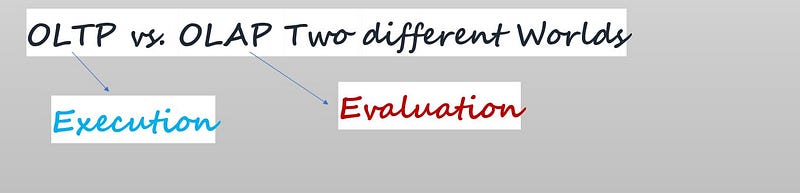
Let’s explore how a properly designed data flow can address these challenges using the OLTP-to-OLAP continuum.

1. Production Database Snapshots

In any data-driven system, the starting point is usually OLTP systems. These systems handle real-time transactions — whether it’s a customer placing an order, transferring money, or updating account details. Every operational activity generates data, and these systems are optimized to record that data at high speed.

However, while OLTP systems are excellent at handling transactions, they are not designed for complex data analysis. This is where production database snapshots come into play. These snapshots provide a periodic snapshot of the operational data, preserving the state of the system at a given moment. The key challenge here is what happens next: if you query directly from this raw snapshot, you’re likely to run into performance and consistency issues.

In an ideal scenario, we should move this snapshot data into a more structured format, setting the stage for accurate and meaningful analysis.

2. Master Data

This is where many data environments struggle. In the absence of a master data layer, analysts are forced to work with raw, inconsistent data. Master data provides a single source of truth, cleaning, organizing, and harmonizing disparate data sources.

For instance, imagine trying to analyze customer data across multiple products without a master data layer. Without a unified view of the customer, you end up with fragmented and sometimes contradictory data. This makes it harder to draw meaningful insights. The master data layer addresses this by creating consistent, well-organized records of key entities like customers, products, transactions, and more.

If I were designing a data solution, ensuring a solid master data layer would be one of my top priorities. This foundational layer improves the quality of data and ensures that all subsequent analyses are based on accurate, reliable information.

3. OLAP Cubes

Once the master data is set, the next step is processing it through OLAP cubes. OLAP systems are designed to handle complex, multidimensional queries that allow for deep analysis. For example, an OLAP cube might allow a company to analyze sales data by region, product category, and time period simultaneously.

The power of OLAP lies in its ability to aggregate data and provide quick access to insights across various dimensions. This is especially important in industries like finance, retail, or logistics, where understanding patterns and trends across different variables is critical for decision-making.

In many environments I’ve observed, OLAP systems are either underutilized or not implemented at all. This results in slow, inefficient analysis that can’t keep up with the speed of modern business. In contrast, using OLAP cubes to handle the heavy lifting of data aggregation ensures that insights can be generated faster and more efficiently.

4. Metrics

At the end of the continuum, we reach metrics — the ultimate output of the entire data pipeline. Whether it’s tracking sales performance, customer behavior, or operational efficiency, these metrics provide the actionable insights that drive business decisions.

However, the quality of these metrics depends entirely on the previous steps. Without proper data snapshots, master data, or OLAP cubes, the metrics generated will be unreliable. If each stage of the continuum is carefully managed, the metrics produced will be accurate and insightful, providing the information decision-makers need to act with confidence.


The key takeaway here is that in any data solution, from the most basic to the most complex, structure matters. A well-designed pipeline ensures that data flows smoothly from OLTP systems to OLAP analysis, ultimately providing the metrics needed to inform business strategy.

Stackademic 🎓

Thank you for reading until the end. Before you go:

SQL for Data Engineering: Window Functions and Common Table Expressions (CTEs)

This article is inspired by a true story involving one of my close friends. He’s a backend developer, not a database expert, but during a recent interview, he was grilled heavily on SQL. After hearing about his experience, I realized something that might resonate with many of you: the days when SQL knowledge was limited to basic GROUP BY and JOIN operations are long gone. Today, the depth of SQL skills required—especially in data engineering roles—demands much more. If you’re preparing for interviews, you’ll need to master more advanced concepts, like window functions and Common Table Expressions (CTEs), to truly stand out.

“In theory, there is no difference between theory and practice. But in practice, there is.” — Yogi Berra

Why Focus on Window Functions in SQL?

As my friend’s story reminded me, SQL interviews aren’t just about basic querying anymore. Window functions, in particular, have become a critical part of data engineering interviews. Whether it’s ranking transactions, calculating rolling metrics, or handling complex partitioning, window functions allow you to perform operations that basic SQL can’t easily handle.

Let’s start by breaking down window functions and why they’re essential in real-world scenarios, especially when working with large-scale data.

What is a Window Function?

A window function is a SQL tool that allows you to perform calculations across a set of rows that are somehow related to the current row. Think of it as looking at a “window” of surrounding rows to compute things like cumulative sums, ranks, or moving averages.

The most common window functions are:

  • LAG: Fetches the value from the previous row.
  • LEAD: Fetches the value from the next row.
  • RANK: Assigns ranks to rows, skipping numbers when there are ties.
  • DENSE_RANK: Similar to RANK but doesn’t skip numbers.
  • ROW_NUMBER: Assigns unique sequential numbers to rows, without ties.

These functions come in handy when dealing with tasks like analyzing customer transactions, calculating running totals, or ranking entries in financial datasets. Now, let’s move into a practical banking example that you might encounter in an interview.

Example: Identifying Top Three Transactions by Amount for Each Customer

Imagine you’re asked in an interview: “Find the top three largest transactions for each customer in the past year.” Right away, you should recognize that a simple GROUP BY or JOIN won’t work here—you’ll need a window function to rank transactions by amount for each customer.

Here’s how to approach it using the ROW_NUMBER function:

WITH customer_transactions AS (
SELECT customer_id, transaction_id, transaction_date, amount,
ROW_NUMBER() OVER (PARTITION BY customer_id ORDER BY amount DESC) AS transaction_rank
FROM transactions
WHERE transaction_date >= DATEADD(year, -1, GETDATE())
)
SELECT customer_id, transaction_id, transaction_date, amount
FROM customer_transactions
WHERE transaction_rank <= 3;

In this query:

  • The PARTITION BY clause divides the data into groups by customer.
  • The ORDER BY clause ranks the transactions based on the amount, from highest to lowest.
  • The ROW_NUMBER() function assigns a unique rank to each transaction for each customer, allowing you to filter out the top three for each.

This example goes beyond basic SQL skills, showcasing how window functions enable you to solve more complex real-world problems — something you’ll encounter frequently in interviews and on the job.

Keywords That Hint at Using Window Functions

In a SQL interview, look out for keywords that signal the need for window functions:

  • Rolling (e.g., rolling sum or average of balances)
  • Rank (e.g., top transactions, highest loan amounts)
  • Consecutive (e.g., consecutive late payments)
  • De-duplicate (e.g., identifying unique customer transactions)

For example, a question like “Give me the top five deposits per account over the past six months” is a clear indication that a window function — such as RANK or ROW_NUMBER—is required.

Understanding the Components of a Window Function

Each window function consists of three main components:

  1. Function: This could be something like SUM(), RANK(), or LAG().
  2. OVER() Clause: Defines the window, i.e., the rows across which the function is applied. Without this, it’s just a regular aggregate function. This is where PARTITION BY and ORDER BY come into play.
  3. Optional ROWS Clause: Rarely used but powerful when you need to calculate things like rolling averages or sums over a defined number of rows.

Let’s look at a practical example for a bank that wants to calculate the rolling 30-day balance for each customer’s account:

SELECT customer_id, transaction_date, 
SUM(amount) OVER (PARTITION BY customer_id ORDER BY transaction_date
ROWS BETWEEN 29 PRECEDING AND CURRENT ROW) AS rolling_balance
FROM transactions;
  • ROWS BETWEEN 29 PRECEDING AND CURRENT ROW defines a 30-day window for the balance calculation.
  • The result is a rolling sum of account balances over the last 30 days for each customer, a common requirement in banking data analysis.

Common Table Expressions (CTEs): Your Best Friend for Complex Queries

CTEs are another key tool in advanced SQL, especially for interviews. A CTE allows you to define a temporary result set that can be referenced within the main query, making your code more readable and maintainable.

Syntax of a CTE:

WITH cte_name AS (
SELECT column1, column2
FROM table
WHERE condition
)
SELECT *
FROM cte_name
WHERE another_condition;

Let’s extend our banking example. Suppose you’re asked to identify customers who have made consecutive late payments. Instead of cluttering your query with subqueries, you can simplify it using a CTE:

WITH customer_late_payments AS (
SELECT customer_id, payment_date,
LAG(payment_status) OVER (PARTITION BY customer_id ORDER BY payment_date) AS previous_payment_status
FROM payments
WHERE payment_status = 'Late'
)
SELECT customer_id, COUNT(*) AS consecutive_late_payments
FROM customer_late_payments
WHERE previous_payment_status = 'Late'
GROUP BY customer_id;

In this case, the LAG() function helps identify whether the previous payment was also marked as “Late.” This query identifies customers with consecutive late payments, a typical use case in risk management for banks.

When to Use CTEs vs. Subqueries vs. Temporary Tables

A common question that arises is when to use CTEs over subqueries or temporary tables. Here’s a quick rule of thumb:

  • CTEs: Ideal for improving readability and maintainability, especially in big data environments like Spark, Snowflake, or Trino.
  • Subqueries: Useful when you need a single scalar value, such as the total sum of loan amounts or average transaction size.
  • Temporary Tables: Best when you need to reuse intermediate results multiple times across queries, often improving performance in complex pipelines.

For example, if you’re working with millions of financial transactions and need to run multiple calculations, a temporary table could save significant processing time by storing intermediate results that are reused in other queries.


Mastering window functions and CTEs is your secret weapon in SQL interviews. These tools allow you to handle complex tasks like ranking transactions, calculating rolling balances, and identifying consecutive events — skills that will set you apart from other candidates.

By focusing on these advanced SQL techniques and understanding when to apply them, you’ll not only excel in interviews but also be prepared for the challenges you’ll face in real-world data analysis.

Stackademic 🎓

Thank you for reading until the end. Before you go:

Ace Your Data Engineering Interviews: A 6-Month Plan for Engineers and Managers

This article addresses the question, “If I want to prepare today, what should I do?” It offers a 6-month roadmap for aspiring and seasoned Data Engineers or Data Engineering Managers, including course recommendations. Keep in mind that the courses are not mandatory, and you should choose based on your availability and interest.

1. Pick Your Cloud Platform (AWS, Azure, GCP)

  • Duration: 60 days
  • Start by choosing a cloud platform based on your experience and background. It’s important to cover all the data-related services offered by the platform and understand their use cases and best practices.
  • If you’re aiming for a managerial role, you should also touch on well-architected frameworks, particularly those related to staging, ingestion, orchestration, transformation, and visualization.
  • Key Advice: Always include a focus on security, especially when dealing with sensitive data.

Some Useful Resources:

Data Engineering on AWS — The complete training

Data Lake in AWS — Easiest Way to Learn [2024]

Migration to AWS

Optional: Consider taking a Pluralsight Skill IQ or Role IQ test to assess where you stand in your knowledge journey at this stage. It’s a great way to identify areas where you need to focus more attention.

“Give me six hours to chop down a tree and I will spend the first four sharpening the axe.” — Abraham Lincoln

2. Master SQL and Data Structures & Algorithms (DSA)

  • Duration: 30 days
  • SQL is the bread and butter of Data Engineering. Ensure you’ve practiced medium to complex SQL scenarios, focusing on real-world problems.
  • Alongside SQL, cover basic DSA concepts relevant to Data Engineering. You don’t need to delve as deep as a full-stack developer, but understanding a few key areas is crucial.

Key DSA Concepts to Cover:

  • Arrays and Strings: How to manipulate and optimize these data structures.
  • Hashmaps: Essential for efficiently handling large data sets.
  • Linked Lists and Trees: Useful for understanding hierarchical data.
  • Basic Sorting and Searching Algorithms: To optimize data processing tasks.

Some Useful Resources:

SQL for Data Scientists, Data Engineers and Developers

50Days of DSA JavaScript Data Structures Algorithms LEETCODE

3. Deep Dive into Data Lake and Data Warehousing

  • Duration: 30 days
  • A thorough understanding of Data Lakes and Data Warehousing is vital. Start with Apache Spark, which can be implemented using Databricks. For Data Warehousing, choose a platform like Redshift, Snowflake, or BigQuery.
  • I recommend focusing on Databricks and Snowflake as they are cloud-agnostic and offer flexibility across platforms.
  • Useful Resources:

Practical Lakehouse Architecture: Designing and Implementing Modern Data Platforms at Scale

4. Build Strong Foundations in Data Modeling

“In God we trust, all others must bring data.” — W. Edwards Deming

  • Duration: 30 days
  • Data Modeling is critical for designing efficient and scalable data systems. Focus on learning and practicing dimensional data models.
  • Useful Resources:

Data Modeling with Snowflake: A practical guide to accelerating Snowflake development using universal data modeling techniques

5. System Design and Architecture

“The best way to predict the future is to create it.” — Peter Drucker

  • Duration: 30 days
  • System design is an advanced topic that often comes up in interviews, especially for managerial roles. Re-design a large-scale project you’ve worked on and improve it based on well-architected principles.
  • Key Advice: Refer to Amazon customer case studies and engineering blogs from leading companies to make necessary changes to your architecture.
  • Useful Resources:

System Design Primer on GitHub

Designing Data-Intensive Applications: The Big Ideas Behind Reliable, Scalable, and Maintainable Systems

Amazon Architecture Blog

6. Fine-Tune Your Resume and Prepare STAR Stories

“Opportunities don’t happen. You create them.” — Chris Grosser

  • Duration: 15 days
  • Now that you have built up your skills, it’s time to work on your resume. Highlight your accomplishments using the STAR method, focusing on customer-centric stories that showcase your experience.
  • Keep actively searching for jobs but avoid cold applications. Instead, try to connect with someone who can help you with a referral.

7. Utilize Referrals & LinkedIn Contacts

“Your network is your net worth.” — Porter Gale

Building connections and networking is crucial in landing a good job. Utilize LinkedIn and other platforms to connect with industry professionals. Remember to research the company thoroughly and understand their strengths, weaknesses, and key technologies before interviews.

  • Always tailor your job applications and resumes to the specific company and role.
  • Utilize your connections to gain insights and possibly a referral, which significantly increases your chances of getting hired.

8. Always Stay Prepared, Even If You’re Not Looking to Move

“Luck is what happens when preparation meets opportunity.” — Seneca

Even if you’re actively working somewhere and not planning to change jobs, it’s wise to stay prepared. In many cases, workplace politics can overshadow skills, and in such scenarios, the quality of empathy may be lacking. Often, self-preservation takes precedence over team or skilled resources, so it’s important to always be ready to seize new opportunities if they arise.

This roadmap offers a structured approach to mastering the necessary skills for Data Engineering and Data Engineering Manager roles within six months. It’s designed to be flexible — feel free to adjust the timeline based on your current experience and availability. Remember, the key to success lies in consistent practice, continuous learning, and proactive networking.

“The only limit to our realization of tomorrow is our doubts of today.” — Franklin D. Roosevelt

Good luck and best wishes in achieving your career goals!

Stackademic 🎓

Thank you for reading until the end. Before you go:

Apache Hive 101: Enabling ACID Transactions

To create ACID tables, ensure Hive is configured to support ACID transactions by setting the following properties:

SET hive.support.concurrency=true;
SET hive.txn.manager=org.apache.hadoop.hive.ql.lockmgr.DbTxnManager;
SET hive.compactor.initiator.on=true;
SET hive.compactor.worker.threads=1;

Hive Version Compatibility

ACID transactions in Hive are supported from version 0.14.0 onwards. Ensure that your Hive installation is at least this version. Hive 3.x introduced significant improvements and additional features for ACID transactions.

Creating ACID Tables

Full ACID Table

Full ACID tables support all CRUD (Create, Retrieve, Update, Delete) operations and require the ORC file format:

CREATE TABLE acidtbl (
key int,
value string
)
STORED AS ORC
TBLPROPERTIES ("transactional"="true")
;

Insert-Only ACID Table

Insert-only ACID tables support only insert operations and can use various storage formats:

CREATE TABLE acidtbl_insert_only (
key int,
value string
)
STORED AS TEXTFILE
TBLPROPERTIES ("transactional"="true", "transactional_properties"="insert_only")
;

Converting Tables to ACID

Non-ACID to Full ACID

To convert a non-ACID managed table to a full ACID table (requires ORC format):

ALTER TABLE nonacidtbl SET TBLPROPERTIES ('transactional'='true');

Non-ACID to Insert-Only ACID

To convert a non-ACID managed table to an insert-only ACID table:

ALTER TABLE nonacidtbl SET TBLPROPERTIES ('transactional'='true', 'transactional_properties'='insert_only');

Data Operations on ACID Tables

Inserting Data

INSERT INTO acidtbl VALUES (1, 'a');
INSERT INTO acidtbl VALUES (2, 'b');

Updating Data

UPDATE acidtbl SET value='updated' WHERE key=1;

Performing Merge Operations

MERGE INTO acidtbl USING src
ON acidtbl.key = src.key
WHEN MATCHED AND src.value IS NULL THEN DELETE
WHEN MATCHED AND (acidtbl.value != src.value) THEN UPDATE SET value = src.value
WHEN NOT MATCHED THEN INSERT VALUES (src.key, src.value);

Understanding Table Structures

ACID Tables (Transactional)

ACID tables have a specific directory structure in HDFS:

/user/hive/warehouse/t/
├── base_0000022/
│ └── bucket_00000
├── delta_0000023_0000023_0000/
│ └── bucket_00000
└── delta_0000024_0000024_0000/
└── bucket_00000
  • Base Directory: Contains the original data files.
  • Delta Directories: Store changes (inserts, updates, deletes).

Non-ACID Tables

Non-ACID tables have a simpler structure:

/user/hive/warehouse/table_name/
├── file1.orc
├── file2.orc
└── file3.orc

# For partitioned tables:
/user/hive/warehouse/table_name/
├── partition_column=value1/
│ ├── file1.orc
│ └── file2.orc
└── partition_column=value2/
├── file3.orc
└── file4.orc

File Format Considerations

  • Full ACID Tables: Only the ORC (Optimized Row Columnar) file format is supported for full ACID tables that allow all CRUD operations.
  • Insert-Only ACID Tables: These tables support various file formats, not limited to ORC. You can use formats like TEXTFILE, CSV, AVRO, or JSON.
  • Managed Tables: The managed table storage type is required for ACID tables.
  • External Tables: ACID properties cannot be applied to external tables, as changes to external tables are beyond Hive’s control.
  • Converting Existing Tables: When converting a non-ACID managed table to a full ACID table, the data must be in ORC format.
  • Default Format: When creating a full ACID table without specifying the storage format, Hive defaults to using ORC.

Managed vs. External Tables

  • Managed Tables: Support ACID transactions. They can be created as transactional (either full ACID or insert-only).

Example of a full ACID managed table:

CREATE TABLE managed_acid_table (
id INT,
name STRING
)
STORED AS ORC
TBLPROPERTIES ("transactional"="true");

Example of an insert-only ACID managed table:

CREATE TABLE managed_insert_only_table (
id INT,
name STRING
)
STORED AS TEXTFILE
TBLPROPERTIES ("transactional"="true", "transactional_properties"="insert_only");

External Tables: Do not support ACID transactions. These tables are used for data managed outside Hive’s control.

Example of an external table:

CREATE EXTERNAL TABLE external_table (
id INT,
name STRING
)
STORED AS TEXTFILE
LOCATION '/path/to/external/data';

Limitations of ACID Tables

  1. Performance Overhead: ACID tables introduce additional overhead due to the need for transactional logging and compaction processes.
  2. Storage Requirements: The delta files and base files can increase storage requirements.
  3. Compaction: Regular compaction is necessary to maintain performance and manage storage, which can add complexity.
  4. Version Dependency: Ensure that you are using a Hive version that supports the desired ACID features, as improvements and bug fixes are version-dependent.
  5. External Table Limitation: ACID properties cannot be applied to external tables.

Key Points

  1. Only managed tables can be converted to ACID tables.
  2. External tables cannot be made transactional.
  3. Full ACID tables require the ORC file format.
  4. Converting ACID tables back to non-ACID tables is not supported.

Stackademic 🎓

Thank you for reading until the end. Before you go:

Data Modelling for Data Warehouses: Bridging OLTP and OLAP for Advanced Data Analytics

This article offers a detailed exploration of the design and implementation of bank reconciliation systems within an Online Transaction Processing (OLTP) environment and their integration with Online Analytical Processing (OLAP) systems for enhanced reporting. It navigates through the progression from transactional processing to analytical reporting, including schema designs and practical examples.

Dimensional Modeling is a data warehousing design approach that transforms complex databases into understandable schemas. It structures data using facts and dimensions, facilitating the creation of data cubes that enable sophisticated analytical queries for business intelligence and data analytics applications. This method ensures rapid data retrieval and aids in making informed decisions based on comprehensive data insights.

“Dimensional modeling is explicitly designed to address the need of users to understand the data easily and to analyze it rapidly.” — Ralph Kimball, “The Data Warehouse Toolkit”

OLTP System Schema

The Online Transaction Processing (OLTP) system is the backbone for capturing real-time banking transactions. It’s designed for high transactional volume, ensuring data integrity and quick response times.

Let’s use a fictitious use case to explain concepts and data modelling.

Core Tables Overview

  1. FinancialInstitutions: Holds details about banks, like identifiers and addresses.
  2. FinancialTransactions: Records each transaction needing reconciliation.
  3. LifecycleAssociations: Tracks the transaction’s lifecycle stages.
  4. AuditLogs: Logs all audit-related actions and changes.

Table Functions

  • FinancialInstitutions: Identifies banks involved in transactions.
  • FinancialTransactions: Central repository for transaction data.
  • LifecycleAssociations: Manages transaction progress through different stages.
  • AuditLogs: Ensures traceability and compliance through logging actions.

“In an OLTP system, the speed of transaction processing is often the key to business competitiveness.” — James Serra, in his blog on Data Warehousing

Transitioning to OLAP for Reporting

Transitioning to an Online Analytical Processing (OLAP) system involves denormalizing OLTP data to optimize for read-heavy analytical queries.

Star Schema Design for Enhanced Reporting

A star schema further refines the data structure for efficient querying, centring around FactTransactionAudit and connected to dimension tables:

  • DimBank
  • DimTransactionDetails
  • DimLifecycleStage
  • DimAuditTrail

Denormalized OLAP Schema Structure Explanation:

transaction_id: Serves as the primary key of the table, uniquely identifying each transaction in the dataset.

bank_id: Acts as a foreign key linking to the DimBank dimension table, which contains detailed information about each bank.

amount: Records the monetary value of the transaction.

transaction_date: Marks the date when the transaction occurred, useful for time-based analyses and reporting.

audit_id: A foreign key that references the DimAuditTrail dimension table, providing a link to audit information related to the transaction.

lifecycle_stage: Describes the current stage of the transaction within its lifecycle, such as “pending,” “processed,” or “reconciled,” which could be linked to the DimLifecycleStage dimension table for detailed descriptions of each stage.

is_auto_matched: A boolean or flag that indicates whether the transaction was matched automatically (AM), requiring no manual intervention. This is crucial for reporting and analyzing the efficiency of the reconciliation process.

“The objective of the data warehouse is to provide a coherent picture of the business at a point in time.” — Bill Inmon, “Building the Data Warehouse”

Reporting Use Cases: Auto Match Reporting

Identify transactions reconciled automatically. This requires joining the FactTransactionAudit table with dimension tables to filter auto-matched transactions.

Access Path for Auto Match Transactions

SELECT
dt.transaction_id,
db.name AS bank_name,
-- Additional fields
FROM
FactTransactionAudit fta
JOIN
DimTransactionDetails dt ON fta.FK_transaction_id = dt.transaction_id
-- Additional joins
WHERE
fta.is_auto_matched = TRUE;

Partitioning Strategy

Partitioning helps manage large datasets by dividing them into more manageable parts based on certain fields, often improving query performance by allowing systems to read only relevant partitions.

Suggested Partitioning Scheme:

For the ConsolidatedTransactions table in an OLAP setting like Hive:

By Date: Partitioning by transaction date (e.g., transaction_date) is a natural choice for financial data, allowing efficient queries over specific periods.

Structure: /year=YYYY/month=MM/day=DD/.

By Bank: If analyses often filter by specific banks, adding a secondary level of partitioning by bank_id can further optimize access patterns.

Structure: /year=YYYY/month=MM/bank_id=XYZ/.

CREATE TABLE ConsolidatedTransactions (
transaction_id STRING,
bank_name STRING,
transaction_description STRING,
transaction_amount FLOAT,
lifecycle_description STRING,
audit_action STRING,
audit_timestamp TIMESTAMP
)
PARTITIONED BY (year STRING, month STRING, day STRING, bank_id STRING)
STORED AS PARQUET;

Optimal Partitioning Strategy

Processing billions of transactions every month can result in generating too many small files if daily partitioning is used. However, if monthly partitioning is applied, it may lead to the creation of very large files that are inefficient to process. To strike a balance between the two, a weekly or bi-weekly partitioning scheme can be adopted. This approach can reduce the overall number of files generated and keep the file sizes manageable.

# Assuming df is your DataFrame loaded with the transaction data
df = df.withColumn("year_week", weekofyear(col("transaction_date")))

“In large databases, partitioning is critical for both performance and manageability.” — C.J. Date, “An Introduction to Database Systems”

Efficient Data Writes

Given the data volume, using repartition based on the partitioning scheme before writing can help distribute the data more evenly across the partitions, especially if the transactions are not uniformly distributed across the period.

Writing Data with Adaptive Repartitioning

Considering the volume, dynamic repartitioning based on the data characteristics of each write operation is necessary.

# Dynamically repartition based on the number of records
# Aim for partitions with around 50 million to 100 million records each

num_partitions = df.count() // 50000000
if num_partitions < 1:
num_partitions = 1 # Ensure at least one partition

df.repartition(num_partitions, "year", "year_week", "bank_id") \
.write \
.mode("overwrite") \
.partitionBy("year", "year_week", "bank_id") \
.format("parquet") \
.saveAsTable("ConsolidatedTransactions")

Dynamic Partitioning for Incremental Loads

For incremental loads, enabling dynamic partitioning in Spark is crucial to ensure that only the relevant partitions are updated without scanning or rewriting the entire dataset.

# Enable dynamic partitioning
spark.conf.set("hive.exec.dynamic.partition", "true")
spark.conf.set("hive.exec.dynamic.partition.mode", "nonstrict")

# Write incremental data
df.write \
.mode("append") \
.partitionBy("year", "year_week", "bank_id") \
.format("parquet") \
.saveAsTable("ConsolidatedTransactions")

Other Considerations

Managing Small Files Issue

Small files can degrade performance in Hadoop ecosystems by overwhelming the NameNode with metadata operations and causing excessive overhead during processing.

Solutions:

Compaction Jobs: Regularly run compaction jobs to merge small files into larger ones within each partition. Spark can be used to read in small files and coalesce them into a smaller number of larger files.

Spark Repartition/Coalesce: When writing data out from Spark, use repartition to increase the number of partitions (and thus files) if needed, or coalesce to reduce them, depending on your use case.

Writing Data with Coalesce to Avoid Small Files:

# Assuming df is your DataFrame loaded with the data ready to be written

df.coalesce(10) \ # Adjust this number based on your specific needs
.write \
.mode("overwrite") \
.partitionBy("year", "month", "day", "bank_id") \
.format("parquet") \
.saveAsTable("ConsolidatedTransactions")

Using Repartition for Better File Distribution

# Adjust the partition column names and number of partitions as needed

df.repartition(10, "year", "month", "day", "bank_id") \
.write \
.mode("overwrite") \
.partitionBy("year", "month", "day", "bank_id") \
.format("parquet") \
.saveAsTable("ConsolidatedTransactions")

Efficiently handling this data volume requires monitoring and tuning Spark’s execution parameters and memory.

  • Cluster Capacity: Ensure the underlying hardware and cluster resources are scaled appropriately to handle the data volume and processing needs.
  • Archival Strategy: Implement a data archival or purging strategy for older data that is no longer actively queried to manage overall storage requirements.

To manage billions of transactions every month, it’s necessary to plan and optimize data storage and processing strategies. You can significantly improve the performance and scalability of your big data system by utilizing partitioning schemes that balance the file size with the number of files and by dynamically adjusting to the data volume during writes.

Stackademic 🎓

Thank you for reading until the end. Before you go:

Apache Spark Aggregation Methods: Hash-based Vs. Sort-based

Apache Spark provides two primary methods for performing aggregations: Sort-based aggregation and Hash-based aggregation. These methods are optimized for different scenarios and have distinct performance characteristics.

Hash-based Aggregation

Hash-based aggregation, as implemented by HashAggregateExec, is the preferred method for aggregation in Spark SQL when the conditions allow it. This method creates a hash table where each entry corresponds to a unique group key. As Spark processes rows, it quickly uses the group key to locate the corresponding entry in the hash table and updates the aggregate values accordingly. This method is generally faster because it avoids sorting the data before aggregation. However, it requires that all intermediate aggregate values fit into memory. If the dataset is too large or there are too many unique keys, Spark might be unable to use hash-based aggregation due to memory constraints. Key points about Hash-based aggregation include:

  • It is preferred when the aggregate functions and group by keys are supported by the hash aggregation strategy.
  • It can be significantly faster than sort-based aggregation because it avoids sorting data.
  • It uses off-heap memory for storing the aggregation map.
  • It may fall back to sort-based aggregation if the dataset is too large or has too many unique keys, leading to memory pressure.

Sort-based Aggregation

Sort-based aggregation, as implemented by SortAggregateExec, is used when hash-based aggregation is not feasible, either due to memory constraints or because the aggregation functions or group by keys are not supported by the hash aggregation strategy. This method involves sorting the data based on the group by keys and then processing the sorted data to compute aggregate values. While this method can handle larger datasets since it only requires some intermediate results to fit into memory, it is generally slower than hash-based aggregation due to the additional sorting step. Key points about Sort-based aggregation include:

  • It is used when hash-based aggregation is not feasible due to memory constraints or unsupported aggregation functions or group by keys.
  • It involves sorting the data based on the group by keys before performing the aggregation.
  • It can handle larger datasets since it streams data through disk and memory.

Detailed Explanation of Hash-based Aggregation

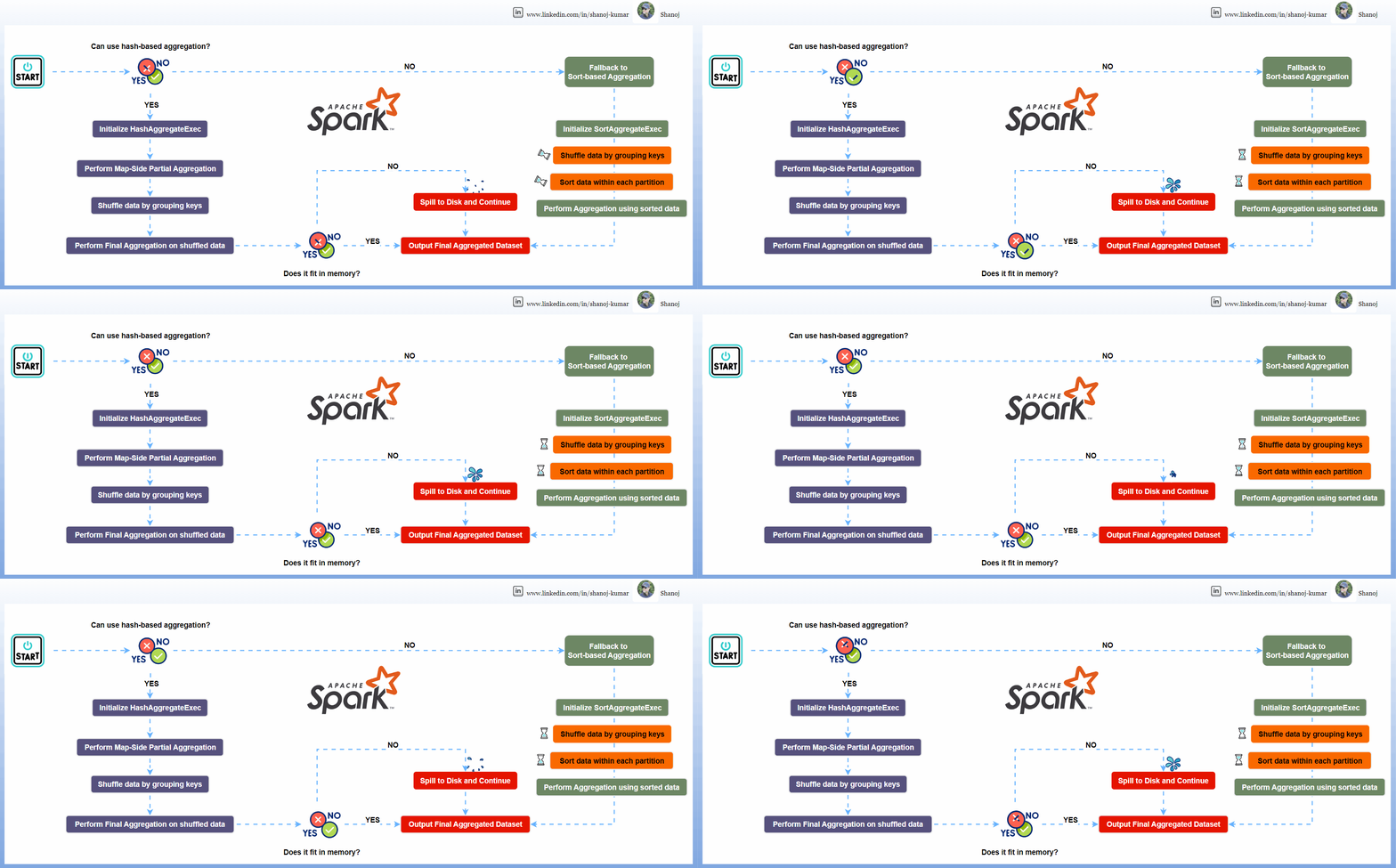
Hash-based Aggregation in Apache Spark operates through the HashAggregateExec physical operator. This process is optimized for aggregations where the dataset can fit into memory, and it leverages mutable types for efficient in-place updates of aggregation states.

  • Initialization: When a query that requires aggregation is executed, Spark determines whether it can use hash-based aggregation. This decision is based on factors such as the types of aggregation functions (e.g., sum, avg, min, max, count), the data types of the columns involved, and whether the dataset is expected to fit into memory.
  • Partial Aggregation (Map Side): The aggregation process begins with a “map-side” partial aggregation. For each partition of the input data, Spark creates an in-memory hash map where each entry corresponds to a unique group key. As rows are processed, Spark updates the aggregation buffer for each group key directly in the hash map. This step produces partial aggregate results for each partition.
  • Shuffling: After the partial aggregation, Spark shuffles the data by the grouping keys, so that all records belonging to the same group are moved to the same partition. This step is necessary to ensure that the final aggregation produces accurate results across the entire dataset.
  • Final Aggregation (Reduce Side): Once the shuffled data is partitioned, Spark performs the final aggregation. It again uses a hash map to aggregate the partially aggregated results. This step combines the partial results from different partitions to produce the final aggregate value for each group.
  • Spill to Disk: If the dataset is too large to fit into memory, Spark’s hash-based aggregation can spill data to disk. This mechanism ensures that Spark can handle datasets larger than the available memory by using external storage.
  • Fallback to Sort-based Aggregation: In cases where the hash map becomes too large or if there are memory issues, Spark can fall back to sort-based aggregation. This decision is made dynamically based on runtime conditions and memory availability.
  • Output: The final output of the HashAggregateExec operator is a new dataset where each row represents a group along with its aggregated value(s).

The efficiency of hash-based aggregation comes from its ability to perform in-place updates to the aggregation buffer and its avoidance of sorting the data. However, its effectiveness is limited by the available memory and the nature of the dataset. For datasets that do not fit well into memory or when dealing with complex aggregation functions that are not supported by hash-based aggregation, Spark might opt for sort-based aggregation instead.

Detailed Explanation of Sort-based Aggregation

Sort-based Aggregation in Apache Spark works through a series of steps that involve shuffling, sorting, and then aggregating the data.

  • Shuffling: The data is partitioned across the cluster based on the grouping keys. This step ensures that all records with the same key end up in the same partition.
  • Sorting: Within each partition, the data is sorted by the grouping keys. This is necessary because the aggregation will be performed on groups of data with the same key, and having the data sorted ensures that all records for a given key are contiguous.
  • Aggregation: Once the data is sorted, Spark can perform the aggregation. For each partition, Spark uses a SortBasedAggregationIterator to iterate over the sorted records. This iterator maintains a buffer row to cache the aggregated values for the current group.
  • Processing Rows: As the iterator goes through the rows, it processes them one by one, updating the buffer with the aggregate values. When the end of a group is reached (i.e., the next row has a different grouping key), the iterator outputs a row with the final aggregate value for that group and resets the buffer for the next group.
  • Memory Management: Unlike hash-based aggregation, which requires a hash map to hold all group keys and their corresponding aggregate values, sort-based aggregation only needs to maintain the aggregate buffer for the current group. This means that sort-based aggregation can handle larger datasets that might not fit entirely in memory.
  • Fallback Mechanism: Although not part of the normal operation, it’s worth noting that Spark’s HashAggregateExec can theoretically fall back to sort-based aggregation if it encounters memory issues during hash-based processing.

The sort-based aggregation process is less efficient than hash-based aggregation because it involves the extra step of sorting the data, which is computationally expensive. However, it is more scalable for large datasets or when dealing with immutable types in the aggregation columns that prevent the use of hash-based aggregation.

Stackademic 🎓

Thank you for reading until the end. Before you go:

Understanding Memory Spills in Apache Spark

Memory spill in Apache Spark is the process of transferring data from RAM to disk, and potentially back again. This happens when the dataset exceeds the available memory capacity of an executor during tasks that require more memory than is available. In such cases, data is spilled to disk to free up RAM and prevent out-of-memory errors. However, this process can slow down processing due to the slower speed of disk I/O compared to memory access.

Dynamic Occupancy Mechanism

Apache Spark employs a dynamic occupancy mechanism for managing Execution and Storage memory pools. This mechanism enhances the flexibility of memory usage by allowing Execution Memory and Storage Memory to borrow from each other, depending on workload demands:

  • Execution Memory: Primarily used for computation tasks such as shuffles, joins, and sorts. When execution tasks demand more memory, they can borrow from the Storage Memory if it is underutilized.
  • Storage Memory: Used for caching and persisting RDDs, DataFrames, and Datasets. If the demand for storage memory exceeds its allocation, and Execution Memory is not fully utilized, Storage Memory can expand into the space allocated for Execution Memory.

Spark’s internal memory manager controls this dynamic sharing and is crucial for optimizing the utilization of available memory resources, significantly reducing the likelihood of memory spills.

Common Performance Issues Related to Spills

Spill(disk) and Spill(memory): When data doesn’t fit in RAM, it is temporarily written to disk. This operation, while enabling Spark to handle larger datasets, impacts computation time and efficiency because disk access is slower than memory access.

Impact on Performance: Spills to disk can negatively affect performance, increasing both the cost and operational complexity of Spark applications. The strength of Spark lies in its in-memory computing capabilities; thus, disk spills are counterproductive to its design philosophy.

Solutions for Memory Spill in Apache Spark

Mitigating memory spill issues involve several strategies aimed at optimizing memory use, partitioning data more effectively, and improving overall application performance.

Optimizing Memory Configuration

  • Adjust memory allocation settings to provide sufficient memory for both execution and storage, potentially increasing the memory per executor.
  • Tune the ratio between execution and storage memory based on the specific requirements of your workload.

Partitioning Data

  • Optimize data partitioning to ensure even data distribution across partitions, which helps in avoiding memory overloads in individual partitions.
  • Consider different partitioning strategies such as range, hash, or custom partitioning based on the nature of your data.

Caching and Persistence

  • Use caching and persistence methods (e.g., cache() or persist()) to store intermediate results or frequently accessed data in memory, reducing the need for recomputation.
  • Select the appropriate storage level for caching to balance between memory usage and CPU efficiency.

Monitoring and Tuning

  • Monitor memory usage and spills using Spark UI or other monitoring tools to identify and address bottlenecks.
  • Adjust configurations dynamically based on performance metrics and workload patterns.

Data Compression

  • Employ data compression techniques and columnar storage formats (e.g., Parquet, ORC) to reduce the memory footprint.
  • Compress RDDs using serialization mechanisms like MEMORY_ONLY_SER to minimize memory usage.

Avoiding Heavy Shuffles

  • Optimize join operations and minimize unnecessary data movement by using strategies such as broadcasting smaller tables or implementing partition pruning.
  • Reduce shuffle operations which can lead to spills by avoiding wide dependencies and optimizing shuffle operations.

Formulaic Approach to Avoid Memory Spills

Apache Spark’s memory management model is designed to balance between execution memory (used for computation like shuffles, joins, sorts) and storage memory (used for caching and persisting data). Understanding and optimizing the use of these memory segments can significantly reduce the likelihood of memory spills.

Memory Configuration Parameters:

  • Total Executor Memory (spark.executor.memory): The total memory allocated per executor.
  • Memory Overhead (spark.executor.memoryOverhead): Additional memory allocated to each executor, beyond spark.executor.memory, for Spark to execute smoothly.
  • Spark Memory Fraction (spark.memory.fraction): Specifies the proportion of the executor memory dedicated to Spark’s memory management system (default is 0.6 or 60%).

Simplified Memory Calculation:

Calculate Available Memory for Spark:

Available Memory=(Total Executor Memory−Memory Overhead)×Spark Memory FractionAvailable Memory=(Total Executor Memory−Memory Overhead)×Spark Memory Fraction

Determine Execution and Storage Memory: Spark splits the available memory between execution and storage. The division is dynamic, but under memory pressure, storage can shrink to as low as the value defined by spark.memory.storageFraction (default is 0.5 or 50% of Spark memory).

Example Calculation:

  • Suppose an executor is configured with 10GB (spark.executor.memory = 10GB) and the default overhead (10% of executor memory or at least 384MB). Let’s assume an overhead of 1GB for simplicity and the default memory fractions.
  • Total Executor Memory: 10GB
  • Memory Overhead: 1GB
  • Spark Memory Fraction: 0.6 (60%)

Available Memory for Spark=(10GB−1GB)×0.6=5.4GBAvailable Memory for Spark=(10GB−1GB)×0.6=5.4GB

  • Assuming spark.memory.storageFraction is set to 0.5, both execution and storage memory pools could use up to 2.7GB each under balanced conditions.

Strategies to Avoid Memory Spills:

  • Increase Memory Allocation: If possible, increasing spark.executor.memory ensures more memory is available for Spark processes.
  • Adjust Memory Fractions: Tweaking spark.memory.fraction and spark.memory.storageFraction can help allocate memory more efficiently based on the workload. For compute-intensive operations, you might allocate more memory for execution.

Real-life Use Case: E-commerce Sales Analysis

An e-commerce platform experienced frequent memory spills while processing extensive sales data during holiday seasons, leading to performance bottlenecks.

Problem:

Large-scale aggregations and joins were causing spills to disk, slowing down the analysis of sales data, impacting the ability to generate real-time insights for inventory and pricing adjustments.

Solution:

  • Memory Optimization: The data team increased the executor memory from 8GB to 16GB per executor and adjusted the spark.memory.fraction to 0.8 to dedicate more memory to Spark’s managed memory system.
  • Partitioning and Data Skew Management: They implemented custom partitioning strategies to distribute the data more evenly across nodes, reducing the likelihood of individual tasks running out of memory.
  • Caching Strategy: Important datasets used repeatedly across different stages of the analysis were persisted in memory, and the team carefully chose the storage levels to balance between memory usage and CPU efficiency.
  • Monitoring and Tuning: Continuous monitoring of the Spark UI and logs allowed the team to identify memory-intensive operations and adjust configurations dynamically. They also fine-tuned spark.memory.storageFraction to better balance between execution and storage memory, based on the nature of their tasks.

These strategies significantly reduced the occurrence of memory spills, improved the processing speed of sales data analysis, and enabled the e-commerce platform to adjust inventory and pricing strategies in near real-time during peak sales periods.

This example demonstrates the importance of a holistic approach to Spark memory management, including proper configuration, efficient data partitioning, and strategic use of caching, to mitigate memory spill issues and enhance application performance.

Stackademic 🎓

Thank you for reading until the end. Before you go:

Data Analytics with AWS Redshift and Redshift Spectrum: A Scenario-Based Approach

In exploring the integration of Amazon Redshift and Redshift Spectrum for data warehousing and data lake architectures, it’s essential to consider a scenario where a data engineer sets up a daily data loading pipeline into a data warehouse.

This setup is geared towards optimizing the warehouse for the majority of reporting queries, which typically focus on the latest 12 months of data. To maintain efficiency and manage storage, the engineer might also implement a process to remove data older than 12 months. However, this strategy raises a question: how to handle the 20% of queries that require historical data beyond this period?

Amazon Redshift is a powerful, scalable data warehouse service that simplifies the process of analyzing large volumes of data with high speed and efficiency. It allows for complex queries over vast datasets, providing the backbone for modern data analytics. Redshift’s architecture is designed to handle high query loads and vast amounts of data, making it an ideal solution for businesses seeking to leverage their data for insights and decision-making. Its columnar storage and data compression capabilities ensure that data is stored efficiently, reducing the cost and increasing the performance of data operations.

Redshift Spectrum extends the capabilities of Amazon Redshift by allowing users to query and analyze data stored in Amazon S3 directly from within Redshift, without the need for loading or transferring the data into the data warehouse. This feature is significant because it enables users to access both recent and historical data seamlessly, bridging the gap between the data stored in Redshift and the extensive, unstructured data residing in a data lake. Spectrum offers the flexibility to query vast amounts of data across a data lake, providing the ability to run complex analyses on data that is not stored within the Redshift cluster itself.

Here, Redshift Spectrum plays a crucial role. It’s a feature that extends the capabilities of the Amazon Redshift data warehouse, allowing it to query data stored externally in a data lake. This functionality is significant because it enables users to access both recent and historical data without the need to store all of it directly within the data warehouse.

The process starts with the AWS Glue Data Catalog, which acts as a central repository for all the databases and tables in the data lake. By setting up Amazon Redshift to work with the AWS Glue Data Catalog, users can seamlessly query tables both inside Redshift and those cataloged in the AWS Glue. This setup is particularly advantageous for comprehensive data analysis, bridging the gap between the structured environment of the data warehouse and the more extensive, unstructured realm of the data lake.

AWS Glue Data Catalog and Apache Hive Metastore are both metadata repositories for managing data structures in data lakes and warehouses. AWS Glue Data Catalog, a cloud-native service, integrates seamlessly with AWS analytics services, offering automatic schema discovery and a fully managed experience. In contrast, Hive Metastore requires more manual setup and maintenance and is primarily used in on-premises or hybrid cloud environments. AWS Glue Data Catalog is easier to use, automated, and tightly integrated within the AWS ecosystem, making it the preferred choice for users invested in AWS services.

In Plain English 🚀

Thank you for being a part of the In Plain English community! Before you go: