
Learn how to harness Kafka, FastAPI, and Spark Streaming to build a production-ready log processing pipeline that handles thousands of events per second in real time.

TL;DR
This article demonstrates how to build a robust, high-throughput log aggregation system using Kafka, FastAPI, and Spark Streaming. You’ll learn the architecture for creating a centralized logging infrastructure capable of processing thousands of events per second with minimal latency, all deployed in a containerized environment. This approach provides both API access and visual dashboards for your logging data, making it suitable for large-scale distributed systems.
The Problem: Why Traditional Logging Fails at Scale
In distributed systems with dozens or hundreds of microservices, traditional logging approaches rapidly break down. When services generate logs independently across multiple environments, several critical problems emerge:
- Fragmentation: Logs scattered across multiple servers require manual correlation
- Latency: Delayed access to log data hinders real-time monitoring and incident response
- Scalability: File-based approaches and traditional databases can’t handle high write volumes
- Correlation: Tracing requests across service boundaries becomes nearly impossible
- Ephemeral environments: Container and serverless deployments may lose logs when instances terminate
These issues directly impact incident response times and system observability. According to industry research, the average cost of IT downtime exceeds $5,000 per minute, making efficient log management a business-critical concern.
The Architecture: Event-Driven Logging
Our solution combines three powerful technologies to create an event-driven logging pipeline:
- Kafka: Distributed streaming platform handling high-throughput message processing
- FastAPI: High-performance Python web framework for the logging API
- Spark Streaming: Scalable stream processing for real-time analytics
This architecture provides several critical advantages:
- Decoupling: Producers and consumers operate independently
- Scalability: Each component scales horizontally to handle increased load
- Resilience: Kafka provides durability and fault tolerance
- Real-time processing: Events processed immediately, not in batches
- Flexibility: Multiple consumers can process the same data for different purposes
System Components

The system consists of four main components:
1. Log Producer API (FastAPI)
- Receives log events via RESTful endpoints
- Validates and enriches log data
- Publishes logs to appropriate Kafka topics
2. Message Broker (Kafka)
- Provides durable storage for log events
- Enables parallel processing through topic partitioning
- Maintains message ordering within partitions
- Offers configurable retention policies
3. Stream Processor (Spark)
- Consumes log events from Kafka
- Performs real-time analytics and aggregations
- Detects anomalies and triggers alerts
4. Visualization & Storage Layer
- Persists processed logs for historical analysis
- Provides dashboards for monitoring and investigation
- Offers API access for custom integrations
Data Flow
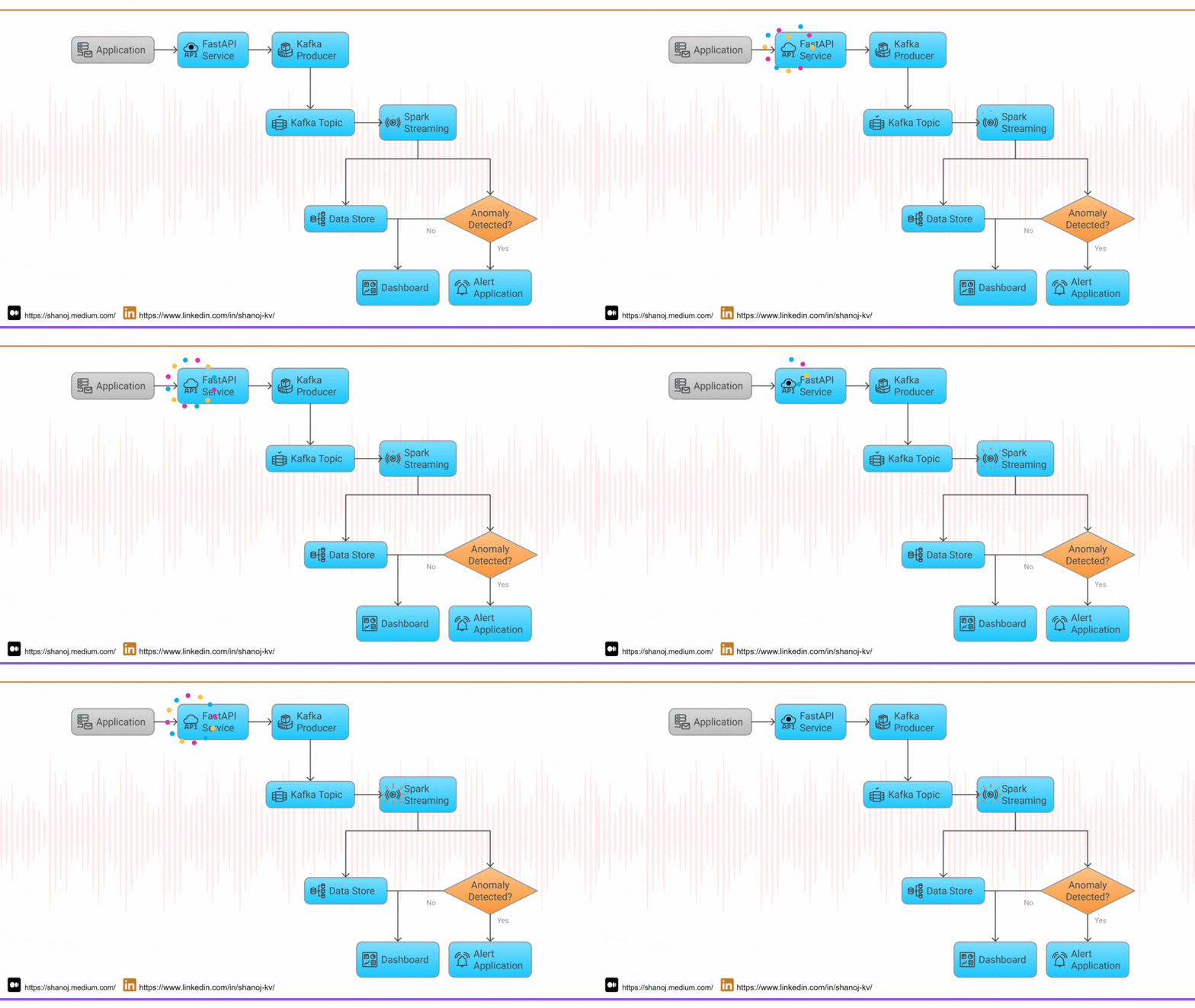
The log data follows a clear path through the system:
- Applications send log data to the FastAPI endpoints
- The API validates, enriches, and publishes to Kafka
- Spark Streaming consumes and analyzes the logs in real-time
- Processed data flows to storage and becomes available via API/dashboards
Implementation Guide
Let’s implement this system using a real-world web log dataset from Kaggle:
Kaggle Dataset Details:
- Name: Web Log Dataset
- Size: 1.79 MB
- Format: CSV with web server access logs
- Contents: Over 10,000 log entries
- Fields: IP addresses, timestamps, HTTP methods, URLs, status codes, browser information
- Time Range: Multiple days of website activity
- Variety: Includes successful/failed requests, various HTTP methods, different browser types
This dataset provides realistic log patterns to validate our system against common web server logs, including normal traffic and error conditions.
Project Structure
The complete code for this project is available on GitHub: GitHub

Repository: kafka-log-api
Data Set Source: Kaggle
kafka-log-api/
│── src/
│   ├── main.py                # FastAPI entry point
│   ├── api/
│   │   ├── routes.py          # API endpoints
│   │   ├── models.py          # Request models & validation
│   ├── core/
│   │   ├── config.py          # Configuration loader
│   │   ├── kafka_producer.py  # Kafka producer
│   │   ├── logger.py          # Centralized logging
│── data/
│   ├── processed_web_logs.csv # Processed log dataset
│── spark/
│   ├── consumer.py            # Spark Streaming consumer
│── tests/
│   ├── test_api.py            # API test suite
│── streamlit_app.py           # Dashboard
│── docker-compose.yml         # Container orchestration
│── Dockerfile                 # FastAPI container
│── Dockerfile.streamlit       # Dashboard container
│── requirements.txt           # Dependencies
│── process_csv_logs.py        # Log preprocessor
Key Components
1. Log Producer API
The FastAPI application serves as the log ingestion point, with the following key files:
src/api/models.py: Defines the data model for log entries, including validationsrc/api/routes.py: Implements the API endpoints for sending and retrieving logssrc/core/kafka_producer.py: Handles publishing logs to Kafka topics
The API exposes endpoints for:
- Submitting new log entries
- Retrieving logs with filtering options
- Sending test logs from the sample dataset
2. Message Broker
Kafka serves as the central nervous system of our logging architecture:
- Topics: Organize logs by service, environment, or criticality
- Partitioning: Enables parallel processing and horizontal scaling
- Replication: Ensures durability and fault tolerance
The docker-compose.yml file configures Kafka and Zookeeper with appropriate settings for a production-ready deployment.
3. Stream Processor
Spark Streaming consumes logs from Kafka and performs real-time analysis:
spark/consumer.py: Implements the streaming logic, including:- Parsing log JSON
- Performing window-based analytics
- Detecting anomalies and patterns
- Aggregating metrics
The stream processor handles:
- Error rate monitoring
- Response time analysis
- Service health metrics
- Correlation between related events
4. Visualization Dashboard
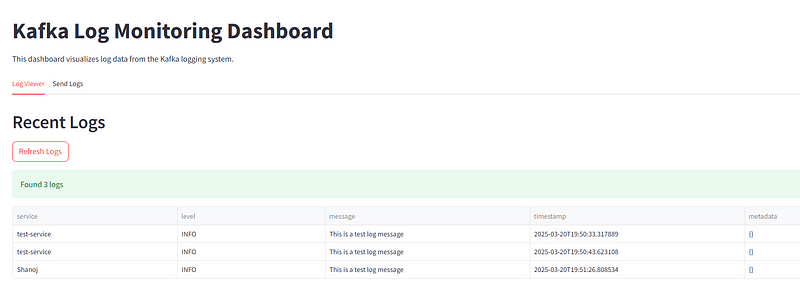
The Streamlit dashboard provides a user-friendly interface for exploring logs:
streamlit_app.py: Implements the entire dashboard, including:- Log-level distribution charts
- Timeline visualizations
- Filterable log tables
- Controls for sending test logs

Deployment
The entire system is containerized for easy deployment:
# Key services in docker-compose.yml
services:
  zookeeper:    # Coordinates Kafka brokers
    image: wurstmeister/zookeeper

  kafka:        # Message broker
    image: wurstmeister/kafka
    environment:
      KAFKA_ADVERTISED_LISTENERS: PLAINTEXT://kafka:9092
      KAFKA_ZOOKEEPER_CONNECT: zookeeper:2181

  log-api:      # FastAPI service
    build: .
    ports:
      - "8000:8000"

  streamlit-ui: # Dashboard
    build:
      context: .
      dockerfile: Dockerfile.streamlit
    ports:
      - "8501:8501"
Start the entire system with:
docker-compose up -d
Then access:
- API documentation:
http://localhost:8000/docs - Dashboard:
http://localhost:8501
Technical Challenges and Solutions
1. Ensuring Message Reliability
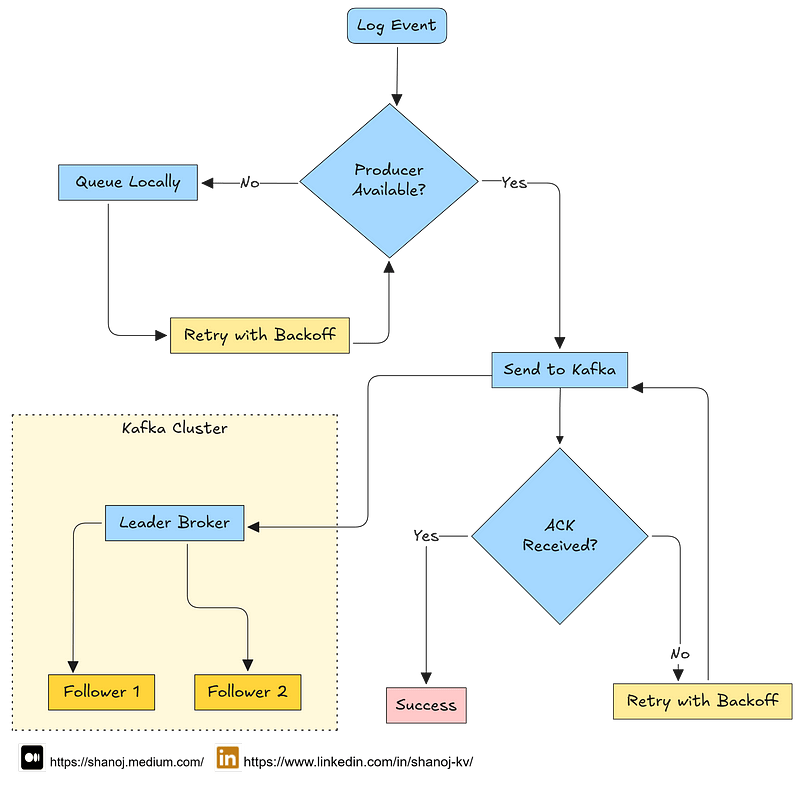
Challenge: Guaranteeing zero log loss during network disruptions or component failures.
Solution:
- Implemented exponential backoff retry in the Kafka producer
- Configured proper acknowledgment mechanisms (acks=all)
- Set appropriate replication factors for topics
- Added detailed failure mode logging
Key takeaway: Message delivery reliability requires a multi-layered approach with proper configuration, monitoring, and error handling at each stage.
2. Schema Evolution Management
Challenge: Supporting evolving log formats without breaking downstream consumers.

Schema Envelope Example:
{
  "schemaVersion": "2.0",
  "requiredFields": {
    "timestamp": "2023-04-01T12:34:56Z",
    "service": "payment-api",
    "level": "ERROR"
  },
  "optionalFields": {
    "traceId": "abc123",
    "userId": "user-456",
    "customDimensions": {
      "region": "us-west-2",
      "instanceId": "i-0a1b2c3d4e"
    }
  },
  "message": "Payment processing failed"
}
Solution:
- Implemented a standardized envelope format with required and optional fields
- Added schema versioning with backward compatibility
- Modified Spark consumers to handle missing fields gracefully
- Enforced validation at the API layer for critical fields
Key takeaway: Plan for schema evolution from the beginning with proper versioning and compatibility strategies.
3. Processing at Scale
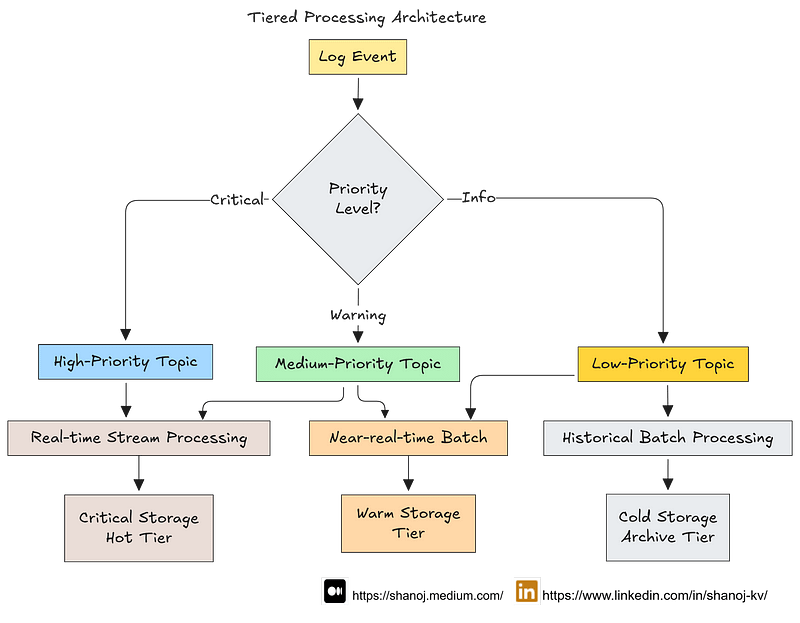
Challenge: Maintaining real-time processing as log volume grows exponentially.
Solution:
- Implemented priority-based routing to separate critical from routine logs
- Created tiered processing with real-time and batch paths
- Optimized Spark configurations for resource efficiency
- Added time-based partitioning for improved query performance
Key takeaway: Not all logs deserve equal treatment — design systems that prioritize processing based on business value.
Performance Results
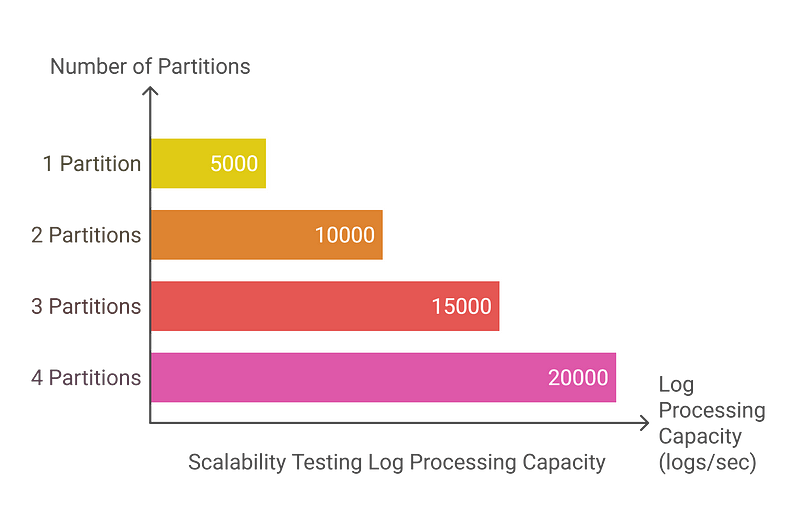
Our system delivers impressive performance metrics:


Practical Applications
This architecture has proven valuable in several real-world scenarios:
- Microservice Debugging: Tracing requests across service boundaries
- Security Monitoring: Real-time detection of suspicious patterns
- Performance Analysis: Identifying bottlenecks in distributed systems
- Compliance Reporting: Automated audit trail generation
Future Enhancements
The modular design allows for several potential enhancements:
- AI/ML Integration: Anomaly detection and predictive analytics
- Multi-Cluster Support: Geographic distribution for global deployments
- Advanced Visualization: Interactive drill-down capabilities
- Tiered Storage: Automatic archiving with cost-optimized retention
Architectural Patterns & Design Principles

The system implemented in this article incorporates several key architectural patterns and design principles that are broadly applicable:
Architectural Patterns
Event-Driven Architecture (EDA)
- Implementation: Kafka as the event backbone
- Benefit: Loose coupling between components, enabling independent scaling
- Applicability: Any system with asynchronous workflows or high-throughput requirements
Microservices Architecture
- Implementation: Containerized, single-responsibility services
- Benefit: Independent deployment and scaling of components
- Applicability: Complex systems where domain boundaries are clearly defined
Command Query Responsibility Segregation (CQRS)
- Implementation: Separate the write path (log ingestion) from the read path (analytics and visualization)
- Benefit: Optimized performance for different access patterns
- Applicability: Systems with imbalanced read/write ratios or complex query requirements
Stream Processing Pattern
- Implementation: Continuous processing of event streams with Spark Streaming
- Benefit: Real-time insights without batch processing delays
- Applicability: Time-sensitive data analysis scenarios
Design Principles
Single Responsibility Principle
- Each component has a well-defined, focused role
- API handles input validation and publication. Spark handles processing
Separation of Concerns
- Log collection, storage, processing, and visualization are distinct concerns
- Changes to one area don’t impact others
Fault Isolation
- The system continues functioning even if individual components fail
- Kafka provides buffering during downstream outages
Design for Scale
- Horizontal scaling through partitioning
- Stateless components for easy replication
Observable By Design
- Built-in metrics collection
- Standardized logging format
- Explicit error handling patterns
These patterns and principles make the system effective for log processing and serve as a template for other event-driven applications with similar requirements for scalability, resilience, and real-time processing.
Building a robust logging infrastructure with Kafka, FastAPI, and Spark Streaming provides significant advantages for engineering teams operating at scale. The event-driven approach ensures scalability, resilience, and real-time insights that traditional logging systems cannot match.
Following the architecture and implementation guidelines in this article, you can deploy a production-grade logging system capable of handling enterprise-scale workloads with minimal operational overhead. More importantly, the architectural patterns and design principles demonstrated here can be applied to various distributed systems challenges beyond logging.
 Shanoj