

In this article, I want to clarify that my intent is not to show bias towards or against any country or perspective. Instead, I aim to offer my observations and insights into my motherland, India, from the lens of an investor who is perpetually seeking better avenues for investment and is committed to being a part of the ever-evolving global economy.
As of the end of 2023, India is poised for explosive economic growth in the coming decade, potentially becoming the world’s third-largest economy by 2027, surpassing both Japan and Germany. This article will explore the factors driving India’s remarkable growth story, the investment opportunities it presents, and how you can potentially benefit as an investor.
The Growth Factors:
Global Offshoring: India’s outsourcing industry has long been a leader in software development and customer service. With a vast pool of talented engineers and a young workforce, India is the go-to destination for companies seeking cost-effective and skilled labour. In addition to traditional outsourcing, India is also attracting investment in manufacturing, contributing to the country’s economic growth.
Financial Transformation: India has embarked on a journey of financial transformation, marked by initiatives like Aadhar, a biometric authentication system, and India Stack, a decentralized utility for payments. These innovations have made it easier for people and businesses to access services, apply for credit, and conduct transactions more efficiently. This transformation is fostering financial inclusion and driving economic growth.
Energy Transition: India is making substantial strides in transitioning from fossil fuels to renewable energy sources. With a commitment to renewable energy, the country is attracting investments and fostering innovation in the sector. This transition addresses environmental concerns and contributes to economic growth and energy security.
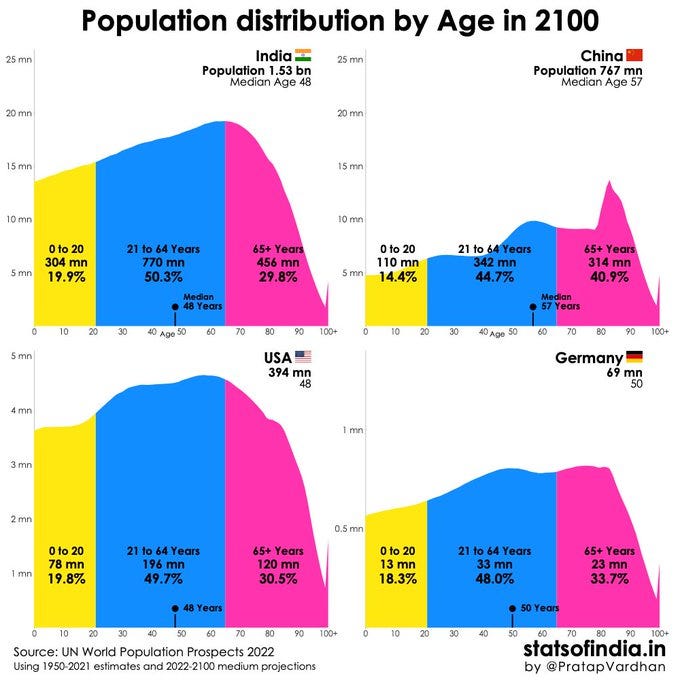
Demographic Advantage: India’s demographic advantage cannot be overstated. The country is home to over 600 million people aged between 18 and 35, with 65% under 35. This youthful workforce provides a significant competitive edge in the global labour market and contributes to India’s economic growth. It’s projected that India’s demographic dividend will persist until 2055–56 and peak around 2041 when the share of the working-age population — 20–59 years — is expected to hit 59%.
Chandrayaan-3, a Historic Achievement: India has achieved remarkable success in space exploration with its Chandrayaan missions. Chandrayaan-3 is the third mission in the Chandrayaan program, a series of lunar exploration missions developed by the Indian Space Research Organisation (ISRO). Launched on 14 July 2023, this mission consists of a lunar lander named Vikram and a lunar rover named Pragyan, similar to those launched aboard Chandrayaan-2 in 2019.
Chandrayaan-3 made history by successfully landing near the Moon’s south pole on 23 August at 18:03 IST (12:33 UTC). This achievement marked India as the fourth country to land on the Moon successfully and the first to do so near the lunar south pole, a region of great scientific interest.
Unified Payments Interface (UPI), a Technological Revolution: Amid India’s remarkable economic growth, technology has transformed the country’s financial landscape. One standout innovation is the Unified Payments Interface (UPI). UPI is a real-time payment system that facilitates effortless and instantaneous money transfers between bank accounts, all through a mobile device, and with no associated fees.
Introduced by the National Payments Corporation of India (NPCI) in 2016, UPI has rapidly gained widespread adoption, fundamentally altering how Indians engage in financial transactions. An impressive 300 million UPI users and 500 million merchants actively utilize this platform to facilitate business transactions.
With UPI, users can seamlessly transfer funds to one another using a unique UPI ID or a Virtual Payment Address (VPA). This revolutionary technology has simplified and democratized financial transactions, making them accessible and efficient for millions of individuals.
The most significant impact of UPI has been its influence on transaction methods in India. According to research by GlobalData, cash transactions, once constituting 90% of the total volume, have now dwindled to less than 60%, with UPI and other digital transaction systems claiming the lion’s share of the remaining space.
National Logistics Policy (NLP) is a transformative initiative by the Indian government that seeks to revolutionize the country’s logistics sector. India has long grappled with high logistics costs, inefficiencies, and delays in transporting goods. This policy addresses these issues by introducing a hub-and-spoke model, where goods are consolidated at central hubs before being distributed to various destinations. By optimizing transportation routes, enhancing digitalization, and simplifying regulatory procedures, the policy can significantly reduce logistics costs, boost the efficiency of goods movement, and make India more competitive globally.
Much like the Unified Payments Interface (UPI) revolutionized digital payments, the National Logistics Policy could usher in a new era of efficiency and growth in the logistics sector, benefiting businesses and consumers alike.
India’s Expanding Road Network: India’s remarkable achievement in becoming the second-largest country globally regarding road network size, trailing only the United States, presents a compelling case for investors. With an impressive addition of 1.45 lakh kilometres to its road connectivity over the past eight years, India’s commitment to infrastructure development is evident. Minister for Road Transport and Highways, Nitin Gadkari, has been instrumental in driving this progress, focusing on improving highways and establishing greenfield expressways. Investors should take note of the near completion of the Delhi-Mumbai Expressway, India’s longest infrastructure project, showcasing the country’s dedication to modernizing its transportation networks.
Under Gadkari’s (Minister for Road Transport and Highways) leadership, the National Highways Authority of India (NHAI) added 30,000 km to India’s 91,287 km road network. Toll revenue surged from Rs 4,770 crore to Rs 41,352 crore in nine years, promising investment growth. With a target of Rs 71.30 lakh crore revenue, India beckons investors to its modernized transportation and logistics sectors, exemplified by efficient FASTag implementation.
Investment Opportunities:
While India’s rapid economic growth presents enticing investment opportunities, it’s essential to approach them wisely. Here are key promises that India holds for investors:
- Vast Market Potential: India is home to over 1.3 billion people, making it one of the largest consumer markets in the world. This presents a significant opportunity for businesses to tap into a massive customer base.
- Skilled Workforce: India possesses a pool of highly skilled and educated professionals, particularly in technology, engineering, and finance. This talent pool is attractive to global companies looking to expand their operations.
- Government Initiatives: The Indian government has introduced various initiatives to promote foreign investment, such as “Make in India” and “Digital India.” These programs aim to ease the business environment and encourage investment in critical sectors.
- Infrastructure Development: India invests in infrastructure development, including transportation, logistics, and smart cities. These projects open avenues for private investment and offer potential returns.
- Startup Ecosystem: India’s startup ecosystem is thriving, with numerous successful startups in sectors like e-commerce, fintech, and healthcare. Investors can explore opportunities in this dynamic sector.
Comparing India to the U.S. Stock Market:
When considering investing in India’s growth, it’s crucial to acknowledge that economic growth (GDP) doesn’t always directly correlate with stock market performance. For instance, the stock market has often outperformed GDP growth in the United States. While India’s GDP growth is projected to be remarkable, it doesn’t guarantee stock market success.
Over the years, the U.S. stock market has demonstrated robust performance, with average annual returns between 7% and 9%. This consistency and predictability make it a preferred choice for many investors.
India’s economic growth story is undeniably compelling, with immense potential for investors. However, the complexity of global markets and the multitude of factors influencing stock performance necessitate a careful and diversified approach to investments. Evaluating your risk tolerance, diversifying your portfolio, and consulting with a financial advisor who can provide tailored guidance are essential as you contemplate your investment strategy.
Whether you choose to invest directly in Indian stocks, explore ETFs, or stick to the familiar U.S. stock market, staying informed and staying the course is key to making sound investment decisions.
 Shanoj