Tag Archives: Interview Preparation

Distributed Design Pattern: Failure Detector

[Cloud Service Availability Monitoring Use Case]

TL;DR

Failure detectors are essential in distributed cloud architectures, significantly enhancing service reliability by proactively identifying node and service failures. Advanced implementations like Phi Accrual Failure Detectors provide adaptive and precise detection, dramatically reducing downtime and operational costs, as proven in large-scale deployments by major cloud providers.

Why Failure Detection is Critical in Cloud Architectures

Have you ever dealt with the aftermath of a service outage that could have been avoided with earlier detection? For senior solution architects, principal architects, and technical leads managing extensive distributed systems, unnoticed failures aren’t just inconvenient — they can cause substantial financial losses and damage brand reputation. Traditional monitoring tools like periodic pings are increasingly inadequate for today’s complex and dynamic cloud environments.

This comprehensive article addresses the critical distributed design pattern known as “Failure Detectors,” specifically tailored for sophisticated cloud service availability monitoring. We’ll dive deep into the real-world challenges, examine advanced detection mechanisms such as the Phi Accrual Failure Detector, provide detailed, practical implementation guidance accompanied by visual diagrams, and share insights from actual deployments in leading cloud environments.

1. The Problem: Key Challenges in Cloud Service Availability

Modern cloud services face unique availability monitoring challenges:

  • Scale and Complexity: Massive numbers of nodes, containers, and functions make traditional heartbeat monitoring insufficient.
  • Variable Latency: Differentiating network-induced latency from actual node failures is non-trivial.
  • Excessive False Positives: Basic health checks frequently produce false alerts, causing unnecessary operational overhead.

2. The Solution: Advanced Failure Detectors (Phi Accrual)

The Phi Accrual Failure Detector significantly improves detection accuracy by calculating a suspicion level (Phi) based on a statistical analysis of heartbeat intervals, dynamically adapting to changing network conditions.

3. Implementation: Practical Step-by-Step Guide

To implement an effective Phi Accrual failure detector, follow these structured steps:

Step 1: Heartbeat Generation

Regularly send lightweight heartbeats from all nodes or services.

async def send_heartbeat(node_url):
async with aiohttp.ClientSession() as session:
await session.get(node_url, timeout=5)

Step 2: Phi Calculation Logic

Use historical heartbeat data to calculate suspicion scores dynamically.

class PhiAccrualDetector:
def __init__(self, threshold=8.0):
self.threshold = threshold
self.inter_arrival_times = []

def update_heartbeat(self, interval):
self.inter_arrival_times.append(interval)

def compute_phi(self, current_interval):
# Compute Phi based on historical intervals
phi = statistical_phi_calculation(current_interval, self.inter_arrival_times)
return phi

Step 3: Automated Response

Set up automatic failover or alert mechanisms based on Phi scores.

class ActionDispatcher:
def handle_suspicion(self, phi, node):
if phi > self.threshold:
self.initiate_failover(node)
else:
self.send_alert(node)

def initiate_failover(self, node):
# Implement failover logic
pass
def send_alert(self, node):
# Notify administrators
pass

4. Challenges & Learnings

Senior architects should anticipate and address:

  • False Positives: Employ adaptive threshold techniques and ML-driven baselines to minimize false alerts.
  • Scalability: Utilize scalable detection protocols (e.g., SWIM) to handle massive node counts effectively.
  • Integration Complexity: Ensure careful integration with orchestration tools (like Kubernetes), facilitating seamless operations.

5. Results & Impact

Adopting sophisticated failure detection strategies delivers measurable results:

  • Reduction of false alarms by up to 70%.
  • Improvement in detection speed by 30–40%.
  • Operational cost savings from reduced downtime and optimized resource usage.

Real-world examples, including Azure’s Smart Detection, confirm these substantial benefits, achieving high-availability targets exceeding 99.999%.

Final Thoughts & Future Possibilities

Implementing advanced failure detectors is pivotal for cloud service reliability. Future enhancements include predictive failure detection leveraging AI and machine learning, multi-cloud adaptive monitoring strategies, and seamless integration across hybrid cloud setups. This continued evolution underscores the growing importance of sophisticated monitoring solutions.


By incorporating advanced failure detectors, architects and engineers can proactively safeguard their distributed systems, transforming potential failures into manageable, isolated incidents.

Thank you for being a part of the community

Before you go:

Distributed Design Pattern: Data Federation for Real-Time Querying

[Financial Portfolio Management Use Case]

In modern financial institutions, data is increasingly distributed across various internal systems, third-party services, and cloud environments. For senior architects designing scalable systems, ensuring real-time, consistent access to financial data is a challenge that can’t be underestimated. Consider the complexity of querying diverse data sources — from live market data feeds to internal portfolio databases and client analytics systems — and presenting it as a unified view.

Problem Context:

As the financial sector moves towards more distributed architectures, especially in cloud-native environments, systems need to ensure that data across all sources is up-to-date and consistent in real-time. This means avoiding stale data reads, which could result in misinformed trades or investment decisions.

For example, a stock trading platform queries live price data from multiple sources. If one of the sources returns outdated prices, a trade might be executed based on inaccurate information, leading to financial losses. This problem is particularly evident in environments like real-time portfolio management, where every millisecond of data staleness can impact trading outcomes.

The Federated Query Processing Solution

Federated Query Processing offers a powerful way to solve these issues by enabling seamless, real-time access to data from multiple distributed sources. Instead of consolidating data into a single repository (which introduces replication and synchronization overhead), federated querying allows data to remain in its source system. The query processing engine handles the aggregation of results from these diverse sources, offering real-time, accurate data without requiring extensive data movement.

How Federated Querying Works

  1. Query Management Layer:
    This layer sits at the front-end of the system, serving as the interface for querying different data sources. It’s responsible for directing the query to the right sources based on predefined criteria and ensuring the appropriate data is retrieved for any given request. As part of this layer, a query optimization strategy is essential to ensure the most efficient retrieval of data from distributed systems.
  2. Data Source Layer:
    In real-world applications, data is spread across various databases, APIs, internal repositories, and cloud storage. Federated queries are designed to traverse these diverse sources without duplicating or syncing data. Each of these data sources remains autonomous and independently managed, but queries are handled cohesively.
  3. Query Execution and Aggregation:
    Once the queries are dispatched to the relevant sources, the results are aggregated by the federated query engine. The aggregation process ensures that users or systems get a seamless, real-time view of data, regardless of its origin. This architecture enables data autonomy, where each source retains control over its data, yet data can be queried as if it were in a single unified repository.

Architectural Considerations for Federated Querying

As a senior architect, implementing federated query processing involves several architectural considerations:

Data Source Independence:
Federated query systems thrive in environments where data sources must remain independently managed and decentralized. Systems like this often need to work with heterogeneous data formats and data models across systems. Ensuring that each source can remain updated without disrupting the overall query response time is critical.

Optimization and Scalability:
Query optimization plays a key role. A sophisticated optimization strategy needs to be in place to handle:

  • Source Selection: The federated query engine should intelligently decide where to pull data from based on query complexity and data freshness requirements.
  • Parallel Query Execution: Given that data is distributed, executing multiple queries in parallel across nodes helps optimize response times.
  • Cache Mechanisms: Using cache for frequently requested data or complex queries can greatly improve performance.

Consistency and Latency:

Real-time querying across distributed systems brings challenges of data consistency and latency. A robust mechanism should be in place to ensure that queries to multiple sources return consistent data. Considerations such as eventual consistency and data synchronization strategies are key to implementing federated queries successfully in real-time systems.

Failover Mechanisms:

Given the distributed nature of data, ensuring that the system can handle failures gracefully is crucial. Federated systems must have failover mechanisms to redirect queries when a data source fails and continue serving queries without significant delay.

Real-World Performance Considerations

When federated query processing is implemented effectively, significant performance improvements can be realized:

  1. Reduction in Network Overhead:
    Instead of moving large volumes of data into a central repository, federated queries only retrieve the necessary data, significantly reducing network traffic and latency.
  2. Scalability:
    As the number of data sources grows, federated query engines can scale by adding more nodes to the query execution infrastructure, ensuring the system can handle larger data volumes without performance degradation.
  3. Improved User Experience:
    In financial systems, low-latency data retrieval is paramount. By optimizing the query process and ensuring the freshness of data, users can access real-time market data seamlessly, leading to more accurate and timely decision-making.

Federated query processing is a powerful approach that enables organizations to handle large-scale, distributed data systems efficiently. For senior architects, understanding how to implement federated query systems effectively will be critical to building systems that can seamlessly scale, improve performance, and adapt to changing data requirements. By embracing these patterns, organizations can create flexible, high-performing systems capable of delivering real-time insights with minimal latency — crucial for sectors like financial portfolio management.

Thank you for being a part of the community

Before you go:

Distributed Design Pattern: Eventual Consistency with Vector Clocks

[Social Media Feed Updates Use Case]

In distributed systems, achieving strong consistency often sacrifices availability or performance. The Eventual Consistency with Vector Clocks pattern is a practical solution that ensures availability while managing data conflicts in a distributed, asynchronous environment.

In this article, we’ll explore a real-world problem that arises in distributed systems, and we’ll walk through how Eventual Consistency and Vector Clocks work together to solve it.

The Problem: Concurrent Updates in a Social Media Feed

Let’s imagine a scenario on a social media platform where two users interact with the same post simultaneously. Here’s what happens:

  1. User A posts a new update: “Excited for the weekend!”
  2. User B likes the post.
  3. At the same time, User C also likes the post.

Due to the distributed nature of the system, the likes from User B and User C are processed by different servers (Server 1 and Server 2, respectively). Because of network latency, the two servers don’t immediately communicate with each other.

The Conflict:

  • Server 1 increments the like count to 1 (User B’s like).
  • Server 2 also increments the like count to 1 (User C’s like).

When the two servers eventually synchronize, they need to reconcile the like count. Without a mechanism to determine the order of events, the system might end up with an incorrect like count (e.g., 1 instead of 2).

This is where Eventual Consistency and Vector Clocks come into play.

The Solution: Eventual Consistency with Vector Clocks

Step 1: Tracking Causality with Vector Clocks

Each server maintains a vector clock to track the order of events. A vector clock is essentially a list of counters, one for each node in the system. Every time a node processes an event, it increments its own counter in the vector clock.

Let’s break down the example:

  • Initial State:
  • Server 1’s vector clock: [S1: 0, S2: 0]
  • Server 2’s vector clock: [S1: 0, S2: 0]
  • User B’s Like (Processed by Server 1):
  • Server 1 increments its counter: [S1: 1, S2: 0]
  • The like count on Server 1 is now 1.
  • User C’s Like (Processed by Server 2):
  • Server 2 increments its counter: [S1: 0, S2: 1]
  • The like count on Server 2 is now 1.

At this point, the two servers have different views of the like count.

Step 2: Synchronizing and Resolving Conflicts

When Server 1 and Server 2 synchronize, they exchange their vector clocks and like counts. Here’s how they resolve the conflict:

  1. Compare Vector Clocks:
  • Server 1’s vector clock: [S1: 1, S2: 0]
  • Server 2’s vector clock: [S1: 0, S2: 1]

Since neither vector clock is “greater” than the other (i.e., neither event happened before the other), the system identifies the likes as concurrent updates.

2. Conflict Resolution:

  • The system uses a merge operation to combine the updates. In this case, it adds the like counts together:
  • Like count on Server 1: 1
  • Like count on Server 2: 1
  • Merged like count: 2

3. Update Vector Clocks:

  • The servers update their vector clocks to reflect the synchronization:
  • Server 1’s new vector clock: [S1: 1, S2: 1]
  • Server 2’s new vector clock: [S1: 1, S2: 1]

Now, both servers agree that the like count is 2, and the system has achieved eventual consistency.

Why This Works

  1. Eventual Consistency Ensures Availability:
  • The system remains available and responsive, even during network delays or partitions. Users can continue liking posts without waiting for global synchronization.

2. Vector Clocks Provide Ordering:

  • By tracking causality, vector clocks help the system identify concurrent updates and resolve conflicts accurately.

3. Merge Operations Handle Conflicts:

  • Instead of discarding or overwriting updates, the system combines them to ensure no data is lost.

This example illustrates how distributed systems balance trade-offs to deliver a seamless user experience. In a social media platform, users expect their actions (likes, comments, etc.) to be reflected instantly, even if the system is handling millions of concurrent updates globally.

By leveraging Eventual Consistency and Vector Clocks, engineers can design systems that are:

  • Highly Available: Users can interact with the platform without interruptions.
  • Scalable: The system can handle massive traffic by distributing data across multiple nodes.
  • Accurate: Conflicts are resolved intelligently, ensuring data integrity over time.

Distributed systems are inherently complex, but patterns like eventual consistency and tools like vector clocks provide a robust foundation for building reliable and scalable applications. Whether you’re designing a social media platform, an e-commerce site, or a real-time collaboration tool, understanding these concepts is crucial for navigating the challenges of distributed computing.

Thank you for being a part of the community

Before you go:

Distributed Systems Design Pattern: Two-Phase Commit (2PC) for Transaction Consistency [Banking…

The Two-Phase Commit (2PC) protocol is a fundamental distributed systems design pattern that ensures atomicity in transactions across multiple nodes. It enables consistent updates in distributed databases, even in the presence of node failures, by coordinating between participants using a coordinator node.

In this article, we’ll explore how 2PC works, its application in banking systems, and its practical trade-offs, focusing on the use case of multi-account money transfers.

The Problem:

In distributed databases, transactions involving multiple nodes can face challenges in ensuring consistency. For example:

  • Partial Updates: One node completes the transaction, while another fails, leaving the system in an inconsistent state.
  • Network Failures: Delays or lost messages can disrupt the transaction’s atomicity.
  • Concurrency Issues: Simultaneous transactions might violate business constraints, like overdrawing an account.

Example Problem Scenario

In a banking system, transferring $1,000 from Account A (Node 1) to Account B (Node 2) requires both accounts to remain consistent. If Node 1 successfully debits Account A but Node 2 fails to credit Account B, the system ends up with inconsistent account balances, violating atomicity.

Two-Phase Commit Protocol: How It Works

The Two-Phase Commit Protocol addresses these issues by ensuring that all participating nodes either commit or abort a transaction together. It achieves this in two distinct phases:

Phase 1: Prepare

  1. The Transaction Coordinator sends a “Prepare” request to all participating nodes.
  2. Each node validates the transaction (e.g., checking constraints like sufficient balance).
  3. Nodes respond with either a “Yes” (ready to commit) or “No” (abort).

Phase 2: Commit or Abort

  1. If all nodes vote “Yes,” the coordinator sends a “Commit” message, and all nodes apply the transaction.
  2. If any node votes “No,” the coordinator sends an “Abort” message, rolling back any changes.
The diagram illustrates the Two-Phase Commit (2PC) protocol, ensuring transaction consistency across distributed systems. In the Prepare Phase, the Transaction Coordinator gathers validation responses from participant nodes. If all nodes validate successfully (“Yes” votes), the transaction moves to the Commit Phase, where changes are committed across all nodes. If any node fails validation (“No” vote), the transaction is aborted, and changes are rolled back to maintain consistency and atomicity. This process guarantees a coordinated outcome, either committing or aborting the transaction uniformly across all nodes.

Problem Context

Let’s revisit the banking use case:

Prepare Phase:

  • Node 1 prepares to debit $1,000 from Account A and logs the operation.
  • Node 2 prepares to credit $1,000 to Account B and logs the operation.
  • Both nodes validate constraints (e.g., ensuring sufficient balance in Account A).

Commit Phase:

  • If both nodes respond positively, the coordinator instructs them to commit.
  • If either node fails validation, the transaction is aborted, and any changes are rolled back.

Fault Recovery in Two-Phase Commit

What happens when failures occur?

  • If a participant node crashes during the Prepare Phase, the coordinator aborts the transaction.
  • If the coordinator crashes after sending a “Prepare” message but before deciding to commit or abort, the nodes enter an uncertain state until the coordinator recovers.
  • A Replication Log ensures that the coordinator’s decision can be recovered and replayed after a crash.

Practical Considerations and Trade-Offs

Advantages:

  1. Strong Consistency: Ensures all-or-nothing outcomes for transactions.
  2. Coordination: Maintains atomicity across distributed nodes.
  3. Error Handling: Logs allow recovery after failures.

Challenges:

  1. Blocking: Nodes remain in uncertain states if the coordinator crashes.
  2. Network Overhead: Requires multiple message exchanges.
  3. Latency: Transaction delays due to prepare and commit phases.

The Two-Phase Commit Protocol is a robust solution for achieving transactional consistency in distributed systems. It ensures atomicity and consistency, making it ideal for critical applications like banking, where even minor inconsistencies can have significant consequences.

By coordinating between participant nodes and enforcing consensus, 2PC eliminates the risk of partial updates, providing a foundation for reliable distributed transactions.

Thank you for being a part of the community

Before you go:

Day -3: Book Summary Notes [Designing Data-Intensive Applications]

Chapter 3: “Storage and Retrieval”

As part of revisiting one of the tech classics, ‘Designing Data-Intensive Applications’, I prepared these detailed notes to reinforce my understanding and share them with close friends. Recently, I thought — why not share them here? Maybe they’ll benefit more people who are diving into the depths of distributed systems and data-intensive designs! 🌟

A Quick Note: These are not summaries of the book but rather personal notes from specific chapters I recently revisited. They focus on topics I found particularly meaningful, written in my way of absorbing and organizing information.

Day -2: Book Summary Notes [Designing Data-Intensive Applications]

Chapter 2: “Data Models and Query Languages”

As part of revisiting one of the tech classics, ‘Designing Data-Intensive Applications’, I prepared these detailed notes to reinforce my understanding and share them with close friends. Recently, I thought — why not share them here? Maybe they’ll benefit more people who are diving into the depths of distributed systems and data-intensive designs! 🌟

A Quick Note: These are not summaries of the book but rather personal notes from specific chapters I recently revisited. They focus on topics I found particularly meaningful, written in my way of absorbing and organizing information.

Distributed Design Pattern: State Machine Replication [IoT System Monitoring Use Case]

The diagram illustrates a distributed state machine replication process for Industrial IoT systems. Sensor data from distributed nodes is ingested into a primary node and propagated to replicas via an event stream (e.g., Kafka). A consensus mechanism ensures consistent state transitions, while a robust error-handling mechanism detects node failures and replays replication logs to maintain system consistency.

Industrial IoT (IIoT) systems depend on accurate, synchronized state management across distributed nodes to ensure seamless monitoring and fault tolerance. The Distributed State Machine Replication pattern ensures consistency in state transitions across all nodes, enabling fault recovery and high availability.

The Problem:

In IIoT environments, state management is critical for monitoring and controlling devices such as factory machinery, sensors, and robotic arms. However, maintaining consistency across distributed systems presents unique challenges:

  1. State Inconsistency: Nodes may fail to apply or propagate updates, leading to diverging states.
  2. Fault Tolerance: System failures must not result in incomplete or incorrect system states.
  3. Scalability: As devices scale across factories, ensuring synchronization becomes increasingly complex.
The diagram illustrates the problem of state inconsistency in IIoT systems due to the lack of synchronized state validation. Sensor Node 1 detects a high temperature alert and sends it to Node A, which initiates an overheating detection and triggers a shutdown. Meanwhile, Sensor Node 2 fails to detect the event, resulting in Node B taking no action. The lack of validation across nodes leads to conflicting actions, delayed system responses, and operational risks, highlighting the need for consistent state synchronization.

Example Problem Scenario:
In a manufacturing plant, a temperature sensor sends an alert indicating that a machine’s temperature has exceeded the safe threshold. If one node processes the alert and another misses it due to a network issue, corrective actions may not be triggered in time, resulting in system failure or downtime.

Distributed State Machine Replication

The Distributed State Machine Replication pattern ensures that all nodes maintain identical states by synchronizing state transitions across the network.

Key Features:

  1. State Machine Abstraction: Each node runs a replicated state machine, processing the same state transitions in the same order.
  2. Consensus Protocol: Protocols like Raft or Paxos ensure that all nodes agree on each state transition.
  3. Log-Based Updates: Updates are logged and replayed on all nodes to maintain a consistent state.
The diagram illustrates how Distributed State Machine Replication ensures consistent state management in IIoT systems. Sensor Nodes send updates to a Primary Node, which coordinates with Replica Nodes (e.g., Node A, Node B, Node C) using a Consensus Protocol to validate and apply state transitions. Upon reaching consensus, updates are logged to the Database and propagated via an Event Stream to downstream systems, ensuring all nodes and systems remain synchronized. In case of failures, the Log Errors & Retry mechanism prevents partial or inconsistent state transitions, while operators are notified, and system states are actively monitored for proactive resolution. This approach ensures reliability, consistency, and fault tolerance across the network.

Implementation Steps

Step 1: State Updates from Sensors

  • Sensors send state updates (e.g., temperature or energy readings) to a primary node.
  • The primary node appends updates to its replication log.

Step 2: Consensus on State Transitions

  • The primary node proposes state transitions to replicas using a consensus protocol.
  • All nodes agree on the transition order before applying the update.

Step 3: Fault Recovery

  • If a node fails, it replays the replication log to recover the current state.
The diagram illustrates the Fault Recovery Process in distributed state machine replication. When a replica node fails, the system detects the failure and replays replication logs to restore data consistency. If consistency is successfully restored, the node is re-synchronized with the cluster, returning the system to normal operation. If the restoration fails, the issue is logged to the event stream, and manual intervention is triggered. This process ensures the system maintains high availability and reliability even during node failures.

Problem Context:

A smart factory monitors machinery health using sensors for temperature, vibration, and energy consumption. When a machine overheats, alerts trigger actions such as slowing or shutting it down.

Solution:

  • State Update: A sensor sends a “High Temperature Alert” to the primary node.
  • Consensus: Nodes agree on the alert’s sequence and validity.
  • State Synchronization: All nodes apply the state transition, triggering machine shutdown.
  • Fault Recovery: A failed node replays the replication log to update its state.

Practical Considerations & Trade-Offs

  1. Latency: Consensus protocols may introduce delays for real-time state transitions.
  2. Complexity: Implementing protocols like Raft adds development overhead.
  3. Resource Usage: Logging and replaying updates require additional storage and compute resources.

The Distributed State Machine Replication pattern provides a reliable and scalable solution for maintaining consistent states in IIoT systems. In a manufacturing context, it ensures synchronized monitoring and fault tolerance, reducing downtime and optimizing operations. For industries where real-time data integrity is crucial, this pattern is indispensable.

Thank you for being a part of the community

Before you go:

Distributed Systems Design Pattern: Lease-Based Coordination — [Stock Trading Data Consistency Use…

An overview of the Lease-Based Coordination process: The Lease Coordinator manages the lease lifecycle, allowing one node to perform exclusive updates to the stock price data at a time.

The Lease-Based Coordination pattern offers an efficient mechanism to assign temporary control of a resource, such as stock price updates, to a single node. This approach prevents stale data and ensures that traders and algorithms always operate on consistent, real-time information.

The Problem: Ensuring Consistency and Freshness in Real-Time Trading

The diagram illustrates how uncoordinated updates across nodes lead to inconsistent stock prices ($100 at T1 and $95 at T2). The lack of synchronization results in conflicting values being served to the trader.

In a distributed stock trading environment, stock price data is replicated across multiple nodes to achieve high availability and low latency. However, this replication introduces challenges:

  • Stale Data Reads: Nodes might serve outdated price data to clients if updates are delayed or inconsistent across replicas.
  • Write Conflicts: Multiple nodes may attempt to update the same stock price simultaneously, leading to race conditions and inconsistent data.
  • High Availability Requirements: In trading systems, even a millisecond of downtime can lead to significant financial losses, making traditional locking mechanisms unsuitable due to latency overheads.

Example Problem Scenario:
Consider a stock trading platform where Node A and Node B replicate stock price data for high availability. If Node A updates the price of a stock but Node B serves an outdated value to a trader, it may lead to incorrect trades and financial loss. Additionally, simultaneous updates from multiple nodes can create inconsistencies in the price history, causing a loss of trust in the system.

Lease-Based Coordination

The diagram illustrates the lease-based coordination mechanism, where the Lease Coordinator grants a lease to Node A for exclusive updates. Node A notifies Node B of its ownership, ensuring consistent data updates.

The Lease-Based Coordination pattern addresses these challenges by granting temporary ownership (a lease) to a single node, allowing it to perform updates and serve data exclusively for the lease duration. Here’s how it works:

  1. Lease Assignment: A central coordinator assigns a lease to a node, granting it exclusive rights to update and serve a specific resource (e.g., stock prices) for a predefined time period.
  2. Lease Expiry: The lease has a strict expiration time, ensuring that if the node fails or becomes unresponsive, other nodes can take over after the lease expires.
  3. Renewal Mechanism: The node holding the lease must periodically renew it with the coordinator to maintain ownership. If it fails to renew, the lease is reassigned to another node.

This approach ensures that only the node with the active lease can update and serve data, maintaining consistency across the system.

Implementation: Lease-Based Coordination in Stock Trading

The diagram shows the lifecycle of a lease, starting with its assignment to Node A, renewal requests, and potential reassignment to Node B if Node A fails, ensuring consistent stock price updates.

Step 1: Centralized Lease Coordinator

A centralized service acts as the lease coordinator, managing the assignment and renewal of leases. For example, Node A requests a lease to update stock prices, and the coordinator grants it ownership for 5 seconds.

Step 2: Exclusive Updates

While the lease is active, Node A updates the stock price and serves consistent data to traders. Other nodes are restricted from making updates but can still read the data.

Step 3: Lease Renewal

Before the lease expires, Node A sends a renewal request to the coordinator. If Node A is healthy and responsive, the lease is extended. If not, the coordinator reassigns the lease to another node (e.g., Node B).

Step 4: Reassignment on Failure

If Node A fails or becomes unresponsive, the lease expires. The coordinator assigns a new lease to Node B, ensuring uninterrupted updates and data availability.

Practical Considerations and Trade-Offs

While Lease-Based Coordination provides significant benefits, there are trade-offs:

  • Clock Synchronization: Requires accurate clock synchronization between nodes to avoid premature or delayed lease expiry.
  • Latency Overhead: Frequent lease renewals can add slight latency to the system.
  • Single Point of Failure: A centralized lease coordinator introduces a potential bottleneck, though it can be mitigated with replication.

Stackademic 🎓

Thank you for reading until the end. Before you go:

Distributed Systems Design Pattern: Version Vector for Conflict Resolution — [Supply Chain Use…

In distributed supply chain systems, maintaining accurate inventory data across multiple locations is crucial. When inventory records are updated independently in different warehouses, data conflicts can arise due to network partitions or concurrent updates. The Version Vector pattern addresses these challenges by tracking updates across nodes and reconciling conflicting changes.

The Problem: Concurrent Updates and Data Conflicts in Distributed Inventory Systems

This diagram shows how Node A and Node B independently update the same inventory record, leading to potential conflicts.

In a supply chain environment, inventory records are updated across multiple warehouses, each maintaining a local version of the data. Ensuring that inventory information remains consistent across locations is challenging due to several key issues:

Concurrent Updates: Different warehouses may update inventory levels at the same time. For instance, one location might log an inbound shipment, while another logs an outbound transaction. Without a mechanism to handle these concurrent updates, the system may show conflicting inventory levels.

Network Partitions: Network issues can cause temporary disconnections between nodes, allowing updates to happen independently in different locations. When the network connection is restored, each node may have different versions of the same inventory record, leading to discrepancies.

Data Consistency Requirements: Accurate inventory data is critical to avoid overstocking, stockouts, and operational delays. If inventory levels are inconsistent across nodes, the supply chain can be disrupted, causing missed orders and inaccurate stock predictions.

Imagine a scenario where a supply chain system manages inventory levels for multiple warehouses. Warehouse A logs a received shipment, increasing stock levels, while Warehouse B simultaneously logs a shipment leaving, reducing stock. Without a way to reconcile these changes, the system could show incorrect inventory counts, impacting operations and customer satisfaction.

Version Vector: Tracking Updates for Conflict Resolution

This diagram illustrates a version vector for three nodes, showing how Node A updates the inventory and increments its counter in the version vector.

The Version Vector pattern addresses these issues by assigning a unique version vector to each inventory record, which tracks updates from each node. This version vector allows the system to detect conflicts and reconcile them effectively. Here’s how it works:

Version Vector: Each inventory record is assigned a version vector, an array of counters where each counter represents the number of updates from a specific node. For example, in a system with three nodes, a version vector [2, 1, 0] indicates that Node A has made two updates, Node B has made one update, and Node C has made none.

Conflict Detection: When nodes synchronize, they exchange version vectors. If a node detects that another node has updates it hasn’t seen, it identifies a potential conflict and triggers conflict resolution.

Conflict Resolution: When conflicts are detected, the system applies pre-defined conflict resolution rules to determine the final inventory level. Common strategies include merging updates or prioritizing certain nodes to ensure data consistency.

The Version Vector pattern ensures that each node has an accurate view of inventory data, even when concurrent updates or network partitions occur.

Implementation: Resolving Conflicts with Version Vectors in Inventory Management

In a distributed supply chain with multiple warehouses (e.g., three nodes), here’s how version vectors track and resolve conflicts:

Step 1: Initializing Version Vectors

Each inventory record starts with a version vector initialized to [0, 0, 0] for three nodes (Node A, Node B, and Node C). This vector keeps track of the number of updates each node has applied to the inventory record.

Step 2: Incrementing Version Vectors on Update

When a warehouse updates the inventory, it increments its respective counter in the version vector. For example, if Node A processes an incoming shipment, it updates the version vector to [1, 0, 0], indicating that it has made one update.

Step 3: Conflict Detection and Resolution

This sequence diagram shows the conflict detection process. Node A and Node B exchange version vectors, detect a conflict, and resolve it using predefined rules.

As nodes synchronize periodically, they exchange version vectors. If Node A has a version vector [2, 0, 0] and Node B has [0, 1, 0], both nodes recognize that they have unseen updates from each other, signaling a conflict. The system then applies conflict resolution rules to reconcile these changes and determine the final inventory count.

The diagram below illustrates how version vectors track updates across nodes and detect conflicts in a distributed supply chain. Each node’s version vector reflects its update history, enabling the system to accurately identify and manage conflicting changes.

Consistent Inventory Data Across Warehouses: Advantages of Version Vectors

  1. Accurate Conflict Detection: Version vectors allow the system to detect concurrent updates, minimizing the risk of unnoticed conflicts and data discrepancies.
  2. Effective Conflict Resolution: By tracking updates from each node, the system can apply targeted conflict resolution strategies to ensure inventory data remains accurate.
  3. Fault Tolerance: In case of network partitions, nodes can operate independently. When connectivity is restored, nodes can reconcile updates, maintaining consistency across the entire network.

Practical Considerations and Trade-Offs

While version vectors offer substantial benefits, there are some trade-offs to consider in their implementation:

Vector Size: The version vector’s size grows with the number of nodes, which can increase storage requirements in larger systems.

Complexity of Conflict Resolution: Defining rules for conflict resolution can be complex, especially if nodes make contradictory updates.

Operational Overhead: Synchronizing version vectors across nodes requires extra network communication, which may affect performance in large-scale systems.

Eventual Consistency in Supply Chain Inventory Management

This diagram illustrates how nodes in a distributed supply chain eventually synchronize their inventory records after resolving conflicts, achieving consistency across all warehouses.

The Version Vector pattern supports eventual consistency by allowing each node to update inventory independently. Over time, as nodes exchange version vectors and resolve conflicts, the system converges to a consistent state, ensuring that inventory data across warehouses remains accurate and up-to-date.

The Version Vector for Conflict Resolution pattern effectively manages data consistency in distributed supply chain systems. By using version vectors to track updates, organizations can prevent conflicts and maintain data integrity, ensuring accurate inventory management and synchronization across all locations.

Stackademic 🎓

Thank you for reading until the end. Before you go:

Distributed Systems Design Pattern: Quorum-Based Reads & Writes — [Healthcare Records…

The Quorum-Based Reads and Writes pattern is an essential solution in distributed systems for maintaining data consistency, particularly in situations where accuracy and reliability are vital. In these systems, quorum-based reads and writes ensure that data remains both available and consistent by requiring a majority consensus among nodes before any read or write operations are confirmed. This is especially important in healthcare, where patient records need to be synchronized across multiple locations. By using this pattern, healthcare providers can access the most up-to-date patient information at all times. The following article offers a detailed examination of how quorum-based reads and writes function, with a focus on the synchronization of healthcare records.

The Problem: Challenges of Ensuring Consistency in Distributed Healthcare Data

In a distributed healthcare environment, patient records are stored and accessed across multiple systems and locations, each maintaining its own local copy. Ensuring that patient information is consistent and reliable at all times is a significant challenge for the following reasons:

  • Data Inconsistency: Updates made to a patient record in one clinic may not immediately reflect at another clinic, leading to data discrepancies that can affect patient care.
  • High Availability Requirements: Healthcare providers need real-time access to patient records. A single point of failure must not disrupt data access, as it could compromise critical medical decisions.
  • Concurrency Issues: Patient records are frequently accessed and updated by multiple users and systems. Without a mechanism to handle simultaneous updates, conflicting data may appear.

Consider a patient who visits two different clinics in the same healthcare network within a single day. Each clinic independently updates the patient’s medical history, lab results, and prescriptions. Without a system to ensure these changes synchronize consistently, one clinic may show incomplete or outdated data, potentially leading to treatment errors or delays.

Quorum-Based Reads and Writes: Achieving Consistency with Majority-Based Consensus

This diagram illustrates the quorum requirements for both write (w=3) and read (r=3) operations in a distributed system with 5 replicas. It shows how a quorum-based system requires a minimum number of nodes (3 out of 5) to confirm a write or read operation, ensuring consistency across replicas. The Quorum-Based Reads and Writes pattern solves these consistency issues by requiring a majority-based consensus across nodes in the network before completing read or write operations. This ensures that every clinic accessing a patient’s data sees a consistent view. The key components of this solution include:

  • Quorum Requirements: A quorum is the minimum number of nodes that must confirm a read or write request for it to be considered valid. By configuring quorums for reads and writes, the system creates an overlap that ensures data is always synchronized, even if some nodes are temporarily unavailable.
  • Read and Write Quorums: The pattern introduces two thresholds, read quorum (R) and write quorum (W), which define how many nodes must confirm each operation. These values are chosen to create an intersection between read and write operations, ensuring that even in a distributed environment, any data read or written is consistent.

To maintain this consistency, the following condition must be met:

R + W > N, where N is the total number of nodes.

This condition ensures that any data read will always intersect with the latest write, preventing stale or inconsistent information across nodes. It guarantees that reads and writes always overlap, maintaining synchronized and up-to-date records across the network.

Implementation: Synchronizing Patient Records with a Quorum-Based Mechanism

In a healthcare system with multiple clinics (e.g., 5 nodes), here’s how quorum-based reads and writes are configured and executed:

Step 1: Configuring Quorums

  • Assume a setup with 5 nodes (N = 5). For this network, set the read quorum (R) to 3 and the write quorum (W) to 3. This configuration ensures that any operation (read or write) requires confirmation from at least three nodes, guaranteeing overlap between reads and writes.
Step 2: Write Operation

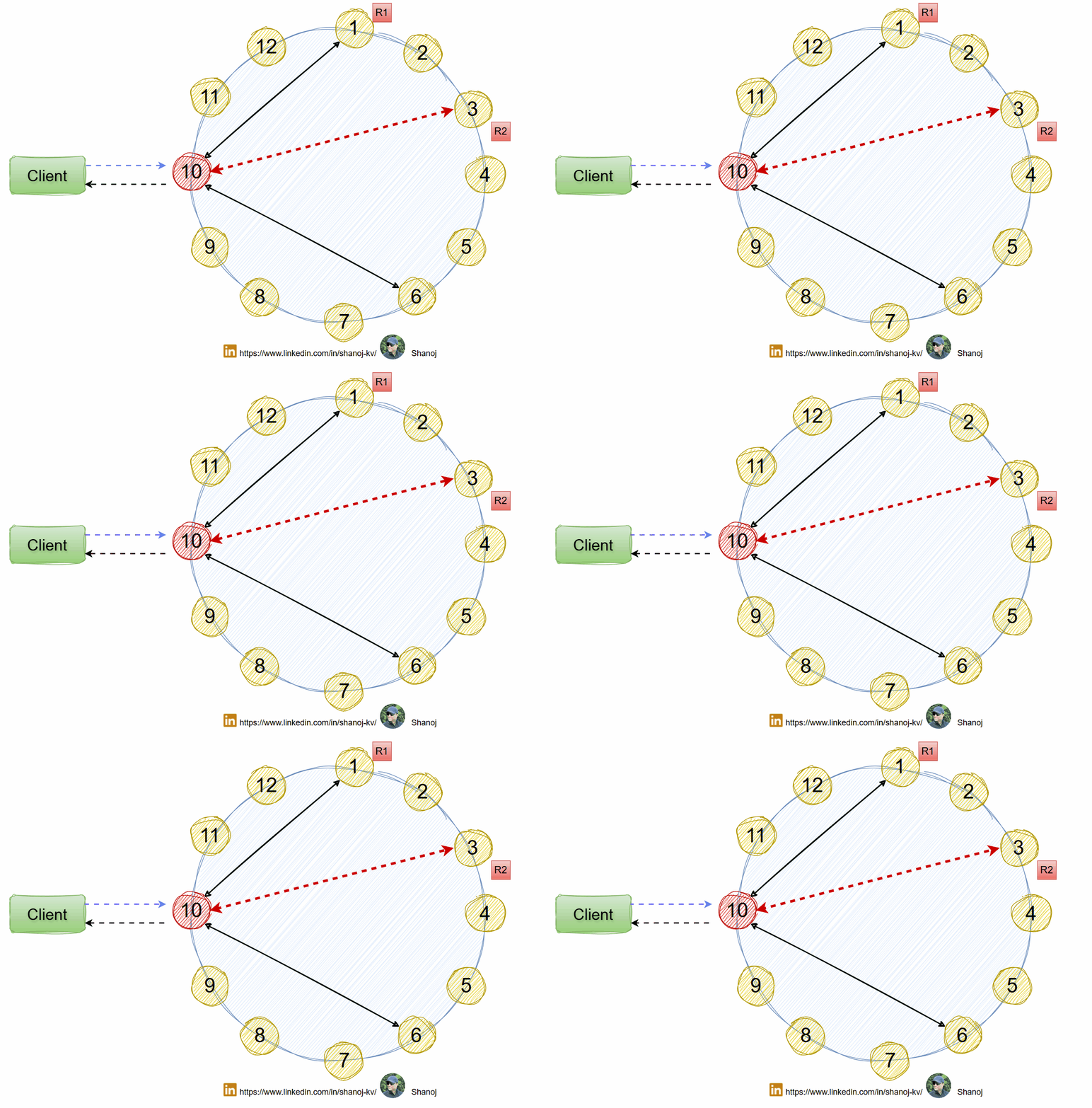
This diagram demonstrates the quorum-based write operation in a distributed healthcare system, where a client (such as a healthcare provider) sends a write request to update a patient’s record. The request is first received by Node 10, which then propagates it to Nodes 1, 3, and 6 to meet the required write quorum. Once these nodes acknowledge the update, Node 10 confirms the write as successful, ensuring the record is consistent across the network. This approach provides high availability and reliability, crucial for maintaining synchronized healthcare data.
  • When a healthcare provider updates a patient’s record at one clinic, the system sends the update to all 5 nodes, but only needs confirmation from a quorum of 3 to commit the change. This allows the system to proceed with the update even if up to 2 nodes are unavailable, ensuring high availability and resilience.

Step 3: Read Operation

This diagram illustrates the quorum-based read operation process. When Clinic B (Node 2) requests a patient’s record, it sends a read request to a quorum of nodes, including Nodes 1, 3, and 4. Each of these nodes responds with a confirmed record. Once the read quorum (R=3) is met, Clinic B displays a consistent and synchronized patient record to the user. This visual effectively demonstrates the quorum confirmation needed for consistent reads across a distributed network of healthcare clinics.
  • When a clinic requests a patient record, it retrieves data from a quorum of 3 nodes. If there are any discrepancies between nodes, the system reconciles differences and provides the most recent data. This guarantees that the clinic sees an accurate and synchronized patient record, even if some nodes lag slightly behind.

Quorum-Based Synchronization Across Clinics

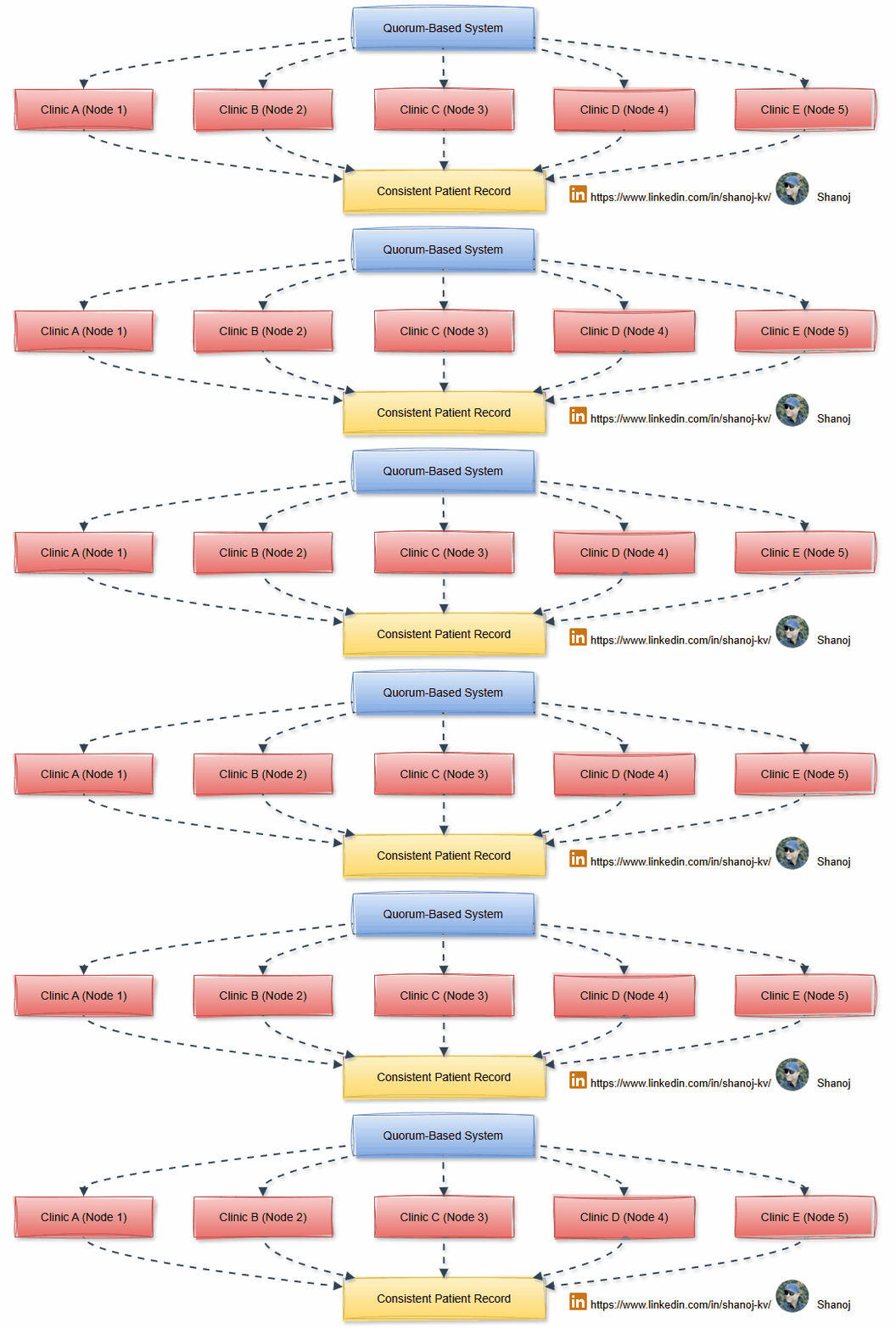
This diagram provides an overview of the quorum-based system in a distributed healthcare environment. It shows how multiple clinics (Nodes 1 through 5) interact with the quorum-based system to maintain a consistent patient record across locations.

Advantages of Quorum-Based Reads and Writes

  1. Consistent Patient Records: By configuring a quorum that intersects read and write operations, patient data remains synchronized across all locations. This avoids discrepancies and ensures that every healthcare provider accesses the most recent data.
  2. Fault Tolerance: Since the system requires only a quorum of nodes to confirm each operation, it can continue functioning even if a few nodes fail or are temporarily unreachable. This redundancy is crucial for systems where data access cannot be interrupted.
  3. Optimized Performance: By allowing reads and writes to complete once a quorum is met (rather than waiting for all nodes), the system improves responsiveness without compromising data accuracy.

Practical Considerations and Trade-Offs

While quorum-based reads and writes offer significant benefits, some trade-offs are inherent to the approach:

  • Latency Impacts: Larger quorums may introduce slight delays, as more nodes must confirm each read and write.
  • Staleness Risk: If a read quorum doesn’t intersect with the latest write quorum, there’s a minor chance of reading outdated data.
  • Operational Complexity: Configuring optimal quorum values (R and W) for a system’s specific requirements can be challenging, especially when balancing high availability and low latency.

Eventual Consistency and Quorum-Based Synchronization

Quorum-based reads and writes support eventual consistency by ensuring that all updates eventually propagate to every node. This means that even if there’s a temporary delay, patient data will be consistent across all nodes within a short period. For healthcare systems spanning multiple regions, this approach maintains high availability while ensuring accuracy across all locations.


The Quorum-Based Reads and Writes pattern is a powerful approach to ensuring data consistency in distributed systems. For healthcare networks, this pattern provides a practical way to synchronize patient records across multiple locations, delivering accurate, reliable, and readily available information. By configuring read and write quorums, healthcare organizations can maintain data integrity and consistency, supporting better patient care and enhanced decision-making across their network.

Stackademic 🎓

Thank you for reading until the end. Before you go: