Tag Archives: Rnn Architecture

How Do RNNs Handle Sequential Data Using Backpropagation Through Time?

Recurrent Neural Networks (RNNs) are essential for processing sequential data, but the true power of RNNs lies in their ability to learn dependencies over time through a process called Backpropagation Through Time (BPTT). In this article, we will dive into the mechanisms of BPTT, how it enables RNNs to learn from sequences, and explore its strengths and challenges in handling sequential tasks. With detailed explanations and diagrams, we’ll demystify the forward and backward computations in RNNs.

Quick Recap of RNN Forward Propagation

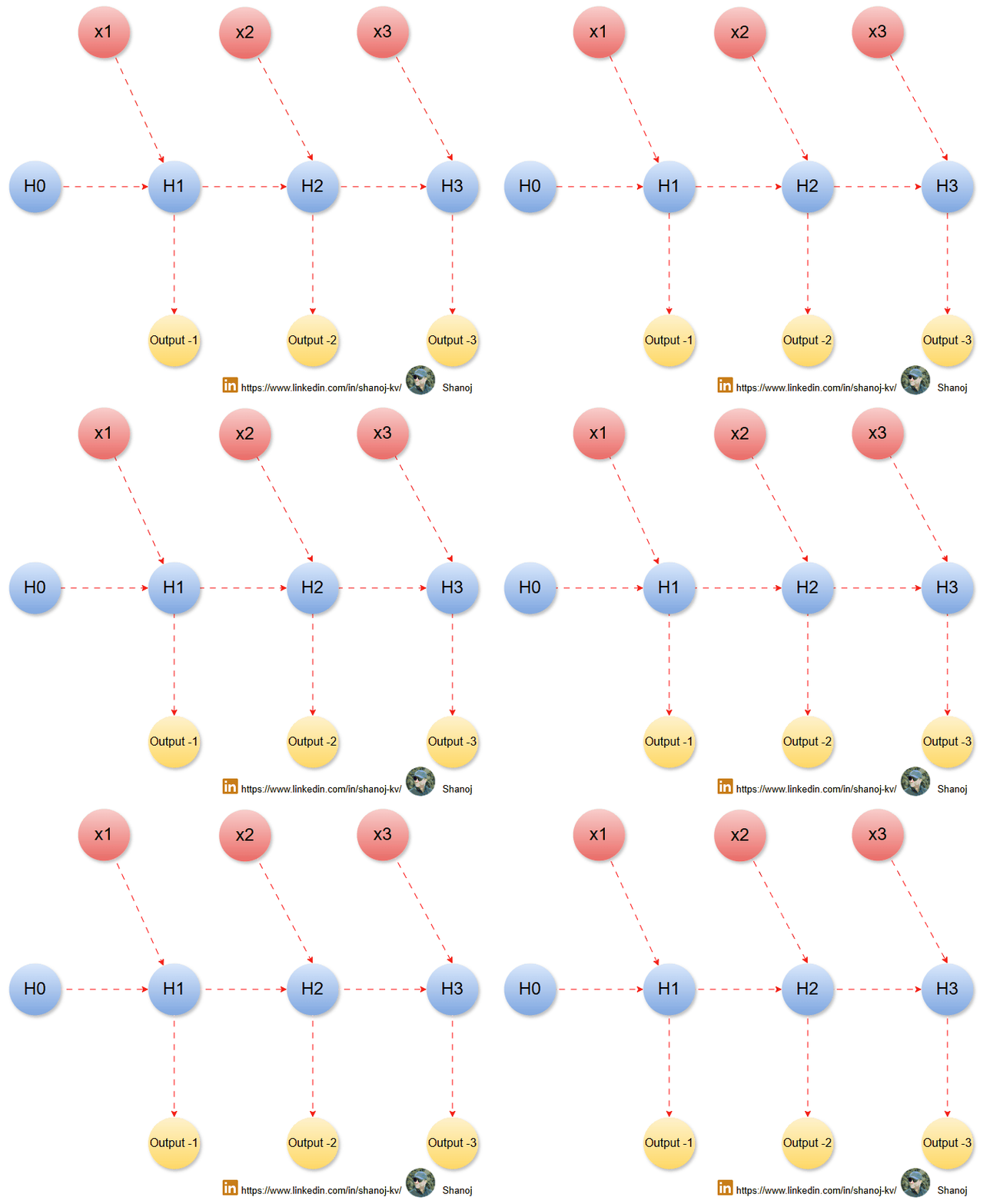
RNNs process sequential data by maintaining hidden states that carry information from previous time steps. For example, in sentiment analysis, each word in a sentence is processed sequentially, and the hidden states help retain context.

Forward Propagation Equations

Forward Propagation in RNN
Backpropagation Through Time (BPTT)

BPTT extends the backpropagation algorithm to sequential data by unrolling the RNN over time. Gradients are calculated for each weight across all time steps and summed up to update the weights.

Challenges in BPTT

  1. Vanishing Gradient Problem: Gradients diminish as they propagate back, making it hard to capture long-term dependencies.
  2. Exploding Gradient Problem: Gradients grow excessively large, causing instability during training.

Mitigation:

  • Use Long Short-Term Memory (LSTM) or Gated Recurrent Units (GRUs) to manage long-term dependencies.
  • Apply gradient clipping to control exploding gradients.

Backpropagation Through Time is a crucial technique for training RNNs on sequential data. However, it comes with challenges such as vanishing and exploding gradients. Understanding and implementing these methods effectively is key to building robust sequential models.

Stackademic 🎓

Thank you for reading until the end. Before you go:

Can We Solve Sentiment Analysis with ANN, or Do We Need to Transition to RNN?

Sentiment analysis involves determining the sentiment of textual data, such as classifying whether a review is positive or negative. At first glance, Artificial Neural Networks (ANN) seem capable of tackling this problem. However, given the sequential nature of text data, RNNs (Recurrent Neural Networks) are often a more suitable choice. Let’s explore this in detail, supported by visual aids.

Sentiment Analysis Problem Setup

We consider a dataset with sentences labelled with sentiments:

Preprocessing the Text Data

  1. Tokenization: Splitting sentences into words.
  2. Vectorization: Using techniques like bag-of-words or TF-IDF to convert text into fixed-size numerical representations.

Example: Bag-of-Words Representation

Given the vocabulary: ["food", "good", "bad", "not"], each sentence can be represented as:

  • Sentence 1: [1, 1, 0, 0]
  • Sentence 2: [1, 0, 1, 0]
  • Sentence 3: [1, 1, 0, 1]

Attempting Sentiment Analysis with ANN

The diagram below represents how an ANN handles the sentiment analysis problem.

  • Input Layer: Vectorized representation of text.
  • Hidden Layers: Dense layers with activation functions.
  • Output Layer: A single neuron with sigmoid activation, predicting sentiment.

Issues with ANN for Sequential Data

  1. Loss of Sequence Information:
  • ANN treats input as a flat vector, ignoring the word order.
  • For example, “The food is not good” is indistinguishable from “The good not food.”

2. Simultaneous Input:

  • All words are processed together, failing to capture dependencies between words.

Transition to RNN

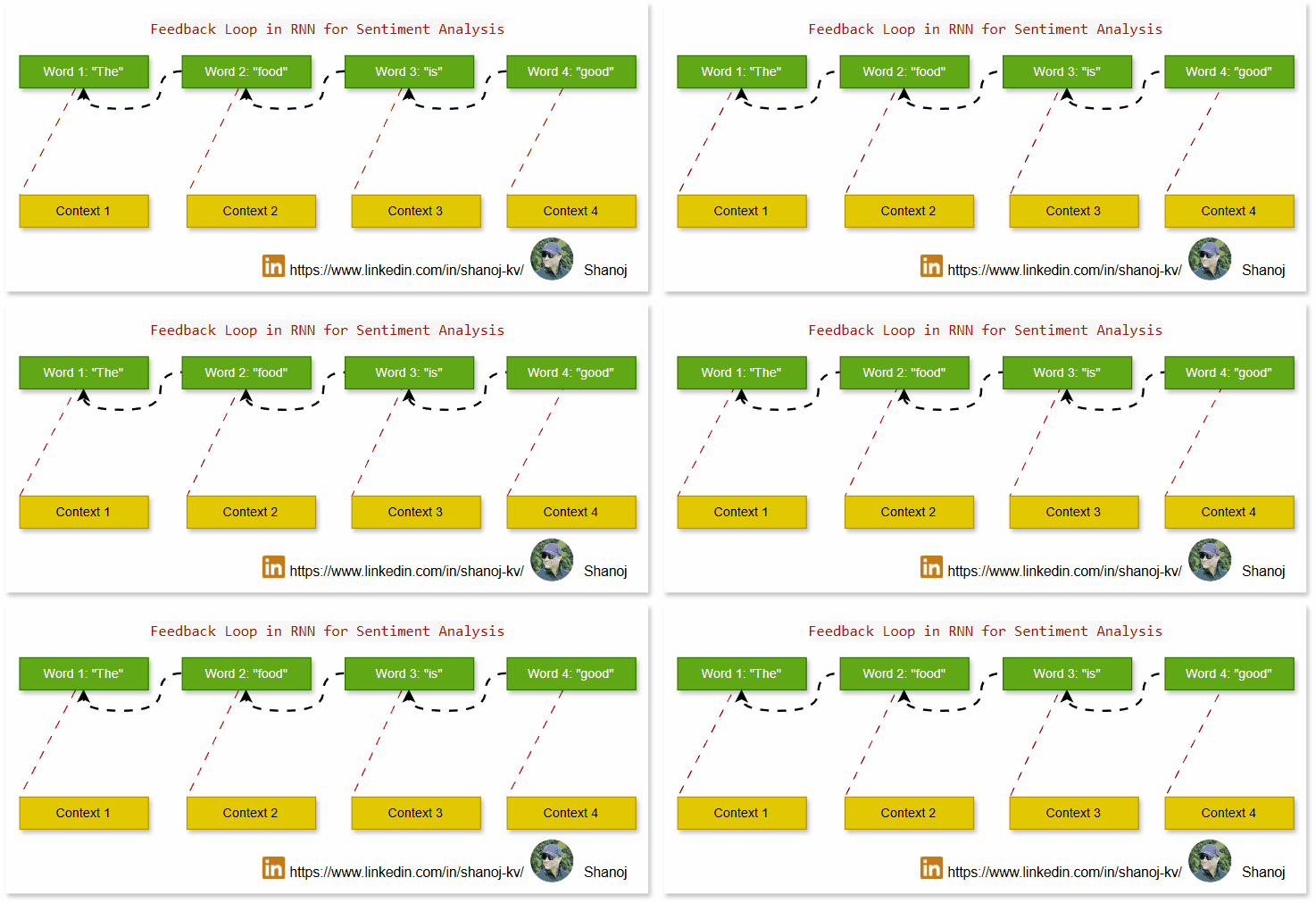
Recurrent Neural Networks address the limitations of ANNs by processing one word at a time and retaining context through hidden states.

The recurrent connections allow RNNs to maintain a memory of previous inputs, which is crucial for tasks involving sequential data.
  • Input Layer: Words are input sequentially (e.g., “The” → “food” → “is” → “good”).
  • Hidden Layers: Context from previous words is retained using feedback loops.
  • Output Layer: Predicts sentiment after processing the entire sentence.

Comparing ANN and RNN for Sentiment Analysis

While ANNs can solve simple text classification tasks, they fall short when dealing with sequential data like text. RNNs are designed to handle sequences, making them the ideal choice for sentiment analysis and similar tasks where word order and context are crucial.

By leveraging RNNs, we ensure that the model processes and understands text in a way that mimics human comprehension. The feedback loop and sequential processing of RNNs make them indispensable for modern NLP tasks.

Stackademic 🎓

Thank you for reading until the end. Before you go: