Tag Archives: Spark Optimization

Apache Spark Aggregation Methods: Hash-based Vs. Sort-based

Apache Spark provides two primary methods for performing aggregations: Sort-based aggregation and Hash-based aggregation. These methods are optimized for different scenarios and have distinct performance characteristics.

Hash-based Aggregation

Hash-based aggregation, as implemented by HashAggregateExec, is the preferred method for aggregation in Spark SQL when the conditions allow it. This method creates a hash table where each entry corresponds to a unique group key. As Spark processes rows, it quickly uses the group key to locate the corresponding entry in the hash table and updates the aggregate values accordingly. This method is generally faster because it avoids sorting the data before aggregation. However, it requires that all intermediate aggregate values fit into memory. If the dataset is too large or there are too many unique keys, Spark might be unable to use hash-based aggregation due to memory constraints. Key points about Hash-based aggregation include:

  • It is preferred when the aggregate functions and group by keys are supported by the hash aggregation strategy.
  • It can be significantly faster than sort-based aggregation because it avoids sorting data.
  • It uses off-heap memory for storing the aggregation map.
  • It may fall back to sort-based aggregation if the dataset is too large or has too many unique keys, leading to memory pressure.

Sort-based Aggregation

Sort-based aggregation, as implemented by SortAggregateExec, is used when hash-based aggregation is not feasible, either due to memory constraints or because the aggregation functions or group by keys are not supported by the hash aggregation strategy. This method involves sorting the data based on the group by keys and then processing the sorted data to compute aggregate values. While this method can handle larger datasets since it only requires some intermediate results to fit into memory, it is generally slower than hash-based aggregation due to the additional sorting step. Key points about Sort-based aggregation include:

  • It is used when hash-based aggregation is not feasible due to memory constraints or unsupported aggregation functions or group by keys.
  • It involves sorting the data based on the group by keys before performing the aggregation.
  • It can handle larger datasets since it streams data through disk and memory.

Detailed Explanation of Hash-based Aggregation

Hash-based Aggregation in Apache Spark operates through the HashAggregateExec physical operator. This process is optimized for aggregations where the dataset can fit into memory, and it leverages mutable types for efficient in-place updates of aggregation states.

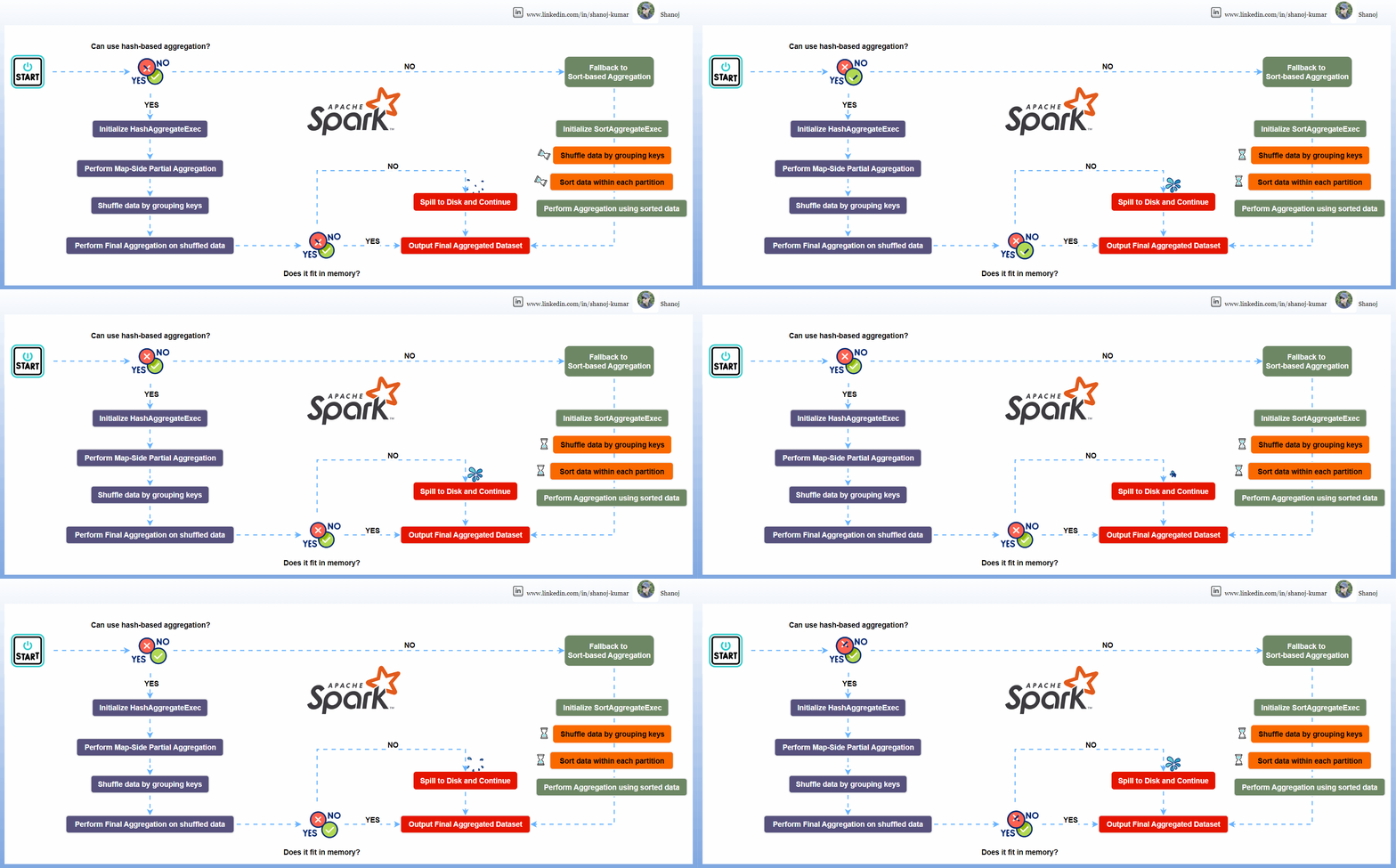
  • Initialization: When a query that requires aggregation is executed, Spark determines whether it can use hash-based aggregation. This decision is based on factors such as the types of aggregation functions (e.g., sum, avg, min, max, count), the data types of the columns involved, and whether the dataset is expected to fit into memory.
  • Partial Aggregation (Map Side): The aggregation process begins with a “map-side” partial aggregation. For each partition of the input data, Spark creates an in-memory hash map where each entry corresponds to a unique group key. As rows are processed, Spark updates the aggregation buffer for each group key directly in the hash map. This step produces partial aggregate results for each partition.
  • Shuffling: After the partial aggregation, Spark shuffles the data by the grouping keys, so that all records belonging to the same group are moved to the same partition. This step is necessary to ensure that the final aggregation produces accurate results across the entire dataset.
  • Final Aggregation (Reduce Side): Once the shuffled data is partitioned, Spark performs the final aggregation. It again uses a hash map to aggregate the partially aggregated results. This step combines the partial results from different partitions to produce the final aggregate value for each group.
  • Spill to Disk: If the dataset is too large to fit into memory, Spark’s hash-based aggregation can spill data to disk. This mechanism ensures that Spark can handle datasets larger than the available memory by using external storage.
  • Fallback to Sort-based Aggregation: In cases where the hash map becomes too large or if there are memory issues, Spark can fall back to sort-based aggregation. This decision is made dynamically based on runtime conditions and memory availability.
  • Output: The final output of the HashAggregateExec operator is a new dataset where each row represents a group along with its aggregated value(s).

The efficiency of hash-based aggregation comes from its ability to perform in-place updates to the aggregation buffer and its avoidance of sorting the data. However, its effectiveness is limited by the available memory and the nature of the dataset. For datasets that do not fit well into memory or when dealing with complex aggregation functions that are not supported by hash-based aggregation, Spark might opt for sort-based aggregation instead.

Detailed Explanation of Sort-based Aggregation

Sort-based Aggregation in Apache Spark works through a series of steps that involve shuffling, sorting, and then aggregating the data.

  • Shuffling: The data is partitioned across the cluster based on the grouping keys. This step ensures that all records with the same key end up in the same partition.
  • Sorting: Within each partition, the data is sorted by the grouping keys. This is necessary because the aggregation will be performed on groups of data with the same key, and having the data sorted ensures that all records for a given key are contiguous.
  • Aggregation: Once the data is sorted, Spark can perform the aggregation. For each partition, Spark uses a SortBasedAggregationIterator to iterate over the sorted records. This iterator maintains a buffer row to cache the aggregated values for the current group.
  • Processing Rows: As the iterator goes through the rows, it processes them one by one, updating the buffer with the aggregate values. When the end of a group is reached (i.e., the next row has a different grouping key), the iterator outputs a row with the final aggregate value for that group and resets the buffer for the next group.
  • Memory Management: Unlike hash-based aggregation, which requires a hash map to hold all group keys and their corresponding aggregate values, sort-based aggregation only needs to maintain the aggregate buffer for the current group. This means that sort-based aggregation can handle larger datasets that might not fit entirely in memory.
  • Fallback Mechanism: Although not part of the normal operation, it’s worth noting that Spark’s HashAggregateExec can theoretically fall back to sort-based aggregation if it encounters memory issues during hash-based processing.

The sort-based aggregation process is less efficient than hash-based aggregation because it involves the extra step of sorting the data, which is computationally expensive. However, it is more scalable for large datasets or when dealing with immutable types in the aggregation columns that prevent the use of hash-based aggregation.

Stackademic 🎓

Thank you for reading until the end. Before you go:

Understanding Memory Spills in Apache Spark

Memory spill in Apache Spark is the process of transferring data from RAM to disk, and potentially back again. This happens when the dataset exceeds the available memory capacity of an executor during tasks that require more memory than is available. In such cases, data is spilled to disk to free up RAM and prevent out-of-memory errors. However, this process can slow down processing due to the slower speed of disk I/O compared to memory access.

Dynamic Occupancy Mechanism

Apache Spark employs a dynamic occupancy mechanism for managing Execution and Storage memory pools. This mechanism enhances the flexibility of memory usage by allowing Execution Memory and Storage Memory to borrow from each other, depending on workload demands:

  • Execution Memory: Primarily used for computation tasks such as shuffles, joins, and sorts. When execution tasks demand more memory, they can borrow from the Storage Memory if it is underutilized.
  • Storage Memory: Used for caching and persisting RDDs, DataFrames, and Datasets. If the demand for storage memory exceeds its allocation, and Execution Memory is not fully utilized, Storage Memory can expand into the space allocated for Execution Memory.

Spark’s internal memory manager controls this dynamic sharing and is crucial for optimizing the utilization of available memory resources, significantly reducing the likelihood of memory spills.

Common Performance Issues Related to Spills

Spill(disk) and Spill(memory): When data doesn’t fit in RAM, it is temporarily written to disk. This operation, while enabling Spark to handle larger datasets, impacts computation time and efficiency because disk access is slower than memory access.

Impact on Performance: Spills to disk can negatively affect performance, increasing both the cost and operational complexity of Spark applications. The strength of Spark lies in its in-memory computing capabilities; thus, disk spills are counterproductive to its design philosophy.

Solutions for Memory Spill in Apache Spark

Mitigating memory spill issues involve several strategies aimed at optimizing memory use, partitioning data more effectively, and improving overall application performance.

Optimizing Memory Configuration

  • Adjust memory allocation settings to provide sufficient memory for both execution and storage, potentially increasing the memory per executor.
  • Tune the ratio between execution and storage memory based on the specific requirements of your workload.

Partitioning Data

  • Optimize data partitioning to ensure even data distribution across partitions, which helps in avoiding memory overloads in individual partitions.
  • Consider different partitioning strategies such as range, hash, or custom partitioning based on the nature of your data.

Caching and Persistence

  • Use caching and persistence methods (e.g., cache() or persist()) to store intermediate results or frequently accessed data in memory, reducing the need for recomputation.
  • Select the appropriate storage level for caching to balance between memory usage and CPU efficiency.

Monitoring and Tuning

  • Monitor memory usage and spills using Spark UI or other monitoring tools to identify and address bottlenecks.
  • Adjust configurations dynamically based on performance metrics and workload patterns.

Data Compression

  • Employ data compression techniques and columnar storage formats (e.g., Parquet, ORC) to reduce the memory footprint.
  • Compress RDDs using serialization mechanisms like MEMORY_ONLY_SER to minimize memory usage.

Avoiding Heavy Shuffles

  • Optimize join operations and minimize unnecessary data movement by using strategies such as broadcasting smaller tables or implementing partition pruning.
  • Reduce shuffle operations which can lead to spills by avoiding wide dependencies and optimizing shuffle operations.

Formulaic Approach to Avoid Memory Spills

Apache Spark’s memory management model is designed to balance between execution memory (used for computation like shuffles, joins, sorts) and storage memory (used for caching and persisting data). Understanding and optimizing the use of these memory segments can significantly reduce the likelihood of memory spills.

Memory Configuration Parameters:

  • Total Executor Memory (spark.executor.memory): The total memory allocated per executor.
  • Memory Overhead (spark.executor.memoryOverhead): Additional memory allocated to each executor, beyond spark.executor.memory, for Spark to execute smoothly.
  • Spark Memory Fraction (spark.memory.fraction): Specifies the proportion of the executor memory dedicated to Spark’s memory management system (default is 0.6 or 60%).

Simplified Memory Calculation:

Calculate Available Memory for Spark:

Available Memory=(Total Executor Memory−Memory Overhead)×Spark Memory FractionAvailable Memory=(Total Executor Memory−Memory Overhead)×Spark Memory Fraction

Determine Execution and Storage Memory: Spark splits the available memory between execution and storage. The division is dynamic, but under memory pressure, storage can shrink to as low as the value defined by spark.memory.storageFraction (default is 0.5 or 50% of Spark memory).

Example Calculation:

  • Suppose an executor is configured with 10GB (spark.executor.memory = 10GB) and the default overhead (10% of executor memory or at least 384MB). Let’s assume an overhead of 1GB for simplicity and the default memory fractions.
  • Total Executor Memory: 10GB
  • Memory Overhead: 1GB
  • Spark Memory Fraction: 0.6 (60%)

Available Memory for Spark=(10GB−1GB)×0.6=5.4GBAvailable Memory for Spark=(10GB−1GB)×0.6=5.4GB

  • Assuming spark.memory.storageFraction is set to 0.5, both execution and storage memory pools could use up to 2.7GB each under balanced conditions.

Strategies to Avoid Memory Spills:

  • Increase Memory Allocation: If possible, increasing spark.executor.memory ensures more memory is available for Spark processes.
  • Adjust Memory Fractions: Tweaking spark.memory.fraction and spark.memory.storageFraction can help allocate memory more efficiently based on the workload. For compute-intensive operations, you might allocate more memory for execution.

Real-life Use Case: E-commerce Sales Analysis

An e-commerce platform experienced frequent memory spills while processing extensive sales data during holiday seasons, leading to performance bottlenecks.

Problem:

Large-scale aggregations and joins were causing spills to disk, slowing down the analysis of sales data, impacting the ability to generate real-time insights for inventory and pricing adjustments.

Solution:

  • Memory Optimization: The data team increased the executor memory from 8GB to 16GB per executor and adjusted the spark.memory.fraction to 0.8 to dedicate more memory to Spark’s managed memory system.
  • Partitioning and Data Skew Management: They implemented custom partitioning strategies to distribute the data more evenly across nodes, reducing the likelihood of individual tasks running out of memory.
  • Caching Strategy: Important datasets used repeatedly across different stages of the analysis were persisted in memory, and the team carefully chose the storage levels to balance between memory usage and CPU efficiency.
  • Monitoring and Tuning: Continuous monitoring of the Spark UI and logs allowed the team to identify memory-intensive operations and adjust configurations dynamically. They also fine-tuned spark.memory.storageFraction to better balance between execution and storage memory, based on the nature of their tasks.

These strategies significantly reduced the occurrence of memory spills, improved the processing speed of sales data analysis, and enabled the e-commerce platform to adjust inventory and pricing strategies in near real-time during peak sales periods.

This example demonstrates the importance of a holistic approach to Spark memory management, including proper configuration, efficient data partitioning, and strategic use of caching, to mitigate memory spill issues and enhance application performance.

Stackademic 🎓

Thank you for reading until the end. Before you go:

Apache Spark Optimizations: Shuffle Join Vs. Broadcast Joins

Apache Spark is an analytics engine that processes large-scale data in distributed computing environments. It offers various join operations that are essential for handling big data efficiently. In this article, we will take an in-depth look at Spark joins. We will compare normal (shuffle) joins with broadcast joins and explore other available join types.

Understanding Joins in Apache Spark

Joins in Apache Spark are operations that combine rows from two or more datasets based on a common key. The way Spark processes these joins, especially in a distributed setting, significantly impacts the performance and scalability of data processing tasks.

Normal Join (Shuffle Join)

Operation

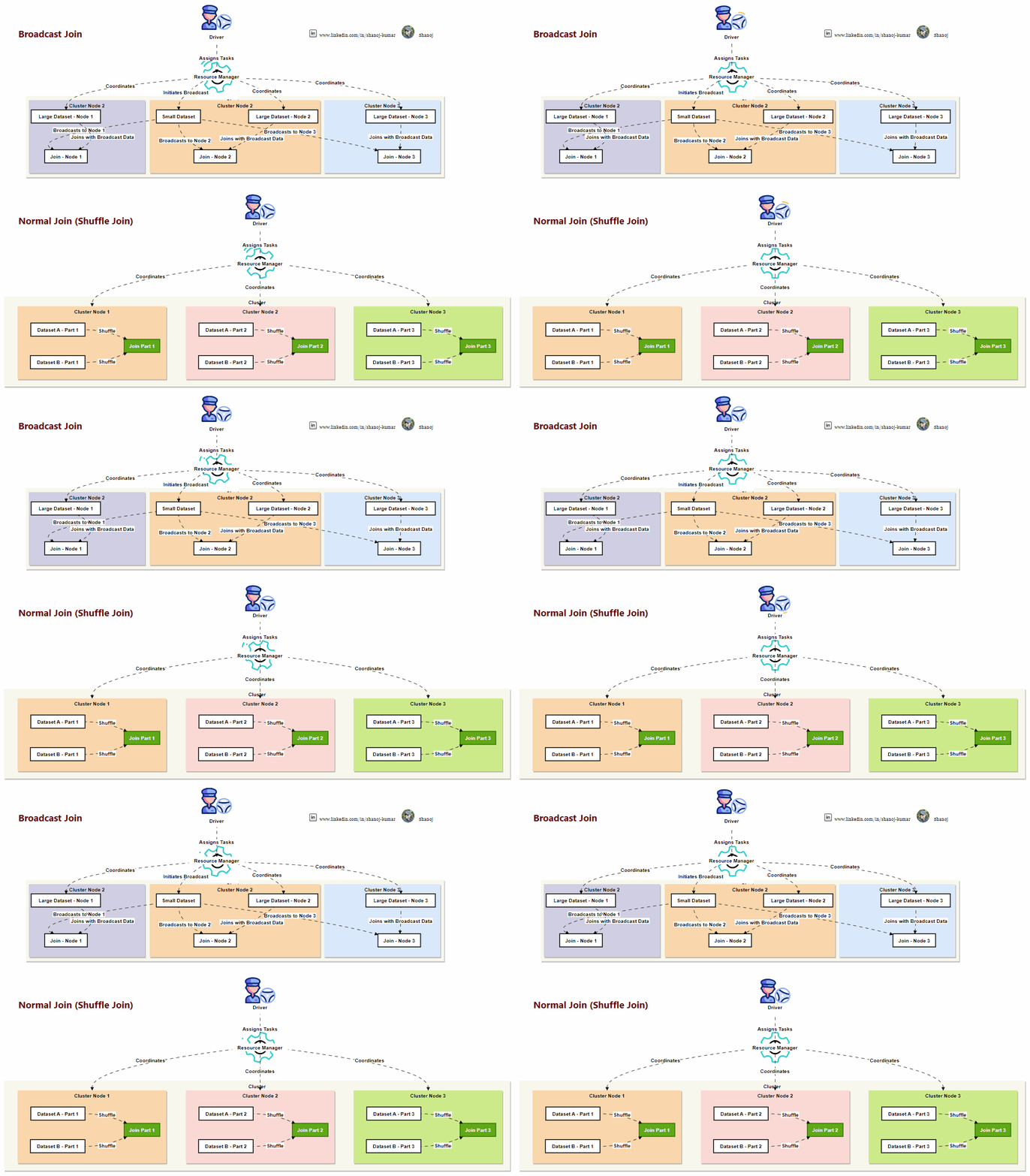
  • Shuffling: Both data sets are shuffled across the cluster based on the join keys in a regular join. This process involves transferring data across different nodes, which can be network-intensive.

Use Case

  • Large Datasets: Best for large datasets where both sides of the join have substantial data. Typically used when no dataset is small enough to fit in the memory of a single worker node.

Performance Considerations

  • Speed: This can be slower due to extensive data shuffling.
  • Bottlenecks: Network I/O and disk writes during shuffling can become bottlenecks, especially for large datasets.

Scalability

  • Large Data Handling: Scales well with large datasets but can only be efficient if optimized (e.g., by partitioning).

Broadcast Join

Operation

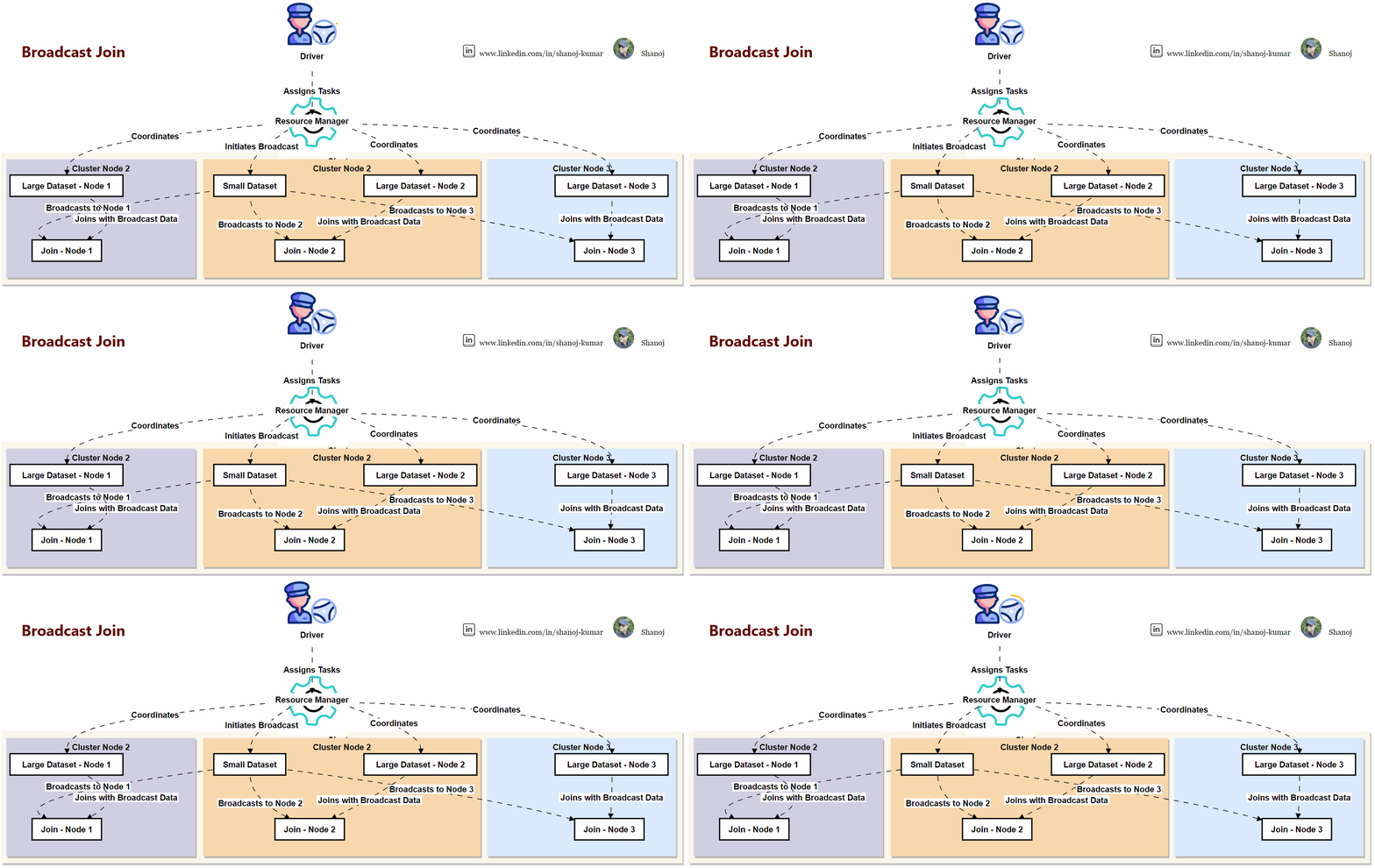
  • Broadcasting: In a broadcast join, the smaller dataset is sent (broadcast) to each node in the cluster, avoiding shuffling the larger dataset.

Use Case

  • Uneven Data Size: Ideal when one dataset is significantly smaller than the other. The smaller dataset should be small enough to fit in the memory of each worker node.

Performance Considerations

  • Speed: Typically faster than normal joins as it minimizes data shuffling.
  • Reduced Overhead: Reduces network I/O and disk write overhead.

Scalability

  • Small Dataset Joins: Works well for joins with small datasets but is not suitable for large to large dataset joins.

Choosing Between Normal and Broadcast Joins

The choice between a normal join and a broadcast join in Apache Spark largely depends on the size of the datasets involved and the resources of your Spark cluster. Here are key factors to consider:

  1. Data Size and Distribution: A broadcast join is usually more efficient if one dataset is small. For two large datasets, a normal join is more suitable.
  2. Cluster Resources: Consider the memory and network resources of your Spark cluster.
  3. Tuning and Optimization: Spark’s ability to optimize queries (e.g., Catalyst optimizer) can sometimes automatically choose the best join strategy.

The configurations that affect broadcast joins in Apache Spark:

spark.sql.autoBroadcastJoinThreshold: Sets the maximum size of a table that can be broadcast. Lowering the threshold can disable broadcast joins for larger tables, while increasing it can enable broadcast joins for bigger tables.

spark.sql.broadcastTimeout: Determines the timeout for the broadcast operation. Spark may fallback to a shuffle join if the broadcast takes longer than this.

spark.driver.memory: Allocates memory to the driver. Since the driver coordinates broadcasting, insufficient memory can hinder the broadcast join operation.


Other Types of Joins in Spark

Apart from normal and broadcast joins, Spark supports several other join types:

  1. Inner Join: Combines rows from both datasets where the join condition is met.
  2. Outer Joins: Includes left outer, right outer, and full outer joins, which retain rows from one or both datasets even when no matching join key is found.
  3. Cross Join (Cartesian Join): Produces a Cartesian product of the rows from both datasets. Every row of the first dataset is joined with every row of the second dataset, often resulting in many rows.
  4. Left Semi Join: This join type returns only the rows from the left dataset for which there is a corresponding row in the right dataset, but the columns from the right dataset are not included in the output.
  5. Left Anti Join: Opposite to the Left Semi Join, this join type returns rows from the left dataset that do not have a corresponding row in the right dataset.
  6. Self Join: This is not a different type of join per se, but rather a technique where a dataset is joined with itself. This can be useful for hierarchical or sequential data analysis.

Considerations for Efficient Use of Joins in Spark

When implementing joins in Spark, several considerations can help optimize performance:

  1. Data Skewness: Imbalanced data distribution can lead to skewed processing across the cluster. Addressing data skewness is crucial for maintaining performance.
  2. Memory Management: Ensuring that the broadcasted dataset fits into memory is crucial for broadcast joins. Out-of-memory errors can significantly impact performance.
  3. Join Conditions: Optimal use of join keys and conditions can reduce the amount of data shuffled across the network.
  4. Partitioning and Clustering: Proper partitioning and clustering of data can enhance join performance by minimizing data movement.
  5. Use of DataFrames and Datasets: Utilizing DataFrames and Datasets API for joins can leverage Spark’s Catalyst Optimizer for better execution plans.

PySpark code for the broadcast join:

from pyspark.sql import SparkSession
from pyspark.sql.functions import broadcast

# Initialize Spark Session
spark = SparkSession.builder \
.appName("BroadcastJoinExample") \
.getOrCreate()

# Sample DataFrames
df_large = spark.createDataFrame([(1, "A"), (2, "B"), (3, "C")], ["id", "value"])
df_small = spark.createDataFrame([(1, "X"), (2, "Y")], ["id", "value2"])

# Perform Broadcast Join
joined_df = df_large.join(broadcast(df_small), "id")

# Show the result
joined_df.show()

# Explain Plan
joined_df.explain()

# Stop the Spark Session
spark.stop()

Stackademic

Thank you for reading until the end. Before you go: