

Back in the 2020s, a project requirement came my way that was both challenging and interesting. My manager and I were very new to the company, so the success of this project was crucial for us. Although the technical stack of this project was relatively simple, it holds a special place in my heart for many reasons. In this article, I aim to share my experience and journey with it. This article is not about the how-to steps; rather, I want to share about mindset and culture on a personal level and as a team.
“The only way to do great work is to love what you do.” — Steve Jobs
The challenges were manifold: there was no budget or only a minimal budget available, a shortage of technical team members, and a need to deliver in a very short timeframe. Sounds interesting, right? I was thrilled by the requirement.
“Start where you are. Use what you have. Do what you can.” — Arthur Ashe
The high-level project details are as follows: From an upstream application to an Oracle-based application, we needed to transfer data downstream in JSON format. The backend-to-frontend relationship of the upstream application is one-to-many, meaning the backend Oracle data has multiple frontend views to represent the data based on business use or objects. Therefore, the data pipeline needed the capacity to transform Oracle-based data into many front-end views, necessitating mapping the data with XML configuration for the front end. The daily transaction volume was not too large, but a decent amount of 3 million records.
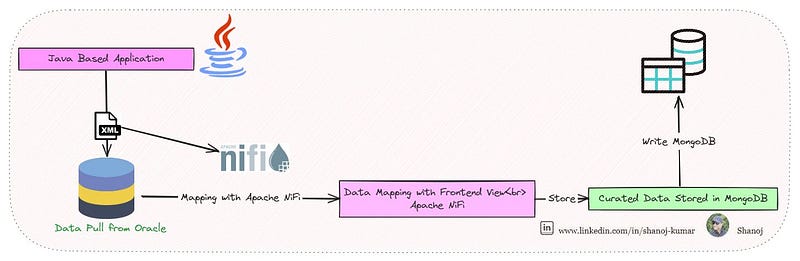
“It always seems impossible until it’s done.” — Nelson Mandela
Since we had no budget or resource strength, I decided to explore open-source and no-code or low-code solutions. After a day or two of research, I decided to use Apache NiFi and MongoDB. The idea was to reverse-engineer the current upstream application using NiFi, which means NiFi would read data from Oracle and simultaneously map those data according to the frontend configuration stored in XML for the frontend application.
“Teamwork is the ability to work together toward a common vision. The ability to direct individual accomplishments toward organizational objectives. It is the fuel that allows common people to attain uncommon results.” — Andrew Carnegie
When I first presented this solution to the team and management, the initial response was not very positive. Except for my manager, most stakeholders expressed doubts, which is understandable since most of them were hearing about Apache NiFi for the first time, and their experience lay primarily in Oracle and Java. MongoDB was also new to them. Normally, people think about “how” first, but I was focused on “why” and “what” before “how.”
After several rounds of discussion, including visual flowcharts and small prototypes, everyone agreed on the tech stack and the solution.
This led to the next challenge: the team we assembled had never worked with these tech stacks. To move forward, we needed to build a production-grade platform. I started by reading books and devised infrastructure build steps for both NiFi and MongoDB clusters. It was challenging, and there were extensive troubleshooting sessions, but we finally built our platform.

“Don’t watch the clock; do what it does. Keep going.” — Sam Levenson
The team was very small, comprising two Java developers and two Linux developers, all new to these tech stacks. Once the platform was ready, my next task was to train our developers to bring them up to speed. Fortunately, I found a book that helped me with Apache NiFi, and for MongoDB, I took a MongoDB University course. I filtered the required information for my team to learn. There were also challenges, as my team was in China and I was in the North American timezone, requiring me to work mostly at night to help my team.
Another challenge that later became an advantage was communication. My Chinese team was not very comfortable with verbal explanations, so I decided to share knowledge through visual aids like flowcharts and diagrams, along with developing small prototypes for them to try and walk through. This approach helped a lot later on, as I learned how to represent complex topics in simple diagrams, a skill I use in my articles today.
“What you get by achieving your goals is not as important as what you become by achieving your goals.” — Zig Ziglar
The lucky factor was that my team was extremely hardworking and quick learners. They adapted to the new tech stack in minimal time. In three months, we built the first end-to-end MVP and presented a full demo to the business, which was a huge success. Three months later, we scaled the application to production-grade and delivered our first release. Today, this team is the fastest in the release cycle and operates independently.
“It is not mandatory for a Solution Architect to be an SME in any specific tool or technology. Instead, he or she should be a strategic thinker, putting “why” and “what” first and adapting quickly to take advantage of opportunities where we can add value to the business or end user despite all limitations and trade-offs.” — Shanoj Kumar V
“Success is not the key to happiness. Happiness is the key to success. If you love what you are doing, you will be successful.” — Albert Schweitzer
Stackademic 🎓
Thank you for reading until the end. Before you go:
- Please consider clapping and following the writer! 👏
- Follow us X | LinkedIn | YouTube | Discord
- Visit our other platforms: In Plain English | CoFeed | Venture | Cubed
- More content at Stackademic.com
 Shanoj